
Main Points :
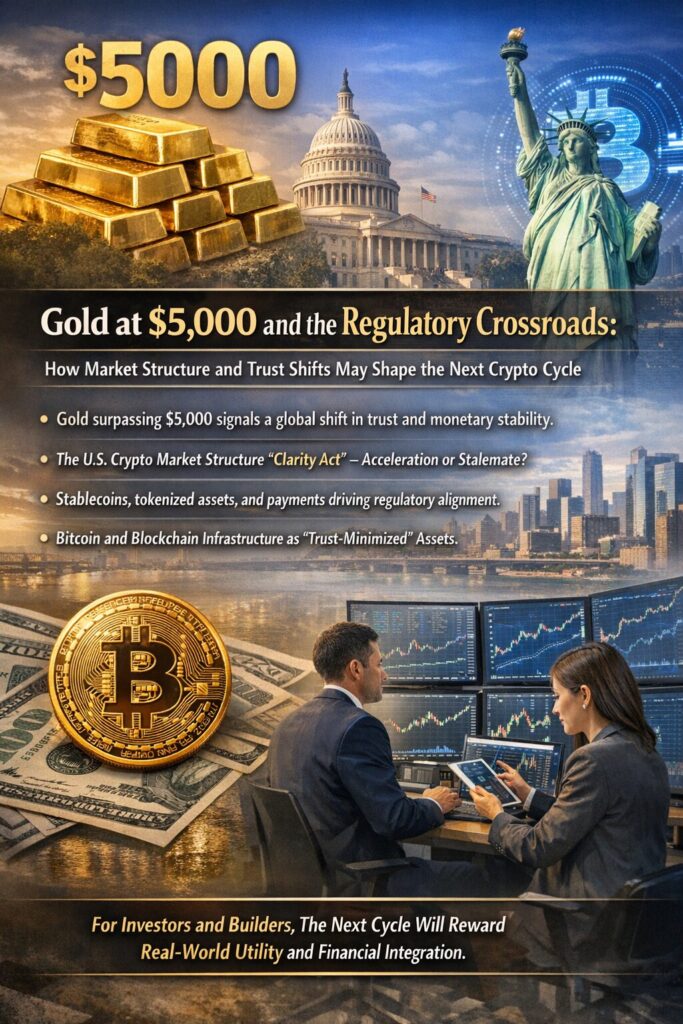
- Gold surpassing $5,000 signals a global shift in how investors perceive trust, monetary stability, and sovereign risk.
- The U.S. Crypto Market Structure “Clarity Act” represents a pivotal fork: institutional acceleration or delayed organic adoption.
- Even if legislation fails, real-world utility—stablecoins, tokenized assets, and payments—can force regulatory alignment within three years.
- Bitcoin and select blockchain infrastructures may increasingly compete with gold as “trust-minimized” assets.
- For investors and builders, the next cycle will reward assets tied to real usage, compliant structures, and financial integration.
1. Introduction: Two Forces Defining the Market
In a recent memo, Bitwise Chief Investment Officer Matt Hougan highlighted two dominant forces shaping the crypto market in early 2026:
the sharp rise in gold prices beyond $5,000 and the uncertain fate of the U.S. crypto market structure legislation, commonly referred to as the “Clarity Act.”
At first glance, gold and crypto regulation may appear unrelated. Yet, beneath the surface, both are deeply connected to a global reassessment of trust—trust in governments, currencies, institutions, and financial intermediaries. This reassessment is redefining capital flows and reshaping how investors evaluate both traditional and digital assets.
This article expands on Hougan’s analysis, incorporates recent global developments, and examines what these trends mean for readers seeking new crypto assets, emerging revenue models, and practical blockchain applications.
2. Gold Above $5,000: More Than a Commodity Rally
Gold’s surge beyond $5,000 per ounce is not merely a speculative spike. It reflects structural changes in the global financial system.
Several long-term drivers are at play:
First, monetary expansion. Major economies have continued to increase money supply to manage debt servicing and economic stabilization. This expansion dilutes fiat currency value and reinforces gold’s role as a monetary hedge.
Second, sovereign debt concerns. Government debt levels, particularly in the United States, Europe, and Japan, have reached historic highs. Investors increasingly question the sustainability of fiscal trajectories.
Third, central bank accumulation. Over the past two years, central banks—especially in emerging markets—have accelerated gold purchases to diversify reserves away from the U.S. dollar.
Finally, changes in asset custody and ownership preferences. Investors are reconsidering where and how assets should be held, favoring assets perceived as politically neutral and resilient.
Conceptual Demand Drivers – Gold vs. Bitcoi
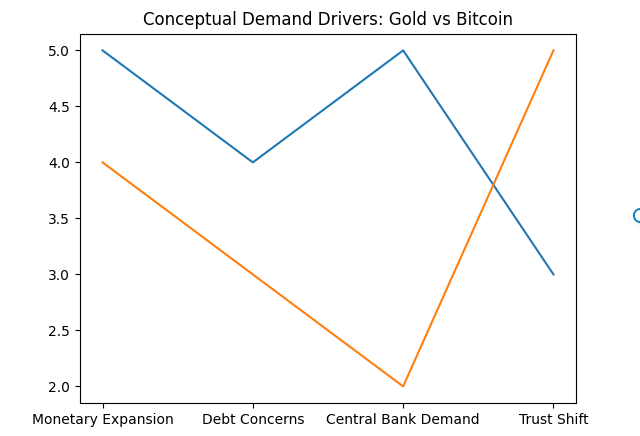
This environment is not uniquely bullish for gold. It also creates favorable conditions for assets that share similar trust-minimizing properties—most notably Bitcoin.
3. Trust as the Hidden Variable
Hougan emphasizes that the surge in gold demand reflects a global shift in trust, not simply inflation hedging.
Trust is moving away from:
- Centralized monetary authorities
- Politically exposed intermediaries
- Systems vulnerable to censorship or capital controls
Toward:
- Assets with predictable issuance
- Systems without centralized points of failure
- Financial networks that operate independently of national politics
This is precisely where Bitcoin enters the conversation.
Bitcoin’s fixed supply, censorship resistance, and global settlement capability align closely with the same motivations driving gold demand—yet Bitcoin adds programmability, instant settlement, and digital portability. For a growing segment of investors, Bitcoin is no longer a speculative alternative to gold but a parallel trust asset.
4. The Clarity Act: Why Regulation Still Matters
While trust shifts explain macro demand, regulation determines speed and scale.
The Clarity Act, which has passed the U.S. House of Representatives and awaits Senate deliberation, aims to formalize a crypto-friendly market structure. Its passage would codify:
- Clear jurisdictional boundaries between regulators
- Legal recognition of digital assets and intermediaries
- Compliance pathways for exchanges, custodians, and issuers
Hougan argues that if enacted, the law would institutionalize today’s relatively positive regulatory stance. Without it, future administrations could reverse course, introducing uncertainty and chilling investment.
From a market perspective, a successful Clarity Act would likely trigger:
- Rapid institutional inflows
- Expansion of regulated crypto ETFs and funds
- Acceleration of tokenized securities and on-chain finance
In such a scenario, crypto markets could experience a sharp upward repricing.
5. If the Law Fails: Adoption Before Legislation
Hougan also explores the alternative: what happens if the Clarity Act fails?
In this case, crypto would lose its regulatory “top cover.” Instead of laws enabling adoption, adoption would need to justify laws.
This path is not unprecedented. Hougan compares it to Uber, which expanded rapidly before regulatory frameworks caught up. When millions relied on the service daily, regulation adapted to reality.
He estimates that a similar process would take approximately three years in crypto.
During this period:
- Stablecoins become embedded in payments and remittances
- Tokenized stocks and bonds gain retail traction
- On-chain settlement reduces costs in traditional finance
Once crypto becomes indispensable to everyday economic activity, regulators would be compelled to provide legal clarity.
Market Impact Scenarios – Clarity Act Pass vs. Fail
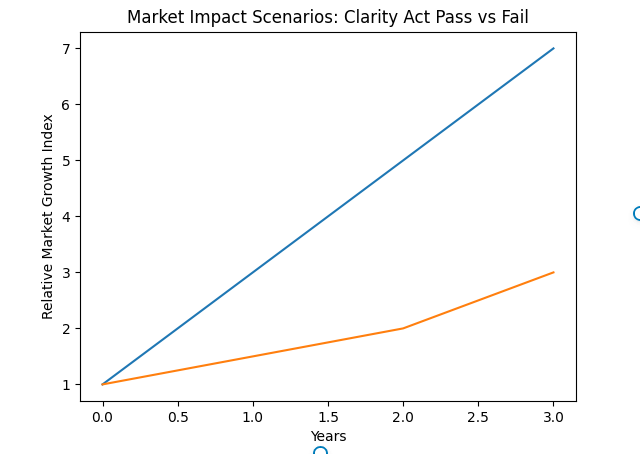
The difference is not whether crypto succeeds—but how fast.
6. Stablecoins and Tokenization as the Trojan Horse
Recent market data supports Hougan’s thesis. Dollar-denominated stablecoins now process transaction volumes rivaling major card networks. Financial institutions are piloting tokenized deposits, bonds, and equities to reduce settlement risk and operational friction.
Tokenized assets offer:
- 24/7 settlement
- Fractional ownership
- Programmable compliance
These features are not ideological—they are economically efficient. As banks, asset managers, and payment companies adopt them, crypto infrastructure becomes unavoidable, even for skeptics.
For investors, this suggests that the next wave of value creation may not lie in speculative tokens, but in:
- Settlement layers
- Compliance-ready blockchains
- Infrastructure supporting regulated tokenization
7. Political Signals and Hougan’s Optimism
Despite uncertainty, Hougan remains optimistic about the Clarity Act’s passage. He notes that the current U.S. administration has largely followed through on its crypto-related campaign promises.
While political outcomes are never guaranteed, market participants should monitor not only legislation, but also:
- Treasury and regulator guidance
- ETF approvals and expansions
- Public-private blockchain initiatives
Regulation, in this context, is not about restriction—it is about permission at scale.
8. Strategic Implications for Investors and Builders
For readers seeking new crypto assets and revenue opportunities, several strategic conclusions emerge:
- Assets aligned with trust minimization benefit from the same forces driving gold.
- Infrastructure supporting real economic activity will outperform narrative-driven projects.
- Regulatory clarity accelerates adoption, but lack of clarity does not stop it—it delays it.
- Bitcoin and select blockchain platforms may increasingly function as macro assets, not niche technologies.
The next cycle is likely to reward patience, compliance-aware design, and integration with existing financial systems.
9. Conclusion: A Market Shaped by Trust and Time
Gold at $5,000 and the Clarity Act debate are not isolated stories. They are reflections of a deeper transformation in global finance.
Trust is being redefined. Capital is migrating toward systems perceived as resilient, transparent, and politically neutral. Whether through legislation or necessity, crypto is moving closer to the financial core.
For those building, investing, or allocating capital today, the question is not whether blockchain will be used—but which parts of the ecosystem will become essential.
The answer will define the next decade of digital finance.
