
Main Points :
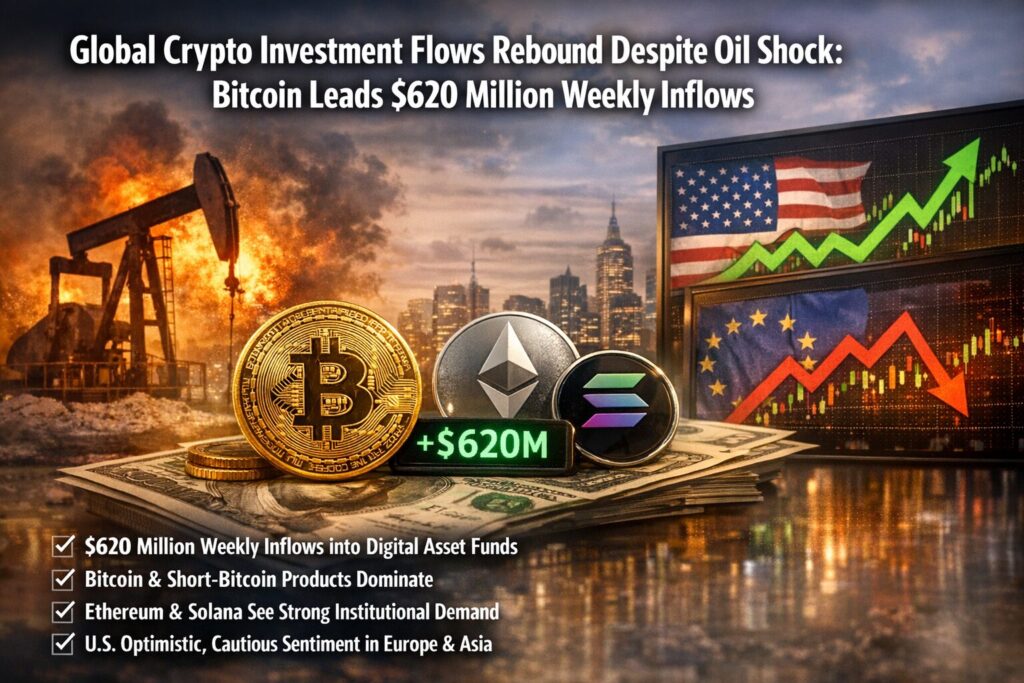
- Digital asset investment products recorded $620 million in net inflows last week, marking the second consecutive week of positive flows.
- Bitcoin investment products dominated the inflows, although short-Bitcoin products also saw notable capital allocations.
- Rising oil prices linked to geopolitical tensions in Iran triggered inflation concerns, causing late-week outflows.
- Ethereum and Solana investment products saw strong inflows, highlighting continued institutional interest in major altcoins.
- Regional sentiment differed significantly: U.S. investors remained optimistic, while Europe, Asia, and Canada showed more cautious positioning.
Introduction: Geopolitics, Inflation, and the Return of Institutional Crypto Demand
The global cryptocurrency investment landscape experienced a complex but ultimately positive week as digital asset investment products recorded approximately $620 million in net inflows (about $620 million USD), according to research released by digital asset investment firm CoinShares. The data indicates that institutional investors continue to allocate capital to crypto assets despite heightened macroeconomic uncertainty.
The flows occurred during a week dominated by geopolitical developments in the Middle East. Rising tensions involving Iran drove oil prices higher, triggering renewed inflation concerns across global financial markets. Traditionally, such macroeconomic pressures tend to suppress risk assets. However, the crypto market demonstrated resilience, attracting net capital inflows for the second consecutive week.
CoinShares’ Head of Research James Butterfill explained that investor sentiment toward digital asset investment products remained broadly positive despite volatility during the latter half of the week. Early-week inflows were strong enough to offset late-week withdrawals triggered by inflation fears linked to rising energy prices.
For investors searching for new crypto assets, emerging yield opportunities, and practical blockchain applications, the data provides a meaningful signal: institutional capital is still entering the ecosystem even as macro conditions fluctuate.
Weekly Crypto Investment Flow Trends
Early Week Optimism Followed by Late-Week Caution
During the week covered by the report, capital flows followed a clear pattern. The first three trading days saw consistent inflows into crypto investment products such as exchange-traded funds (ETFs), trusts, and institutional funds. These inflows reflected a positive reaction from investors to geopolitical developments, as markets initially perceived the situation as manageable.
However, sentiment shifted later in the week. Rising oil prices triggered fears that inflation might reaccelerate globally. This concern intensified after weaker-than-expected U.S. employment data suggested that economic growth could be slowing while inflation risks remained present.
As a result, digital asset investment products experienced net outflows during the final two days of the week. Despite this reversal, total inflows during the early part of the week were large enough to ensure that the overall weekly balance remained positive.
This pattern reflects a broader trend in crypto markets: institutional capital is increasingly sensitive to macroeconomic signals but still views digital assets as a viable long-term allocation.
Weekly Global Crypto Investment Flows
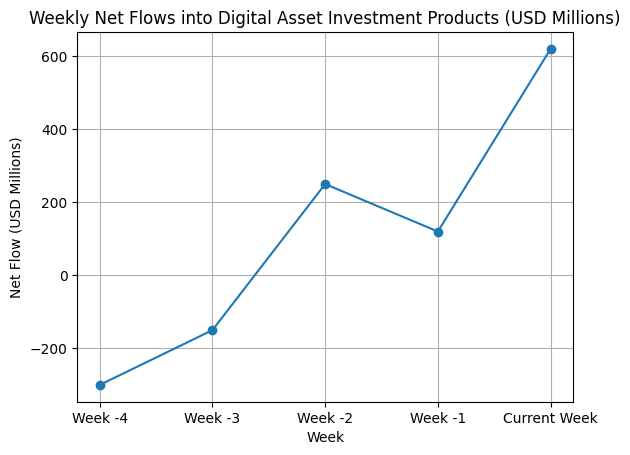
The chart illustrates weekly net inflows into digital asset investment products, showing two consecutive weeks of positive capital movement.
Bitcoin Leads Institutional Investment Activity
Bitcoin Investment Products Dominate Inflows
Bitcoin once again served as the primary driver of institutional crypto investment flows. The majority of the $620 million in net inflows entered Bitcoin-related investment products, including ETFs and institutional funds.
Bitcoin’s dominance in institutional flows is not surprising. The asset remains the most widely recognized and liquid cryptocurrency, making it the preferred entry point for large investors seeking exposure to the digital asset class.
Several factors likely contributed to Bitcoin’s strong inflows:
- Institutional ETF adoption continues to expand, particularly in the United States.
- Bitcoin’s store-of-value narrative strengthens during periods of macroeconomic uncertainty.
- Market participants increasingly view Bitcoin as “digital gold” in a diversified portfolio.
At the same time, investors remain divided about short-term price direction. Interestingly, the report noted that short-Bitcoin investment products also recorded net inflows during the week.
This dual activity suggests that while many investors expect Bitcoin’s long-term trajectory to remain positive, others are hedging against near-term volatility.
Altcoins Gain Momentum: Ethereum and Solana
Institutional Interest Expands Beyond Bitcoin
Although Bitcoin dominated total inflows, the report also highlighted growing interest in major altcoins.
Ethereum (ETH) and Solana (SOL) were the most prominent beneficiaries among non-Bitcoin digital assets. Investment products tied to these networks saw relatively strong capital inflows compared to other altcoins.
Several structural trends help explain this development:
Ethereum: The Institutional Smart-Contract Platform
Ethereum remains the backbone of decentralized finance (DeFi), tokenization initiatives, and many enterprise blockchain projects. Institutional investors continue to accumulate ETH exposure due to:
- Growth of tokenized real-world assets (RWAs)
- Expansion of Layer-2 scaling solutions
- Increased adoption of staking-based yield strategies
With multiple asset managers pursuing spot Ethereum ETFs, institutional demand for ETH may continue expanding in the coming years.
Solana: High-Performance Blockchain Ecosystem
Solana has reemerged as a major blockchain platform thanks to its high throughput and low transaction fees. The network’s ecosystem has grown rapidly across sectors such as:
- DeFi trading platforms
- NFT marketplaces
- Web3 gaming
- Payment infrastructure
Institutional inflows into Solana investment products indicate that investors increasingly view the network as a potential competitor to Ethereum in certain use cases.
Regional Differences in Investor Sentiment
United States Remains the Most Bullish Market
CoinShares’ regional data reveals a clear divergence in investor sentiment across global markets.
United States investors showed the strongest positive sentiment, driving the majority of inflows into digital asset investment products.
Several factors explain this trend:
- Approval and expansion of spot Bitcoin ETFs
- Increasing institutional participation from asset managers and hedge funds
- Growing acceptance of digital assets within the U.S. financial system
By contrast, investors in Europe, Asia, and Canada demonstrated greater caution.
This more defensive positioning may reflect regional economic uncertainty, regulatory developments, or differing monetary policy expectations.
Crypto Investment Flows by Asset
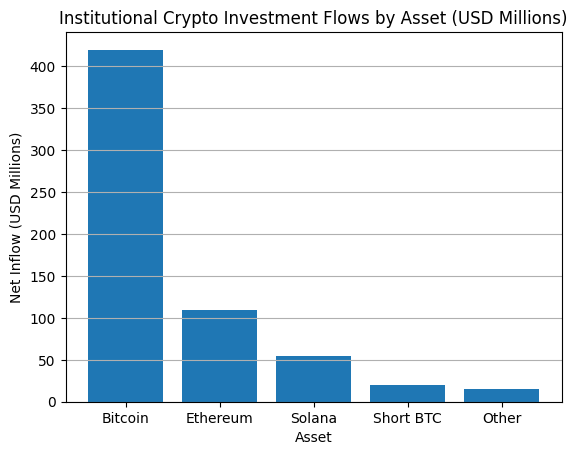
Bitcoin dominated inflows, while Ethereum and Solana also attracted significant institutional capital.
Macro Factors: Oil Prices, Inflation, and Crypto Markets
How Energy Prices Influence Digital Asset Investment
One of the most important drivers of last week’s market volatility was the rise in global oil prices.
Geopolitical tensions involving Iran pushed energy markets higher, creating renewed fears that inflation could reaccelerate. Higher energy prices typically affect financial markets in several ways:
- They increase production and transportation costs.
- They reduce consumer purchasing power.
- They force central banks to maintain tighter monetary policy.
For cryptocurrency markets, inflation dynamics are particularly significant. On one hand, inflation concerns can boost interest in Bitcoin as an alternative store of value. On the other hand, rising interest rates and tighter liquidity conditions can reduce speculative investment in digital assets.
This push-and-pull dynamic was visible throughout the week, as crypto investment flows shifted in response to macroeconomic news.
The Broader Institutional Crypto Trend
Long-Term Capital Continues to Enter the Market
Despite short-term volatility, the broader trajectory of institutional capital entering the crypto ecosystem remains positive.
Several structural trends support this view:
1. Expansion of Crypto ETFs
The launch and growth of spot Bitcoin ETFs has dramatically lowered barriers for institutional investors to access crypto exposure.
2. Tokenization of Real-World Assets
Financial institutions are increasingly experimenting with blockchain-based tokenization of bonds, funds, and other traditional assets.
3. Stablecoin Growth
Stablecoins are becoming an important infrastructure layer for global payments, remittances, and decentralized finance.
4. Integration With Traditional Finance
Major financial institutions are building custody, trading, and settlement infrastructure for digital assets.
These developments suggest that institutional adoption of crypto is transitioning from experimentation to structural integration.
Conclusion: A Market Balancing Risk and Opportunity
The latest data from CoinShares reveals a cryptocurrency market navigating a complex macroeconomic environment. Rising oil prices and geopolitical tensions triggered temporary volatility, yet digital asset investment products still recorded $620 million in net inflows, marking the second consecutive week of positive capital movement.
Bitcoin remains the primary driver of institutional investment, reinforcing its position as the gateway asset for the crypto market. At the same time, strong inflows into Ethereum and Solana highlight growing institutional interest in blockchain platforms beyond Bitcoin.
Regional differences in sentiment further illustrate the evolving global crypto landscape, with the United States emerging as the most bullish market while investors in other regions remain cautious.
For investors seeking the next generation of digital assets and blockchain-based revenue opportunities, the data provides an important takeaway: institutional capital is continuing to flow into the crypto ecosystem, even amid macroeconomic uncertainty.
As financial markets adjust to geopolitical shifts, inflation pressures, and changing monetary policy, digital assets are increasingly establishing themselves as a permanent component of the global investment landscape.
