
Main Points :
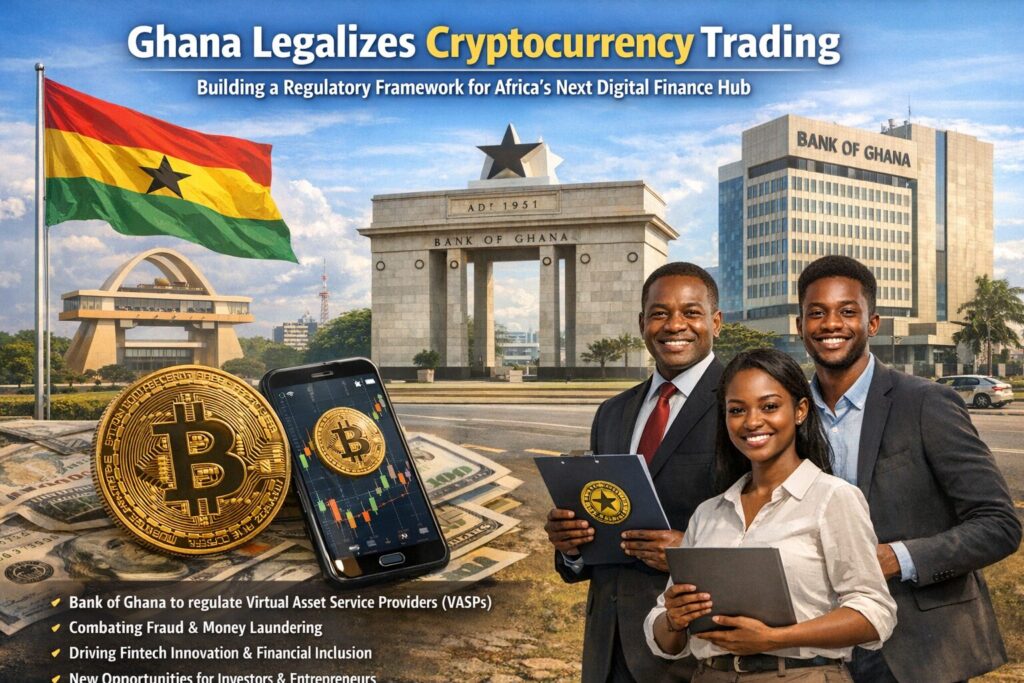
- Ghana has formally legalized cryptocurrency trading by passing a new law regulating Virtual Asset Service Providers (VASPs).
- The Bank of Ghana (BoG) is designated as the primary regulator, with authority over licensing, supervision, and enforcement.
- The framework aims to reduce fraud, money laundering, and systemic risk, while clarifying the legal status of crypto activities.
- Ghana is already among the top five Sub-Saharan African countries by cryptocurrency inflows, reflecting strong real-world adoption.
- Regulatory clarity is expected to accelerate fintech innovation, youth entrepreneurship, and financial inclusion.
- Ghana’s move aligns with a broader global trend of crypto normalization, creating new opportunities for investors, builders, and institutions.
Introduction: From Legal Gray Zone to Formal Recognition
In a landmark step for African digital finance, Ghana has officially legalized cryptocurrency trading by passing a comprehensive regulatory framework for virtual assets. This move transforms crypto from a legally ambiguous activity into a formally recognized and supervised sector of the financial system.
For years, Ghana—like many emerging economies—existed in a gray zone where crypto usage was widespread but lacked explicit legal recognition. Now, with parliamentary approval of the Virtual Asset Service Providers Bill, the country joins a growing list of jurisdictions seeking to regulate rather than suppress crypto activity.
This development is not merely symbolic. It represents a strategic acknowledgment of crypto’s economic relevance, especially in regions where traditional banking access remains limited and digital-native financial tools are filling real gaps.
Legalization and the New Role of the Bank of Ghana
Under the new law, the Bank of Ghana becomes the principal authority overseeing cryptocurrency activities. This includes licensing, supervision, compliance enforcement, and risk monitoring for all Crypto Asset Service Providers (CASPs) operating in or targeting Ghanaian users.
Speaking at a central bank–hosted event, BoG Governor Johnson Asiama clarified a crucial point: cryptocurrency trading is now explicitly legal, and individuals can no longer be arrested simply for engaging in crypto-related activities. This statement alone removes a major psychological and legal barrier that previously discouraged institutional participation.
The centralization of oversight under the BoG signals a “regulated acceptance” model—one where crypto is treated neither as a prohibited threat nor as an unregulated free-for-all, but as a financial activity subject to prudential rules.
Consumer Protection, AML, and Systemic Risk Management
A core objective of Ghana’s new crypto law is risk mitigation. According to the BoG, the framework is designed to enhance protections against:
- Fraud and scams
- Money laundering and terrorist financing
- Market manipulation and systemic instability
By requiring CASPs to obtain licenses and comply with supervisory standards, the law creates accountability where none previously existed. This mirrors regulatory approaches in jurisdictions such as the EU (MiCA) and parts of Asia, where crypto firms are increasingly treated like financial institutions rather than tech startups operating outside the law.
Importantly, this framework also resolves long-standing uncertainty about crypto’s legal status. For businesses, uncertainty is often more damaging than regulation itself. Clear rules allow exchanges, wallet providers, payment platforms, and blockchain startups to design compliant products with confidence.
Financial Inclusion and Youth-Led Innovation
Beyond risk management, Ghana’s policymakers emphasize innovation and inclusion. The BoG has explicitly framed the crypto law as a tool to expand financial access—especially among young, tech-savvy entrepreneurs.
Ghana has a rapidly growing population of developers, fintech founders, and digital freelancers. For many of them, crypto is not a speculative asset but an operational tool: a way to receive cross-border payments, access global markets, and build decentralized applications without reliance on legacy banking infrastructure.
Legalization lowers the barrier for these innovators to:
- Launch compliant exchanges and wallets
- Integrate stablecoins into payment flows
- Build blockchain-based lending, remittance, and identity solutions
In this sense, the law acts as an innovation enabler rather than a constraint.
Ghana’s Position in Sub-Saharan Africa’s Crypto Economy
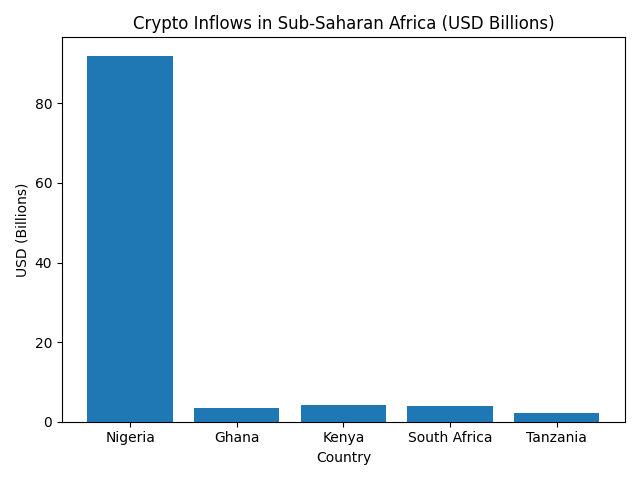
Ghana’s regulatory shift is grounded in economic reality. According to data from Chainalysis, Ghana ranked among the top five Sub-Saharan African countries by total cryptocurrency received between July 2024 and June 2025.
This places Ghana alongside regional heavyweights like Nigeria, which alone received at least $92 billion in crypto during the same period.
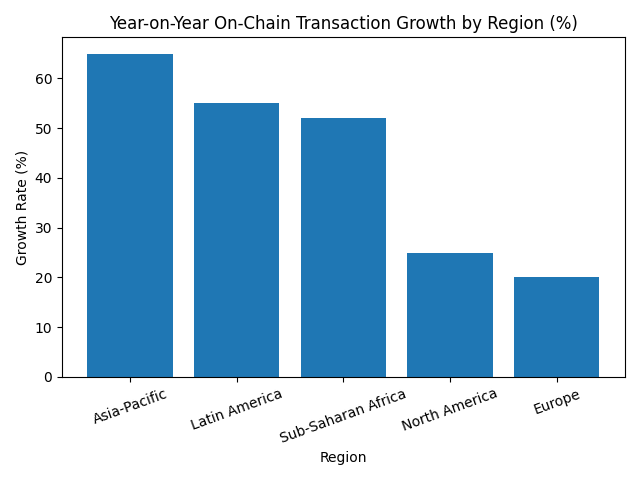
Chainalysis also reports that total on-chain transaction volume across Sub-Saharan Africa exceeded $205 billion, representing a 52% year-over-year increase. This growth rate ranks third globally, behind only Asia-Pacific and Latin America.
Why Crypto Is Growing So Fast in Africa
The explosive growth of crypto adoption in Africa is driven by structural factors rather than hype:
- Currency volatility and inflation concerns
- High remittance costs through traditional channels
- Limited access to international banking services
- A young, mobile-first population
Crypto—particularly stablecoins—has become an informal financial rail for everyday economic activity. Ghana’s decision to regulate rather than restrict this reality reflects pragmatic governance.
By legalizing crypto, Ghana positions itself to capture value that was previously operating off-grid: taxable revenues, formal employment, and international investment.
Implications for Investors and Builders
For investors seeking emerging crypto markets, Ghana now offers something rare: high adoption combined with regulatory clarity. This combination is often what precedes institutional entry.
Potential opportunities include:
- Regulated exchanges and brokerage services
- Stablecoin-based payment and remittance platforms
- Blockchain infrastructure and compliance tooling
- Web3 applications tailored to African use cases
For blockchain builders, Ghana could become a regulatory testbed—similar to how Singapore or the UAE function in other regions—where compliant innovation is encouraged rather than stifled.
Ghana in the Global Context of Crypto Regulation
Globally, the narrative around crypto regulation has shifted. Rather than asking whether crypto should exist, regulators are now asking how it should be governed.
Ghana’s framework aligns with this global normalization trend:
- The EU implements MiCA
- Japan operates under strict exchange licensing
- Emerging markets increasingly adopt sandbox-style oversight
By moving early within West Africa, Ghana may gain first-mover advantages in attracting talent and capital.
Conclusion: A Strategic Step Toward Africa’s Digital Future
Ghana’s legalization of cryptocurrency trading marks more than a policy update—it is a strategic declaration that digital assets are part of the country’s financial future.
By empowering the Bank of Ghana as a regulator, protecting consumers, and encouraging innovation, Ghana is building the foundations of a regulated crypto economy that reflects local realities and global standards.
For readers interested in new digital assets, revenue opportunities, and practical blockchain applications, Ghana’s move is a signal worth watching closely. It illustrates how emerging markets may lead—not follow—the next phase of global crypto adoption.
