
Main Points :
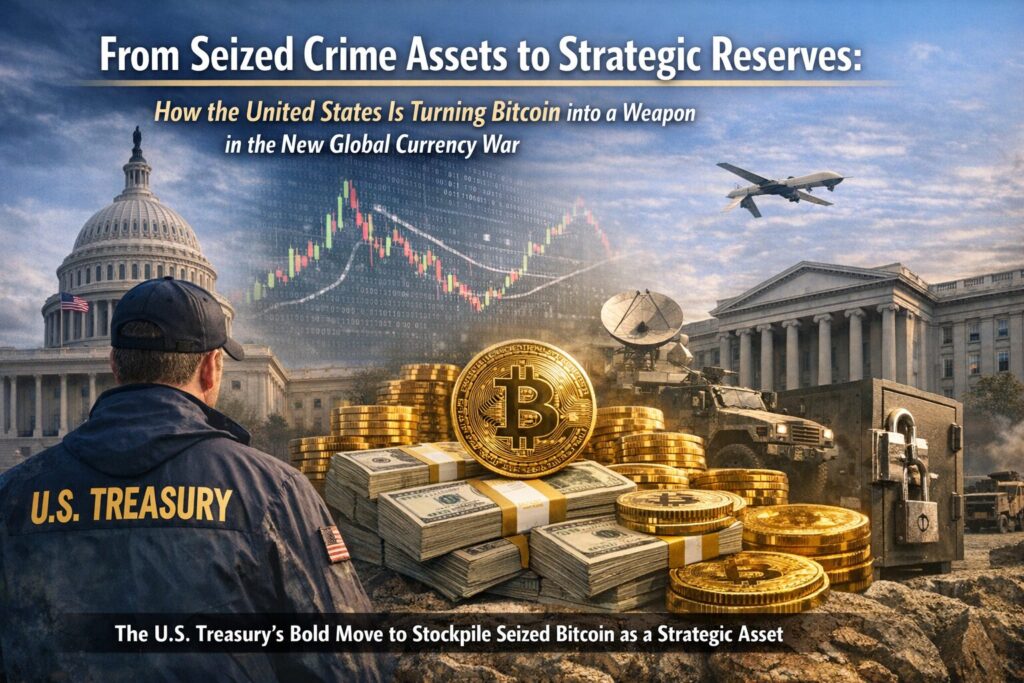
- The U.S. Treasury’s decision to retain seized Bitcoin as a strategic reserve marks a historic reversal in state policy toward digital assets.
- By locking seized Bitcoin instead of liquidating it, the U.S. accelerates global supply scarcity and implicitly underwrites Bitcoin’s legitimacy.
- This move signals the beginning of a new form of financial cold war, where digital scarcity becomes a tool of national defense.
- Bitcoin is repositioned from a criminal instrument to a sovereign-grade strategic asset that complements the U.S. dollar.
- Other nations now face a game-theoretic pressure to follow, potentially triggering a global digital “gold rush.”
1. Redefining Seized Assets: From Instruments of Crime to Guardians of the State
For decades, the United States followed a simple and seemingly rational rule when dealing with assets seized during criminal investigations. Whether confiscated from drug trafficking, cybercrime, or financial fraud, seized assets—including cryptocurrencies—were promptly auctioned off, converted into U.S. dollars, and deposited into the Treasury.
That rule has now been fundamentally overturned.
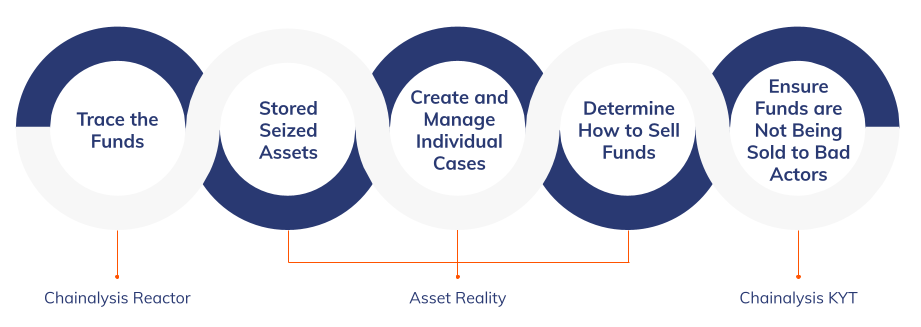
In early 2026, the U.S. Treasury Secretary reaffirmed a policy that would have been unthinkable just a few years ago: Bitcoin seized in criminal investigations will no longer be sold. Instead, it will be held as a strategic national reserve. This decision represents a complete inversion of the government’s historical posture toward digital assets.
What was once treated as a toxic byproduct of illicit activity is now formally recognized as a legitimate store of national value. In practical terms, this is the strongest form of state-level endorsement Bitcoin has ever received. Without passing a single “Bitcoin law,” the U.S. government has effectively granted Bitcoin sovereign recognition through action rather than rhetoric.
Historically, gold played this role. During the gold standard era, national wealth was anchored in physical reserves buried beneath the earth. In 2026, that definition has shifted decisively. Value is no longer stored underground, but encrypted across distributed networks and protected by mathematics rather than militaries.
By elevating seized Bitcoin to the status of a strategic reserve, the United States is not merely adapting to technological change—it is redefining what constitutes a defensive asset in the digital age. Just as gold once underwrote trust in fiat currencies, Bitcoin is now positioned as a complementary pillar supporting the dollar’s global role.
This decision also resolves a deeper philosophical question: what is value in the 21st century? The U.S. government’s answer is clear. Rather than resisting decentralized digital scarcity, it has chosen to absorb and weaponize it.
2. The Global Race for Digital Seigniorage and the White House’s Scarcity Lock Strategy
The implications of this policy extend far beyond U.S. borders.
While many countries remain trapped in regulatory debates—arguing over tax treatment, consumer protection, and compliance frameworks—the United States has moved decisively ahead. By formally designating seized Bitcoin as untouchable strategic reserves, it has altered the global monetary game board.
This is not simply a matter of asset accumulation. It is a calculated move to secure digital seigniorage—the ability of a state to benefit from controlling scarce monetary assets. Traditionally, seigniorage derived from issuing fiat currency. In a digitally scarce world, it increasingly derives from controlling non-inflatable assets.
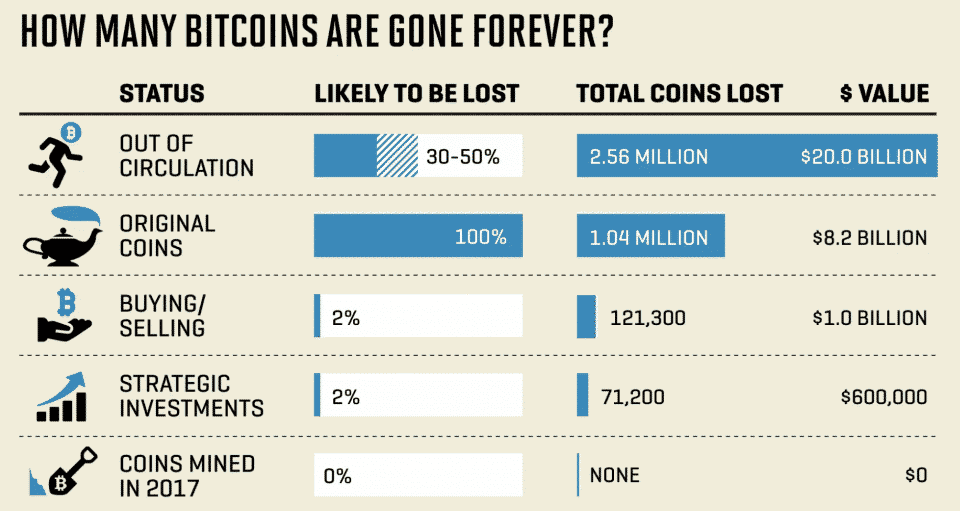
Bitcoin’s supply is permanently capped at 21 million units. When a government as large as the United States removes a significant quantity from circulation and locks it away indefinitely, the effect on global supply dynamics is profound. Scarcity intensifies not by market speculation, but by sovereign decree.
Ironically, this “cold storage” strategy turns seized assets into a price-support mechanism. Assets that would once have flooded the market and depressed prices are now permanently withheld. The state, in effect, becomes a long-term holder whose interests align with price stability and appreciation.
If other nations follow suit—and game theory suggests they must—the result is an irreversible feedback loop. Each country faces pressure to accumulate more Bitcoin than its peers, not for profit alone, but for monetary defense. Falling behind becomes synonymous with strategic vulnerability.
This dynamic mirrors historical arms races. However, instead of nuclear warheads or aircraft carriers, the new competition centers on cryptographic keys stored in sovereign vaults. The “digital gold rush” is no longer speculative—it is geopolitical.
Bitcoin locked in White House-controlled reserves now functions as a cyber-equivalent of an aircraft carrier: a silent but powerful deterrent embedded within the global financial system.
3. A New Financial Cold War: Strategic Reserves as the Dollar’s Last Line of Defense
The Treasury Secretary’s decision sends an unmistakable signal: cryptocurrencies are no longer fringe phenomena. They are now recognized as strategic energy sources capable of influencing national survival.
In 2026, the world enters a new era—a financial cold war where states directly confront one another through control of digital scarcity. What was once the domain of private investors and early adopters has been elevated to the level of national security.
For the U.S. dollar, this strategy serves a dual purpose. In the short term, it dampens market volatility by removing supply shocks. In the long term, it anchors confidence in a future where fiat systems face mounting debt and inflationary pressures.
Bitcoin’s defining feature—its resistance to inflation—positions it as a structural hedge against systemic fiat risk. By holding Bitcoin at the sovereign level, the United States effectively installs a financial backstop beneath the dollar-based system.
More provocatively, this opens the door to future financial engineering. A world in which the U.S. Treasury issues debt instruments implicitly or explicitly backed by Bitcoin collateral is no longer science fiction. Such instruments would fundamentally reshape global capital markets.
We are standing at a historical boundary. Trust based on paper promises is gradually giving way to trust anchored in mathematical verification. By embracing this shift, the United States signals that even if the dollar’s dominance weakens, control over alternative reservoirs of value will ensure continued influence.
In this new cold war, the first shot was not fired by missiles or sanctions—but by a policy memo from the Treasury.
What follows will not be a mere investment cycle. It will be a comprehensive, multidimensional power struggle unfolding across digital networks, financial institutions, and national balance sheets.
Conclusion: Witnessing the Rewriting of Monetary History
The transformation of seized Bitcoin from criminal residue into sovereign reserve marks one of the most consequential financial decisions of the 21st century.
It validates Bitcoin not through ideology, but through necessity. It reframes digital assets as instruments of statecraft rather than speculative curiosities. And it forces every other nation to confront a stark choice: adapt to a world of digital scarcity, or be left exposed within it.
For investors, builders, and institutions seeking the next source of value creation, the message is unmistakable. The age of crypto as a parallel system is ending. The age of crypto as an integrated component of global power has begun.
We are no longer observing history from the sidelines. We are standing inside the moment where the rules of money are being rewritten.
