

Key Takeaways :
- Bitcoin investors are shifting from panic selling to building cash buffers using stablecoins
- Stablecoin transfer volume surged to $440 billion, signaling active capital rotation
- Despite rising volatility, long-term panic remains absent
- Futures markets show declining leverage and cautious sentiment
- Spot trading volume remains subdued, indicating wait-and-see positioning
- Macro factors (war, interest rates) are driving risk-off behavior with strategic readiness
1. Introduction: A Structural Shift in Bitcoin Investor Psychology
The cryptocurrency market has entered a new behavioral phase. Unlike previous cycles dominated by emotional reactions and panic selling, Bitcoin holders are now demonstrating a markedly more disciplined and strategic approach. Rather than liquidating positions during periods of volatility, investors are increasingly reallocating capital into stablecoins such as USDT and USDC—effectively building “cash buffers” that can be rapidly deployed when favorable buying opportunities emerge.
This shift is not merely anecdotal; it is strongly supported by on-chain data and market structure indicators. On March 22 alone, total stablecoin transfer volume reached approximately $440 billion, highlighting a massive surge in liquidity repositioning. This behavior reflects a more mature market where participants are prioritizing optionality and timing over emotional decision-making.
At the same time, broader macroeconomic conditions—including geopolitical tensions involving the United States, Israel, and Iran, as well as the Federal Reserve’s reluctance to cut interest rates—are reinforcing a risk-off environment. Yet, instead of triggering widespread capitulation, these pressures are catalyzing a more calculated form of engagement.
2. Rising Volatility Without Panic: A New Market Resilience
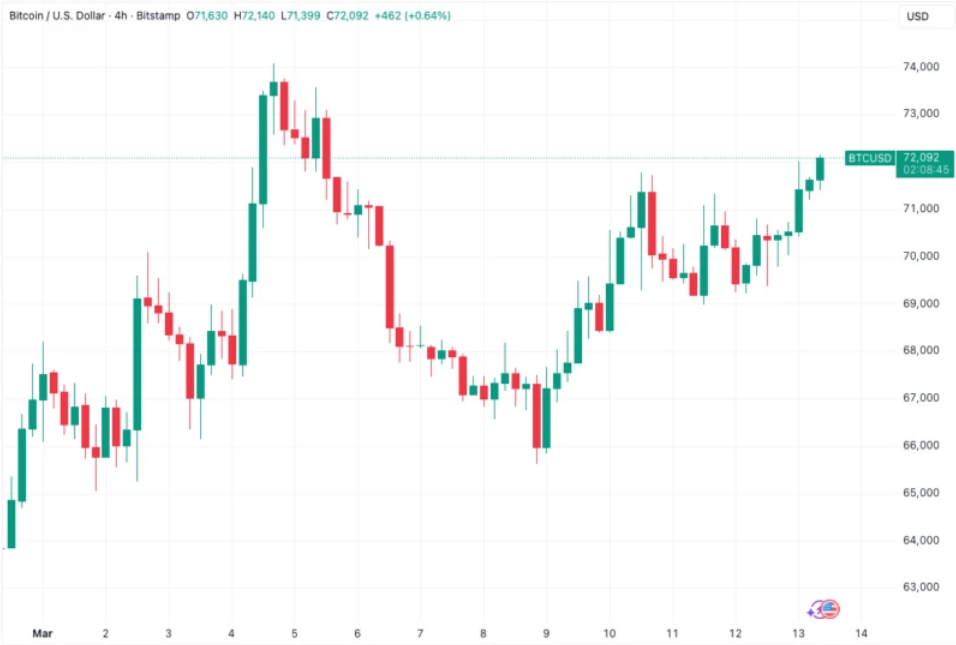
Bitcoin’s recent price movements vividly illustrate heightened volatility. Within a short span, BTC dropped approximately 3.75% to around $67,300, only to rebound above $71,700 the following day. These sharp fluctuations were largely driven by geopolitical developments rather than intrinsic crypto market factors.
More importantly, realized volatility metrics have surged significantly:
- 3-month realized volatility: from ~60% → 107%
- 6-month realized volatility: from ~94.5% → 148%
However, the most telling indicator is that 1-year realized volatility remains stable around 180%. This suggests that while short-term turbulence has intensified, the broader market structure has not entered a panic-driven phase.
In previous cycles, such volatility spikes would have triggered cascading liquidations and widespread fear. Today, however, investors appear to be absorbing uncertainty without resorting to disorderly exits. This resilience indicates a fundamental shift in market maturity.
3. Stablecoins as Strategic Cash Buffers
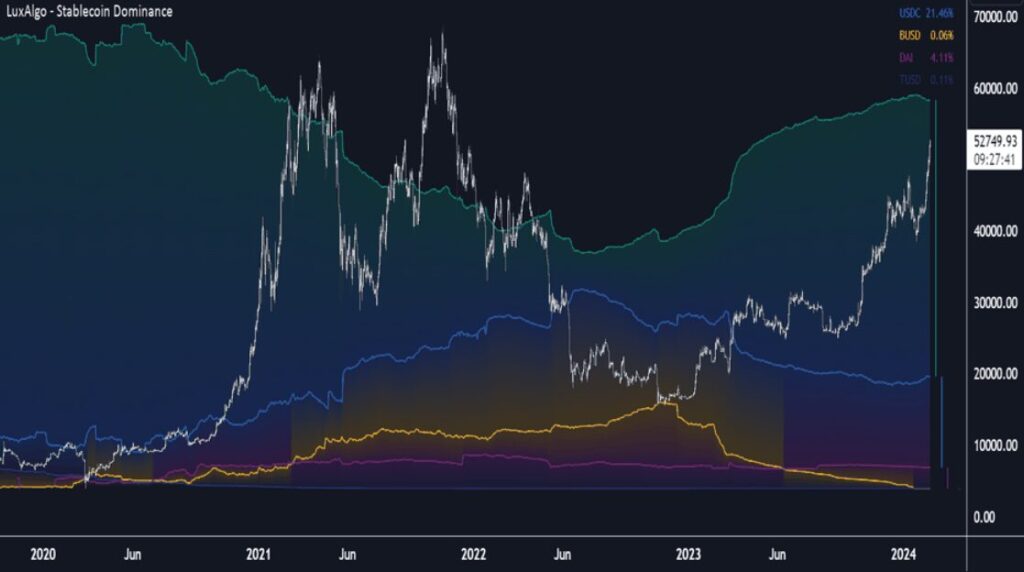
The surge in stablecoin activity is perhaps the clearest signal of this evolving strategy. On March 22:
- USDC transfers surged dramatically (over 2,000% increase day-over-day)
- USDT transfers on Ethereum reached approximately $72 billion
- Combined stablecoin movement totaled roughly $440 billion
These flows represent more than simple transactions—they reflect capital rotation and liquidity parking strategies. Investors are temporarily moving funds out of volatile assets into stablecoins, not as an exit, but as a tactical repositioning.
This behavior creates a “cash buffer” dynamic, where capital remains within the crypto ecosystem but is shielded from immediate price risk. Crucially, this liquidity can be redeployed instantly when market conditions become favorable.
Such a mechanism mirrors traditional finance strategies, where institutional investors maintain cash reserves to capitalize on market dislocations. The increasing prevalence of this approach in crypto suggests a convergence toward more sophisticated capital management practices.
4. Derivatives Market Signals: Deleveraging and Caution
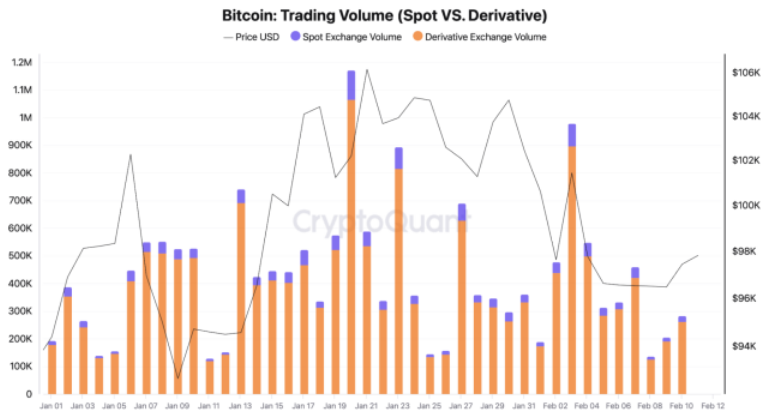
The derivatives market further reinforces the narrative of caution and discipline.
Key observations include:
- Bitcoin open interest has declined by approximately $19 billion over six months
- Funding rates have dropped from ~0.1% (overheated levels) to around 0.01%, occasionally turning negative
- Perpetual futures are trading at a discount to spot prices
These indicators collectively point to a systematic reduction in leverage. Traders are unwinding risk rather than aggressively building new positions. This deleveraging process reduces the likelihood of forced liquidations and contributes to overall market stability.
At the same time, the absence of strong positive funding rates suggests a lack of bullish conviction. The market is not overtly bearish, but it is clearly cautious—leaning slightly negative while awaiting clearer signals.
5. Spot Market Weakness and Participation Decline
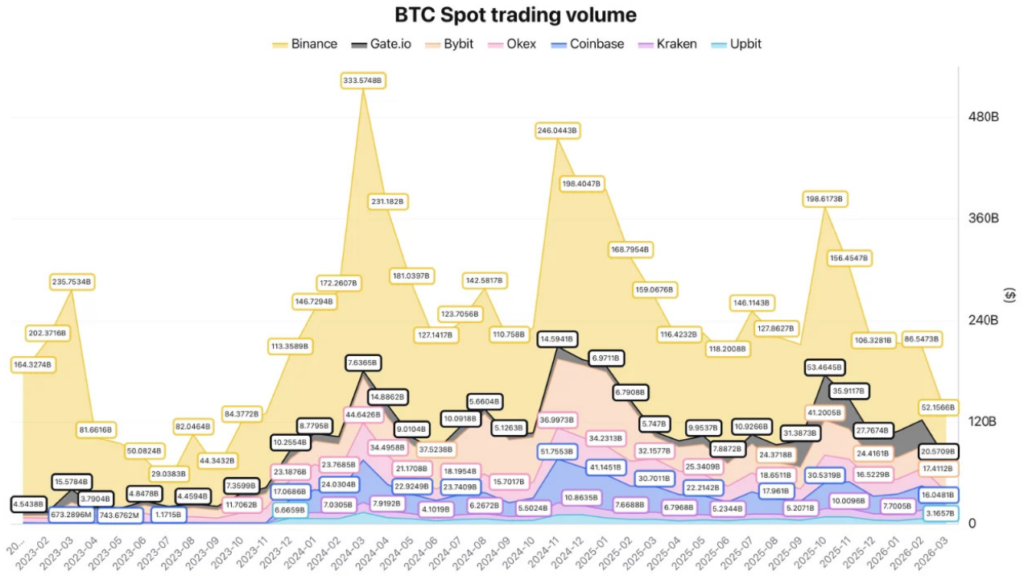
Spot market activity paints a similarly subdued picture. Monthly spot trading volume on major exchanges such as Binance has fallen to around $52 billion, marking one of the lowest levels since September 2023.
This decline in participation aligns more closely with historical bear market phases than with bullish expansion periods. Retail engagement appears muted, and even institutional players are adopting a more observational stance.
However, this should not be interpreted as a lack of liquidity. On the contrary, liquidity remains abundant—it is simply not being deployed into Bitcoin at present. Instead, it resides in stablecoins, waiting for clearer entry points.
6. Macro Drivers: War, Energy, and Monetary Polic
The current market environment cannot be understood without considering macroeconomic forces. Escalating tensions involving the United States, Israel, and Iran have driven energy prices higher, increasing global economic uncertainty.
Simultaneously, the Federal Reserve’s decision to maintain higher interest rates has dampened expectations for near-term monetary easing. This combination has reinforced a risk-off sentiment across global markets, including cryptocurrencies.
Yet, unlike traditional risk assets, crypto markets are exhibiting a unique adaptive behavior. Rather than exiting entirely, participants are maintaining exposure indirectly through stablecoins, preserving both liquidity and optionality.
7. Implications for Investors: A New Playbook
This evolving market structure carries important implications for investors seeking opportunities in the crypto space:
1. Liquidity is Power
Maintaining a cash buffer in stablecoins allows investors to act quickly during market dislocations. This strategy reduces emotional decision-making and enhances timing precision.
2. Volatility is Opportunity, Not Threat
In a mature market, volatility becomes a tool rather than a risk. Strategic investors can exploit price swings rather than fear them.
3. Leverage Discipline is Critical
The ongoing deleveraging trend highlights the importance of avoiding excessive risk. Sustainable gains are increasingly driven by capital efficiency rather than leverage.
4. Watch Stablecoin Flows Closely
Stablecoin activity is emerging as a leading indicator of market intent. Sudden inflows into BTC from stablecoins may signal the beginning of a new upward phase.
8. Conclusion: The Rise of a More Sophisticated Crypto Market
The behavior of Bitcoin holders is undergoing a profound transformation. The shift from panic-driven selling to disciplined liquidity management marks a significant milestone in the evolution of the crypto market.
Despite heightened volatility and macroeconomic uncertainty, investors are demonstrating restraint, strategic thinking, and adaptability. The growing use of stablecoins as cash buffers reflects a deeper understanding of market cycles and capital allocation.
In many ways, this transition signals the emergence of a more institutionalized and resilient crypto ecosystem—one where participants are no longer merely reacting to price movements, but actively shaping their outcomes.
As liquidity continues to build on the sidelines, the next major market move may not be driven by new capital entering the system, but by existing capital being redeployed with precision and intent.
