
Key Points :
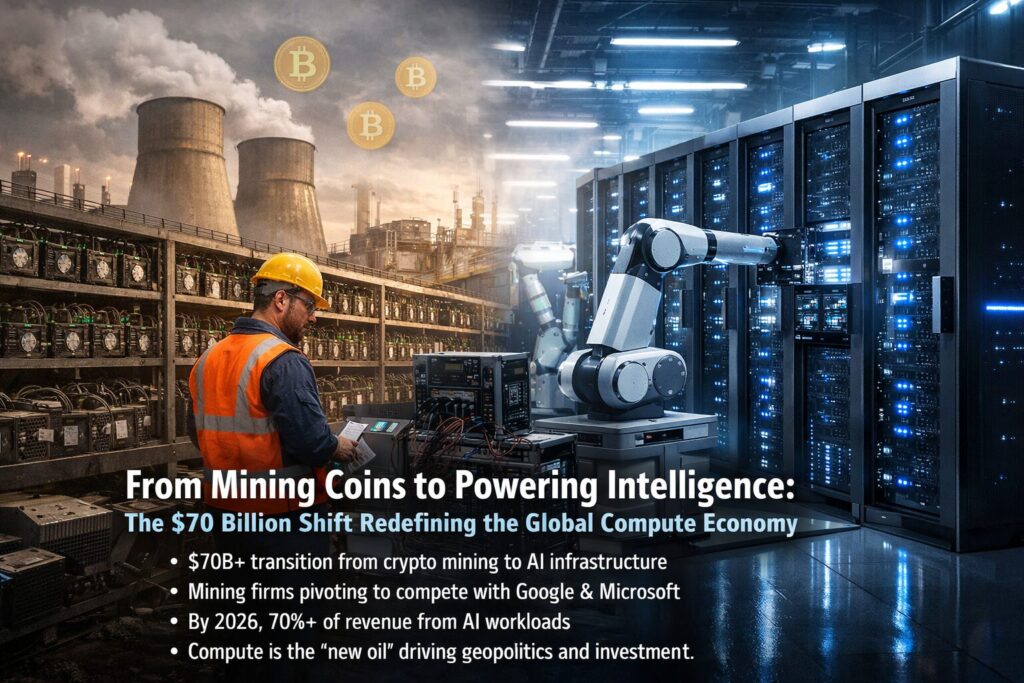
- A $70 billion+ wave of contracts signals a structural shift from crypto mining to AI infrastructure
- Mining companies are transforming into compute infrastructure providers competing with Google and Microsoft
- By 2026, over 70% of revenue for major players may come from AI workloads
- Compute is emerging as the “new oil”, reshaping geopolitics and capital allocation
- Mining is becoming a secondary activity, utilizing surplus energy from AI data centers
1. The $70 Billion Signal: From Currency Extraction to Intelligence Creation
The emergence of contracts exceeding $70 billion marks one of the most important inflection points in the history of digital infrastructure. What was once a volatile and speculative industry—cryptocurrency mining—has begun transforming into a foundational pillar of the global economy.
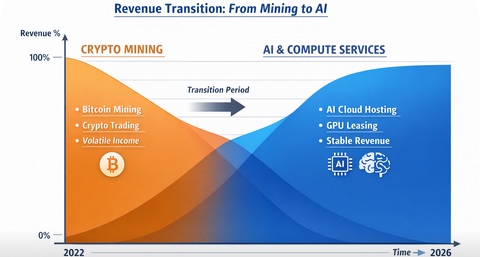
Historically, mining firms depended heavily on the price fluctuations of assets like Bitcoin. Their revenue models were fragile, cyclical, and deeply tied to market sentiment. However, the exponential rise of artificial intelligence has fundamentally altered this equation.
The demand for compute power—driven by large-scale AI models, generative systems, and enterprise automation—has reached unprecedented levels. This demand is not speculative; it is structural. AI systems require continuous training, inference, and optimization, all of which consume enormous computational resources.
This shift is best understood not as a pivot, but as a reclassification of value. Compute is no longer merely a means to produce digital currency. It has become the backbone of intelligence itself.
By 2026, leading mining firms aim to derive over 70% of their revenue from AI-related services, including:
- GPU cloud leasing
- AI model hosting
- High-performance computing (HPC) services
This transition eliminates the fragility of mining-based income and replaces it with predictable, long-term enterprise contracts.
In essence, we are witnessing the birth of a new industrial category:
Compute-as-Infrastructure for Intelligence.
Revenue Transition Model
2. Physical Assets Become Strategic Weapons
One of the most underestimated aspects of this transformation is the importance of physical infrastructure.
Crypto miners spent the last decade optimizing:
- Cooling systems
- Power distribution
- Land acquisition
- Energy contracts
What was once criticized as wasteful energy consumption has now become a strategic advantage.
These assets are exactly what AI companies desperately need.
Unlike software startups, AI infrastructure cannot scale purely in the cloud. It requires:
- Massive energy supply
- Specialized cooling (liquid/immersion cooling)
- Physical proximity optimization
As a result, mining companies are now competing directly with Big Tech players like Google and Microsoft—not as software developers, but as infrastructure providers.
This creates a new class of companies:
Compute Landlords of the Digital Age
Their competitive advantage lies in:
- Lower cost per kilowatt-hour
- Existing large-scale facilities
- Operational efficiency from mining experience
The philosophy of “compute at the lowest possible cost,” refined during the mining era, now translates directly into dominance in AI infrastructure.
3. The Rise of the Data Center Empires
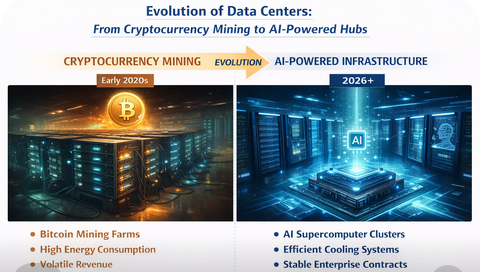
The modern data center is no longer just a server warehouse. It is evolving into the core engine of civilization.
Mining-based data centers are being repurposed into AI clusters capable of supporting:
- Large language models
- Autonomous systems
- Financial modeling engines
- Real-time global computation
These facilities are becoming the modern equivalent of industrial-age factories—but instead of producing goods, they produce intelligence.
Evolution of Data Centers
This transformation also triggers capital reallocation:
- Sale of mining rigs
- Investment into GPUs (NVIDIA-class infrastructure)
- Long-term AI contracts
Importantly, this is not a decline—it is industrial maturation.
The industry is moving from:
| Old Model | New Model |
|---|---|
| Speculative mining | Contract-based AI services |
| Retail-driven | Enterprise-driven |
| Volatile revenue | Stable cash flow |
4. Compute as the New Oil: A Global Power Shift
Compute is rapidly becoming the most valuable resource on Earth.
Just as oil defined the 20th century, compute will define the 21st.
This has several implications:
- Geopolitical Competition
Nations will compete for compute capacity, not just energy. - Capital Reallocation
Institutional investors are shifting from crypto speculation to infrastructure investment. - New Market Structure
Compute marketplaces will emerge, pricing compute like commodities. - Integration with Finance
AI-driven finance systems will rely directly on compute providers.
This shift also explains why traditional financial institutions are entering the space—not to trade crypto, but to secure compute infrastructure.
5. Mining Becomes a Secondary Activity
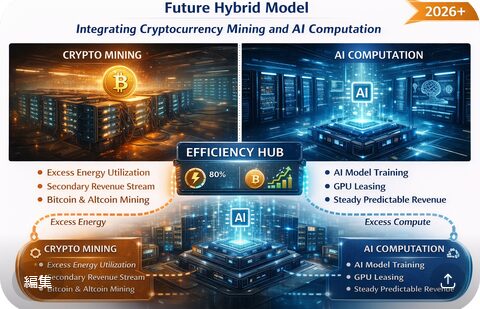
By late 2026, mining is expected to become a secondary, efficiency-driven process.
Instead of being the primary business, it will:
- Utilize excess energy from AI workloads
- Stabilize infrastructure utilization
- Provide additional yield
This is a critical conceptual shift:
Mining is no longer the goal—it is the byproduct.
This mirrors how industrial processes reuse excess heat or energy to maximize efficiency.
Future Hybrid Model
6. Strategic Implications for Investors and Builders
For readers seeking new opportunities in crypto and blockchain, this shift opens several pathways:
A. Infrastructure Tokens
Projects tied to compute, storage, and decentralized AI will gain prominence.
B. Energy + Compute Integration
Renewable energy combined with compute infrastructure becomes a dominant theme.
C. AI + Blockchain Convergence
On-chain verification of AI outputs and decentralized compute networks will grow.
D. Stable Revenue Models
Shift from speculative trading to yield from infrastructure leasing.
7. Conclusion: The Birth of a New Economic Layer
We are witnessing more than an industry shift—we are observing the birth of a new economic layer.
The transition from mining coins to powering intelligence represents:
- The end of speculation-driven crypto narratives
- The beginning of infrastructure-driven digital economies
Compute is no longer invisible.
It is the foundation of everything:
- Finance
- AI
- Governance
- Society itself
Those who understand this shift—and position themselves accordingly—will not merely participate in the next wave.
They will define it.
