
Main Points :
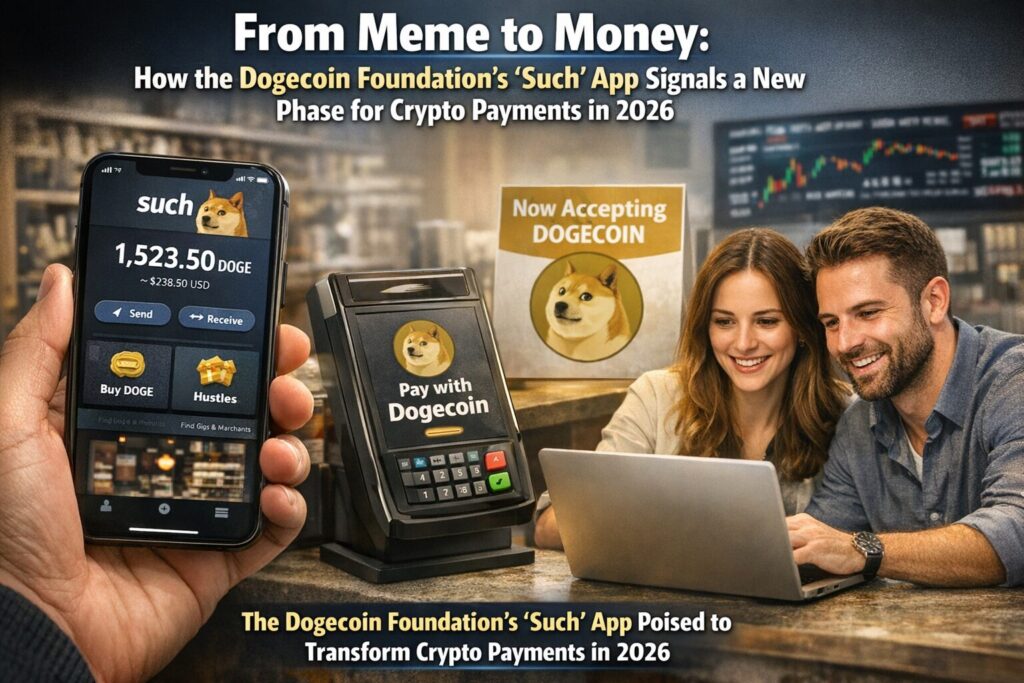
- The Dogecoin Foundation plans to release its official payment app “Such” in the first half of 2026, aiming to expand Dogecoin’s real-world usage.
- Development is led by House of Doge in collaboration with Bragg House Holdings, a Nasdaq-listed company, signaling increasing institutional coordination.
- The app emphasizes self-custody wallets, simple Dogecoin purchases, and merchant onboarding via a feature called “Hustles”, targeting freelancers and small businesses.
- This move reflects a broader trend in crypto: renewed focus on payments, UX simplicity, and everyday economic activity, rather than speculation alone.
- If successful, “Such” could reposition Dogecoin from a meme-driven asset to a practical decentralized payment rail, influencing how other Layer-1 communities approach adoption.
Introduction: Dogecoin’s Long Road from Meme to Medium of Exchange
Dogecoin (DOGE) began as an internet joke in 2013, yet over the past decade it has repeatedly defied expectations. Despite lacking many of the complex features associated with newer blockchains, Dogecoin has maintained one of the largest and most loyal communities in the crypto ecosystem. Its low transaction fees, relatively fast confirmations, and cultural accessibility have long made it a candidate for everyday payments—at least in theory.
In practice, however, Dogecoin’s use as a payment method has been fragmented. Users often relied on third-party wallets, exchanges, or merchant tools that were not officially supported or optimized for mainstream adoption. This gap between potential and actual usage is what the Dogecoin Foundation now seeks to address with its upcoming official payment application, “Such.”
Announced on January 20, 2026, the app is scheduled for release in the first half of the year and represents one of the most concrete steps yet toward embedding Dogecoin into daily economic activity.
1. What Is the “Such” App? An Official Payment Layer for Dogecoin
The “Such” app is positioned as the official payment application of the Dogecoin ecosystem. Developed by House of Doge together with Bragg House Holdings, it is designed to lower the barriers for both individuals and merchants to transact in DOGE.
Core Features
At launch, the app is expected to include:
- Self-custodial wallet creation
Users will be able to create wallets where they control their private keys, aligning with crypto’s core principle of self-sovereignty. - Dogecoin purchase functionality
Integrated purchase flows aim to reduce friction for new users entering the ecosystem. All price references and balances are expected to be displayed in USD ($) equivalents for clarity. - Merchant enablement via “Hustles”
A standout feature, “Hustles,” allows freelancers and small businesses—such as artists, lawn-care providers, or side-hustle operators—to accept Dogecoin payments with only a few clicks.
【Diagram showing User → Such App Wallet → Merchant (Hustles) → DOGE settlement】
2. Strategic Partners: Why House of Doge and Bragg House Matter
House of Doge serves as the official corporate arm of the Dogecoin Foundation, bridging the gap between a decentralized community and traditional corporate structures. Its collaboration with Bragg House Holdings is particularly notable because it introduces public-market discipline and accountability into a meme-originated ecosystem.
Why This Partnership Is Significant
- Credibility and Governance
A Nasdaq-listed partner brings regulatory awareness, reporting standards, and investor scrutiny—elements often missing from purely community-driven crypto projects. - Capital and Scaling Capacity
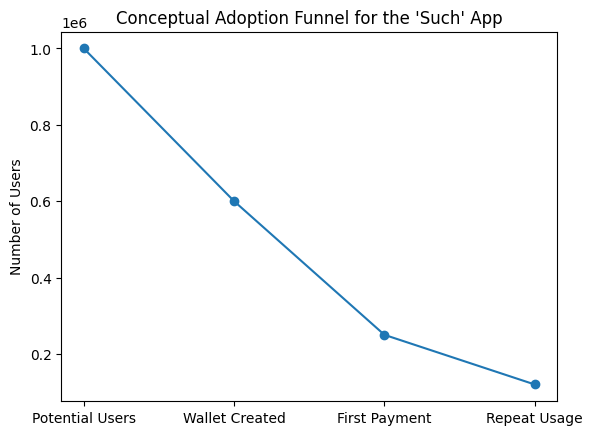
Building consumer-grade payment apps requires sustained funding, UX research, compliance work, and long-term maintenance. This partnership increases the likelihood that “Such” will be more than a short-lived experiment. - IPO Ambitions
House of Doge and Bragg House signed a merger agreement in December 2025, aiming for a public listing in early 2026. The “Such” app is likely to become a flagship product supporting that narrative.
3. The Technical Philosophy: Simplicity Over Complexity
Unlike many modern blockchain projects that emphasize smart contracts, DeFi composability, or Layer-2 rollups, Dogecoin’s technical philosophy has remained relatively conservative.
According to Timothy Stebbing, CTO of House of Doge, the goal is not to overwhelm users with features but to make payments effortless. This is a deliberate contrast to DeFi-heavy apps that often intimidate non-technical users.
Why This Matters for Adoption
- Lower cognitive load
For mainstream users, sending money should feel as easy as using a messaging app. - Reduced operational risk
Fewer features mean fewer attack surfaces and simpler security models. - Clear value proposition
Dogecoin is positioned not as a yield-generating asset, but as digital cash.
4. Market Context: Crypto Payments Are Back in Focus
The timing of the “Such” app is not accidental. After several years dominated by NFTs, DeFi speculation, and Layer-2 scaling debates, the crypto industry in 2025–2026 has seen renewed interest in real-world payments.
Supporting Trends
- Stablecoins gaining institutional traction
USD-denominated stablecoins now process trillions of dollars annually, proving that blockchain-based payments can scale. - Merchants seeking lower fees
Traditional card networks charge 2–3% per transaction, while crypto payments can settle for fractions of a cent. - Regulatory clarity improving
In several jurisdictions, including parts of Asia and Europe, clearer frameworks for crypto payments have reduced legal uncertainty.
Within this environment, Dogecoin’s low-fee and fast-settlement characteristics become highly relevant again.
【Comparison chart of transaction fees (Credit Card vs Stablecoin vs Dogecoin) in USD】

5. Economic Implications: Can Dogecoin Become a Functional Economy?
Marco Margiotta, CEO of House of Doge, has stated that the ultimate goal is to make Dogecoin a widely used decentralized currency, not merely a traded asset.
Potential Economic Effects
- Circular economies
If merchants earn DOGE and also spend DOGE (on suppliers or services), dependence on fiat off-ramps decreases. - Microtransactions
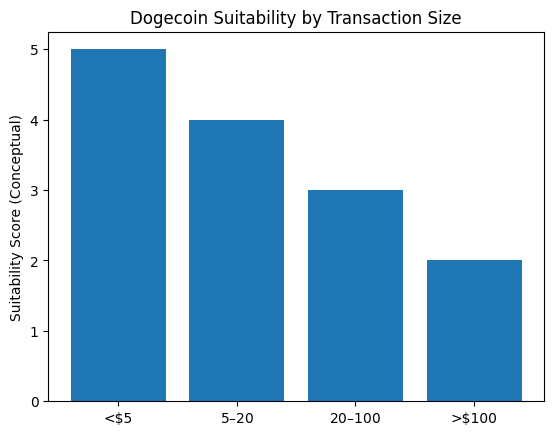
Dogecoin’s low fees make it suitable for small-value transactions, such as tipping, digital content, or local services under $5. - Global accessibility
For users without access to traditional banking, a mobile-first Dogecoin wallet could function as an entry point to digital commerce.
However, volatility remains a challenge. Unlike stablecoins, DOGE’s price can fluctuate significantly, which may discourage some merchants from holding balances long-term.
6. Risks and Open Questions
Despite its promise, the “Such” app faces several uncertainties:
- User acquisition
Can Dogecoin attract users beyond its existing community? - Regulatory treatment
Even with self-custody, payment apps often face scrutiny around KYC/AML obligations. - Competition
Stablecoin wallets, Lightning-based Bitcoin apps, and even traditional fintech platforms are all competing for the same “everyday payments” niche.
The success of “Such” will depend not only on technology, but on distribution, trust, and timing.
Conclusion: A Small App with Big Symbolic Weight
The planned release of the “Such” app in early 2026 marks a symbolic and practical turning point for Dogecoin. For years, Dogecoin has existed in a liminal space—widely recognized, heavily traded, yet underutilized as a medium of exchange.
By delivering an official, user-friendly payment application focused on real economic activity, the Dogecoin Foundation and its partners are making a clear statement: crypto’s future is not only about financial engineering, but about usability and everyday relevance.
Whether “Such” becomes a dominant payment app or remains a niche tool, its launch will be closely watched. For investors, builders, and entrepreneurs seeking the next phase of blockchain adoption, Dogecoin’s experiment may offer valuable lessons on how community, simplicity, and practicality can converge into a functioning crypto economy.
