
Main Points :
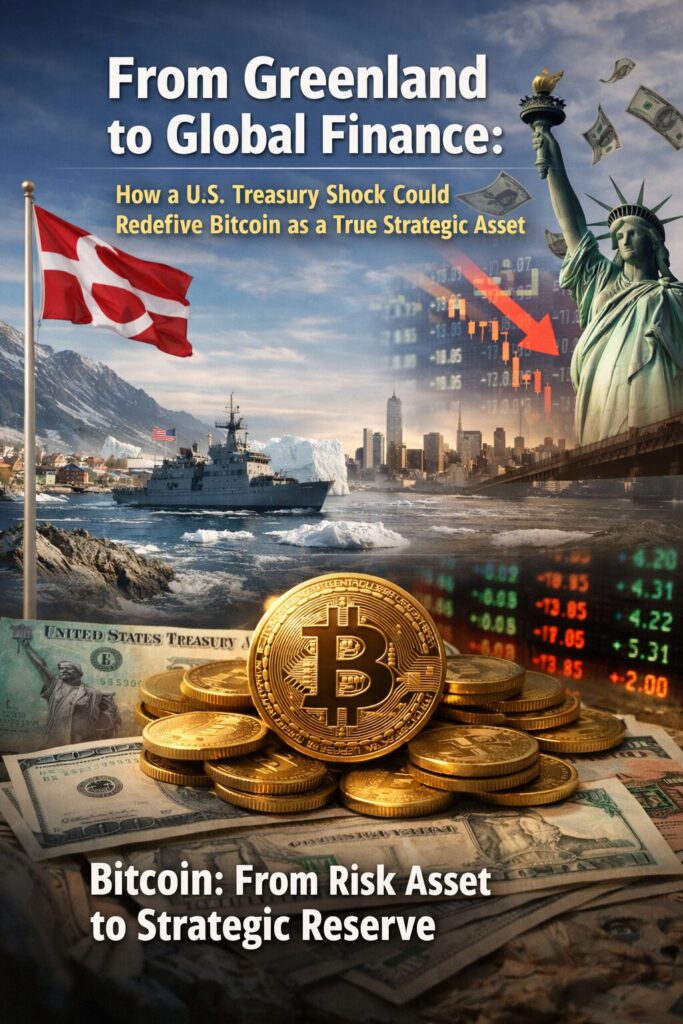
- Rising geopolitical tension surrounding Greenland has triggered a new scenario in which U.S. Treasuries may be used as a political bargaining chip by European stakeholders.
- Even limited signaling of Treasury liquidation could push U.S. yields sharply higher, affecting the dollar, global liquidity, and crypto markets.
- Higher Treasury yields may initially pressure Bitcoin and Ethereum prices through discount-rate effects.
- Over the medium to long term, politicization of the dollar system may accelerate Bitcoin’s role as a neutral, non-sovereign asset.
- Bitcoin’s transformation from a “risk asset” to a “strategic reserve alternative” is no longer theoretical—it is becoming scenario-dependent reality.
1. The Greenland Question and the Return of Geopolitical Finance
The renewed geopolitical tension surrounding Greenland has reintroduced an uncomfortable reality for global markets: sovereign assets are no longer politically neutral.
While Greenland itself is geographically remote, its strategic importance—due to Arctic routes, military positioning, and resource access—has placed it at the center of quiet but escalating friction between the United States and Europe. According to multiple reports, European political leaders have begun discussing the potential use of U.S. Treasuries as leverage, not necessarily through immediate liquidation, but through policy signaling and reserve management adjustments.
This represents a fundamental shift. U.S. Treasuries have long been treated as the world’s ultimate risk-free asset, insulated from geopolitical retaliation. That assumption is now being tested.
2. Why U.S. Treasuries Matter More Than Any Other Asset
To understand why this matters for crypto investors, one must understand the central role of U.S. Treasuries in global finance.
U.S. Treasuries are not merely government debt instruments; they are:
- The backbone of global collateral markets
- The benchmark for global risk-free rates
- The foundation of dollar liquidity
- A key reserve asset held by central banks and sovereign institutions
Any disruption—real or perceived—in Treasury demand reverberates across interest rates, currency markets, equity valuations, and crypto liquidity.
Historical Research Insight
Past academic and central bank research indicates that a sudden reduction in foreign official Treasury purchases can raise the 5-year Treasury yield by several tens of basis points within a short period. Even a 30–50 basis point move is enough to reprice risk assets globally.
3. Short-Term Shock: Yield Spikes and Crypto Price Pressure
Mechanism: Discount Rate Compression
If Treasury yields rise rapidly:
- Risk-free rates increase
- Discount rates for future cash flows rise
- Speculative and high-duration assets suffer first
Bitcoin and Ethereum, despite their unique properties, are still priced at the margin as global liquidity assets. As yields rise, capital shifts toward yield-bearing instruments, at least temporarily.
This suggests a short-term downside risk for BTC and ETH prices, not due to structural weakness, but due to macro repricing.
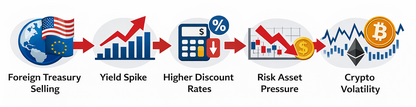
【U.S. Treasury Yield Shock Transmission】
Foreign Treasury Selling → Yield Spike → Higher Discount Rates → Risk Asset Pressure → Crypto Volatility
4. The Dollar’s Fragility: When “Safe” Becomes Political
However, this is only half of the story.
If U.S. Treasuries begin to be weaponized—explicitly or implicitly—as geopolitical tools, the perceived neutrality of the U.S. dollar itself comes into question.
The dollar’s dominance is built on three pillars:
- Liquidity
- Legal predictability
- Political neutrality
The third pillar is the most fragile.
Once reserve holders perceive that dollar assets can be influenced by political conflict, diversification away from the dollar accelerates, not necessarily through immediate selling, but through marginal allocation decisions.
5. Bitcoin’s Second Act: From Speculation to Monetary Neutrality
This is where Bitcoin’s narrative fundamentally changes.
Bitcoin is not controlled by any state.
Bitcoin is not issued by any central bank.
Bitcoin does not discriminate between users.
In a world where:
- Sovereign debt becomes a negotiation tool
- Reserve assets carry geopolitical risk
- Financial infrastructure is increasingly politicized
Bitcoin emerges as monetary infrastructure, not just an asset.
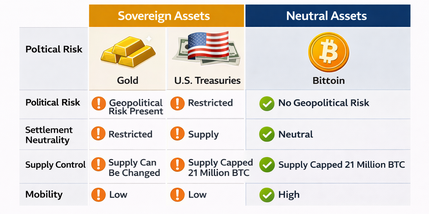
【Sovereign Assets vs. Neutral Assets】
Gold / U.S. Treasuries / Bitcoin across dimensions ofPolitical Risk, Settlement Neutrality, Supply Control, Mobility
6. Liquidity Paradox: Why Crises Hurt Bitcoin First—and Help It Later
A critical misconception among investors is assuming Bitcoin should immediately rise during crises.
Historically, Bitcoin often falls first, because:
- Investors liquidate liquid assets to meet margin calls
- Dollar demand spikes temporarily
- Volatility rises across all markets
However, once forced liquidation ends, Bitcoin often recovers faster than traditional assets—especially when the crisis involves trust in sovereign systems.
This pattern was observed during:
- The March 2020 liquidity shock
- Regional banking stress events
- Capital control episodes in emerging markets
7. Portfolio Reallocation: Why “1% Bitcoin” Is Becoming Obsolete
Recent institutional research suggests that 1% Bitcoin allocation is no longer sufficient to meaningfully hedge systemic risk.
Instead, 2–5% allocations are increasingly discussed among:
- Family offices
- Endowments
- Crypto-native hedge funds
- Sovereign-adjacent investment vehicles
This shift reflects Bitcoin’s evolving role from volatility enhancer to systemic risk offset.
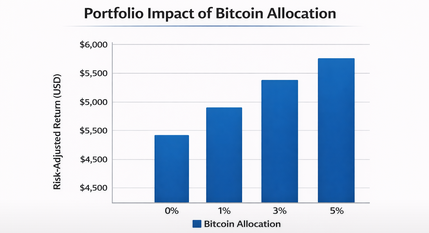
【Portfolio Impact of Bitcoin Allocation】
Bar chart showing risk-adjusted returns with 0%, 1%, 3%, and 5% Bitcoin allocation (all values in USD terms)
8. Ethereum and Beyond: Infrastructure Assets vs. Monetary Assets
While Bitcoin benefits from monetary neutrality, Ethereum and other smart-contract platforms play a different role.
Ethereum’s value proposition lies in:
- Settlement infrastructure
- Tokenization platforms
- Stablecoin issuance
- DeFi and on-chain finance
In a world of fragmented financial trust, blockchain infrastructure assets may outperform purely speculative tokens, especially those tied to real economic activity.
9. What This Means for Builders, Investors, and Institutions
For investors, the Greenland-Treasury scenario reinforces the need to distinguish between:
- Liquidity risk
- Political risk
- Monetary risk
For builders, it highlights demand for:
- Neutral settlement rails
- Cross-border payment systems
- Asset-backed and trust-minimized financial products
For institutions, it signals that crypto is no longer optional as a contingency layer.
10. Conclusion: Bitcoin’s Maturity Will Be Crisis-Driven
The Greenland issue itself may never result in direct Treasury liquidation.
But markets do not move on actions alone—they move on credible scenarios.
Once investors accept that:
- U.S. Treasuries are not politically untouchable
- The dollar’s neutrality can be questioned
- Financial infrastructure is becoming fragmented
Bitcoin’s role as a true global, non-sovereign asset becomes not ideological, but practical.
Bitcoin does not need to replace the dollar.
It only needs to remain neutral while others do not.
That alone may be enough.
