
Main Points :
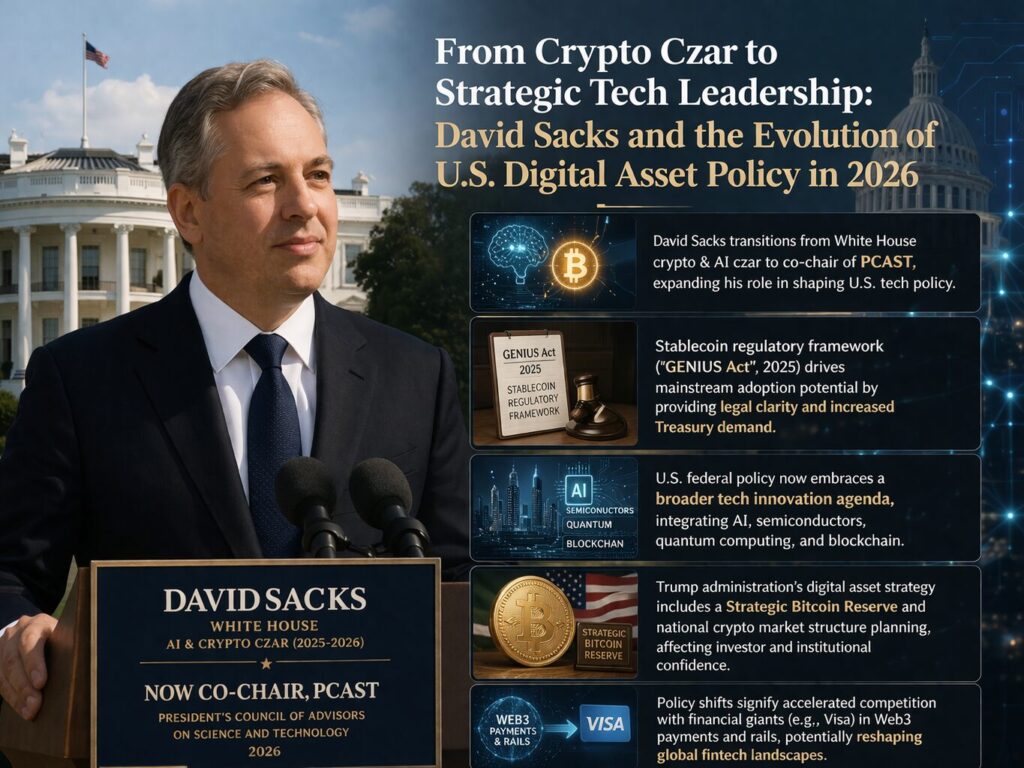
- David Sacks transitions from White House crypto & AI czar to co‑chair of PCAST, expanding his role in shaping U.S. tech policy.
- Stablecoin regulatory framework (‘GENIUS Act’, 2025) drives mainstream adoption potential by providing legal clarity and increased Treasury demand.
- U.S. federal policy now embraces a broader tech innovation agenda, integrating AI, semiconductors, quantum computing, and blockchain.
- Trump administration’s digital asset strategy includes a Strategic Bitcoin Reserve and national crypto market structure planning, affecting investor and institutional confidence.
- Policy shifts signify accelerated competition with financial giants (e.g., Visa) in Web3 payments and rails, potentially reshaping global fintech landscapes.
Part I — Background: Sacks and the U.S. Crypto Policy Environment
In March 2026, the White House announced that David Sacks — previously serving as the Special Envoy for Artificial Intelligence and Cryptocurrency — has completed his allowable 130‑day tenure as a special government employee and will transition to serve as co‑chair of the President’s Council of Advisors on Science and Technology (PCAST).
This transition underscores a decisive shift in how the U.S. federal government is structuring leadership and advisory input on digital asset policy. Rather than retaining a narrow role focused only on digital assets and AI, Sacks will now influence technology policy across a wider spectrum — including semiconductors, quantum computing, cybersecurity, and deep‑tech innovation.
As co‑chair of PCAST, Sacks joins an advisory body whose members include seminal figures from the global tech industry such as Nvidia CEO Jensen Huang, Meta CEO Mark Zuckerberg, Oracle co‑founder Larry Ellison, Google co‑founder Sergey Brin, and Silicon Valley venture capitalist Marc Andreessen.
Importantly, Fred Ehrsam — co‑founder of Coinbase and partner at cryptocurrency venture firm Paradigm — also sits on the council, signaling that digital asset insight remains part of high‑level strategic discussions, though within a broader tech policy framework.
Part II — The Legal Framework: GENIUS Act and Stablecoin Regulation
One of the most consequential achievements during Sacks’ tenure as crypto envoy was the passage of the GENIUS Act, a federal law enacted in July 2025 that establishes a comprehensive regulatory framework for payment stablecoins.
The law requires stablecoins to be backed one‑for‑one with U.S. Dollars or other low‑risk assets and aims to bring clarity to an area that previously lacked federal oversight. This legal clarity fuels institutional confidence and positions stablecoins as viable instruments for payment and settlement — potentially catalyzing mainstream adoption and on‑chain utility.
Stablecoins regulated under GENIUS have also contributed to increased demand for U.S. Treasuries, reinforcing the dollar’s global dominance while integrating digital asset instruments into traditional financial markets.
Insert Figure 1 Here: Stablecoin Regulatory Timeline + Market Adoption Impact in $ billions
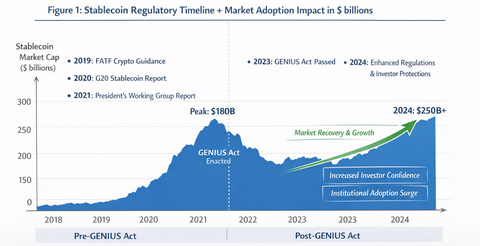
(Suggesting a timeline showing stablecoin regulatory milestones against market size growth, including pre‑ and post‑GENIUS Act effects.)
Part III — A Broader Technology Strategy: PCAST and Innovation Priorities
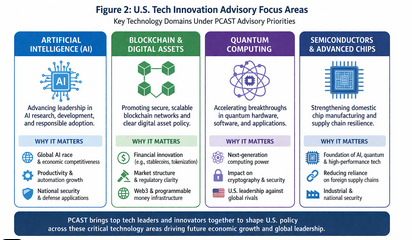
While Sacks’ influence on digital asset policy remains significant, his new leadership role within PCAST signals a broader federal approach to technology strategy. PCAST is mandated to provide recommendations on cutting‑edge innovation — including but not limited to AI governance, semiconductor supply chain resilience, quantum computing advancement, and future tech integration.
This expanded focus reflects an evolution in federal policy from siloed issue‑by‑issue advisement toward a holistic innovation agenda — one that simultaneously addresses:
- AI policy and safe‑yet‑accelerated AI development
- Blockchain and decentralized infrastructure integration
- Semiconductor manufacturing and supply chain robustness
- Quantum computing and next‑generation computational capability
Broadening the advisory footprint is intended to maintain U.S. competitiveness in a global technology race while positioning digital assets as part of a holistic innovation ecosystem.
Insert Figure 2 Here: U.S. Tech Innovation Advisory Focus Areas (AI, Blockchain, Quantum, Semiconductors)
Part IV — Strategic Digital Asset Initiatives: Bitcoin Reserve and Market Structure
Beyond regulatory clarity for stablecoins, the U.S. federal approach to digital assets encompasses additional strategic initiatives. Notably, in March 2025, the Trump administration issued an executive order establishing a Strategic Bitcoin Reserve and U.S. Digital Asset Stockpile — elevating Bitcoin’s role as a strategic financial instrument.
Unlike prior administrations where Bitcoin was peripheral to national finance policy, this initiative explicitly integrates BTC into sovereign asset strategies — akin to other national reserves such as gold or foreign currency holdings.
During this period, the administration also pursued a working group on digital asset market structure, aiming for greater clarity and infrastructure stability. Although not yet fully legislated like GENIUS, this work represents future policy leverage for market participants and institutional players seeking long‑term engagement with regulated digital asset frameworks.
Part V — Web3 Payments and Competitive Dynamics
The intersection of federal policy and private fintech competition is now shaping the future of digital payments. Federal clarity around stablecoin issuance lowers barriers to entry — encouraging banks, fintech firms, and blockchain‑native entities to participate in digital payment rails.
This dynamic accelerates competition with legacy incumbents such as Visa and Mastercard, which have traditionally dominated payments infrastructure. Web3‑centric payment solutions — including tokenized USD stablecoins — are increasingly viable for:
- Cross‑border settlement
- Merchant acceptance frameworks
- On‑chain programmable transactions
The implication for builders, developers, and institutional adopters is substantial: new business models may emerge around blockchain payment layers, liquidity provisioning, and integrated decentralized finance (DeFi) primitives.
Part VI — Criticisms, Risks, and Industry Considerations
Despite strong government support, the evolution of U.S. digital asset policy is not without criticism. Some policymakers and consumer advocates argue that regulatory frameworks may prioritize industry innovation at the expense of consumer safeguards, financial stability, or equitable oversight.
Furthermore, institutional players now operate in a landscape where federal objectives (innovation, competitiveness, national leadership) intersect with systemic risk considerations. This tension underscores that regulatory certainty should be balanced with robust governance frameworks capable of protecting participants without hindering innovation.
For savvy developers, entrepreneurs, and asset allocators, such dynamics present both opportunities and risks:
- Opportunity: participation in stablecoin issuance, decentralized payments, digital asset liquidity markets.
- Risk: regulatory shifts, enforcement uncertainty, macroeconomic impacts on token valuations.
Conclusion: The Future of Blockchain Innovation in the U.S.
The appointment of David Sacks as co‑chair of PCAST — and the broader trajectory of U.S. digital asset policy — reflects a maturation of how blockchain technology, stablecoins, and decentralized infrastructure are integrated into national technology strategy.
By combining a stablecoin regulatory foundation (GENIUS Act) with a broader innovation agenda, the U.S. government is signaling profound confidence in digital asset utility and strategic importance. For builders, investors, and enterprises, this translates into a landscape where blockchain technology is not merely experimental but is positioned as central to future digital finance, payments, and web3 integration.
The transition from specialized crypto czar to holistic tech advisory leadership underscores a new era of cohesive technology policy, placing blockchain alongside AI, quantum computing, and semiconductor innovation — all essential vectors for future economic and financial systems.
