
Key Takeaways :
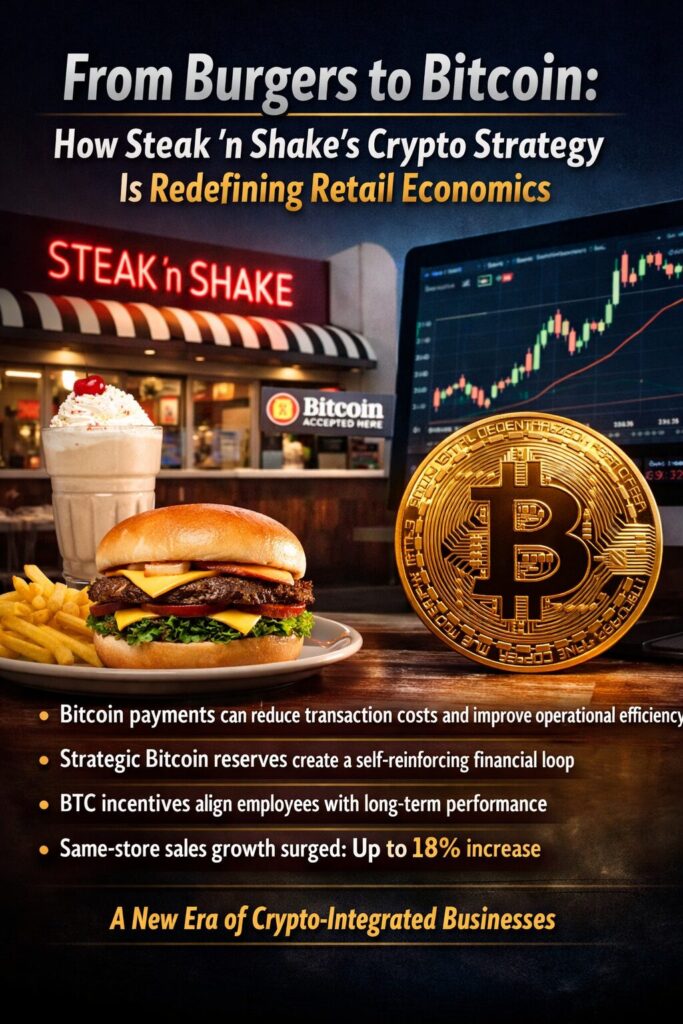
- Bitcoin payments can reduce transaction costs and improve operational efficiency
- Strategic Bitcoin reserves (SBR) create a self-reinforcing financial loop
- Employee incentives in BTC align workforce with long-term company performance
- Same-store sales growth surged, reportedly reaching double digits and up to ~18%
- The model signals a broader shift toward crypto-integrated real-world businesses
Introduction: A Restaurant Chain Becomes a Fintech Experiment
The American restaurant chain Steak ‘n Shake has taken a bold step beyond burgers and milkshakes into the world of digital assets. By integrating Bitcoin payments into its operations, the company is not merely experimenting with a new payment method—it is reshaping its entire financial and operational model.
What makes this development particularly noteworthy is not just the adoption of Bitcoin payments, but the creation of a closed-loop economic system where revenue, employee incentives, and treasury management are all interconnected through BTC.
This article explores how this strategy works, why it matters, and what it signals for the future of blockchain in real-world business applications.
The “Burger-to-Bitcoin” Strategy Explained
Steak ’n Shake refers to its approach as a “Burger-to-Bitcoin” strategy—a concept that encapsulates the transformation of traditional consumer spending into digital asset accumulation.
At its core, the strategy involves:
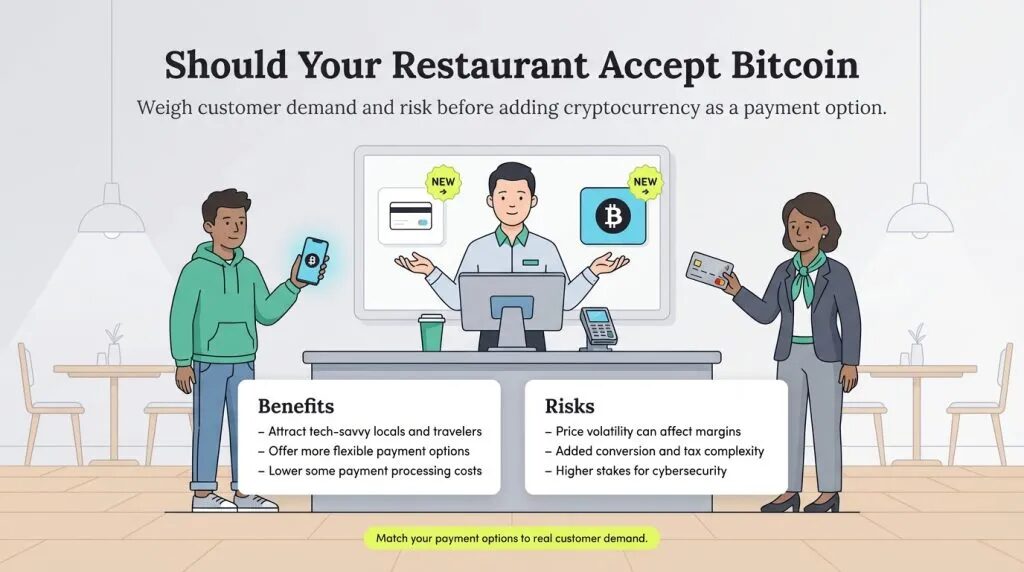
- Accepting Bitcoin as payment from customers
- Converting that revenue into a corporate Bitcoin treasury
- Using that treasury to fund incentives and strategic growth
Unlike traditional fiat systems, where revenue is quickly recycled into operational expenses, this model introduces an asset appreciation layer. Bitcoin received from customers is not immediately liquidated but stored in what the company calls a Strategic Bitcoin Reserve (SBR).
This fundamentally changes the economics of revenue. Instead of being static, revenue becomes potentially appreciating capital.
Strategic Bitcoin Reserve (SBR): A Self-Reinforcing System
The Strategic Bitcoin Reserve acts as the financial backbone of the company’s crypto integration.
How It Works
- Customers pay in Bitcoin
- BTC flows into the SBR
- The reserve funds employee bonuses and long-term strategy
- Improved performance drives more revenue
- More revenue increases BTC reserves
This creates a closed-loop feedback system, where operational success and digital asset accumulation reinforce each other.
The company has reportedly accumulated over 161.6 BTC, valued at approximately $11.93 million, with an average acquisition cost of around $92,851 per BTC.
Such a treasury model mirrors strategies seen in companies like MicroStrategy, but with a crucial difference: Steak ’n Shake integrates Bitcoin directly into its revenue engine rather than simply acquiring it as a balance sheet asset.
Operational Efficiency and Cost Reduction
One of the most immediate benefits cited by the company is cost reduction.
Traditional payment systems—credit cards in particular—can charge fees ranging from 2% to 3%. By accepting Bitcoin, especially through efficient payment rails like the Lightning Network (in broader industry practice), businesses can significantly reduce these costs.
Savings from transaction fees are reportedly reinvested into:
- Food quality improvements
- Operational enhancements
- Customer experience upgrades
This reinvestment strategy creates a tangible link between fintech innovation and customer satisfaction—something that purely financial crypto strategies often lack.
Employee Incentives: Aligning Labor with Digital Assets
A unique aspect of Steak ’n Shake’s model is its employee compensation structure.
Hourly employees receive approximately $0.21 per hour in Bitcoin bonuses, subject to a two-year vesting period.
Why This Matters
- Encourages long-term thinking among employees
- Aligns staff incentives with company performance
- Introduces employees to digital asset ownership
This approach is reminiscent of equity compensation in tech companies but adapted for a crypto-native framework. Instead of stock options, employees receive exposure to Bitcoin.
Over time, this could create a workforce that is not only operationally engaged but also financially aligned with the company’s success in the digital asset space.
Sales Growth: Correlation or Causation?
Perhaps the most striking claim is the impact on sales.
The company reports:
- Double-digit same-store sales growth in 2025
- Approximately 15% growth in the most recent quarter
- Around 18% growth in early 2026 across corporate and franchise stores
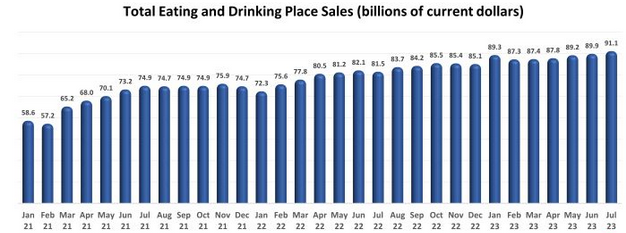
While it is difficult to isolate Bitcoin adoption as the sole driver, several contributing factors are likely at play:
- Increased brand visibility among crypto communities
- Differentiation from competitors
- Reinvestment into product quality
- Novelty-driven customer engagement
Even if partially driven by marketing effects, the outcome remains significant: Bitcoin integration appears to correlate with strong business performance.
Broader Industry Context: Crypto Moves Into the Real Economy
Steak ’n Shake’s experiment is part of a larger trend where cryptocurrencies are moving beyond speculation into practical use cases.
Companies such as Block and PayPal have already integrated crypto payments and custody solutions.
Meanwhile, nation-state experiments like El Salvador adopting Bitcoin as legal tender have pushed the narrative further.
What distinguishes Steak ’n Shake is its full-stack integration:
- Payments
- Treasury
- Incentives
- Operations
This level of integration represents a shift from crypto as a feature to crypto as infrastructure.
Risks and Challenges
Despite its promise, the model is not without risks.
1. Volatility
Bitcoin’s price fluctuations can impact the value of reserves and employee bonuses.
2. Regulatory Uncertainty
Different jurisdictions may impose restrictions on crypto payments and accounting treatment.
3. Accounting Complexity
Handling BTC as revenue versus an asset introduces complexities in financial reporting.
4. Adoption Barriers
Mainstream consumers may still prefer traditional payment methods.
For companies considering similar strategies, these risks must be carefully managed—particularly in regulated environments like EMI/VASP operations.
Implications for Crypto Investors and Builders
For readers interested in new crypto assets, revenue opportunities, and practical blockchain applications, this case offers several insights:
1. Real-World Yield Models
Crypto can generate value not just through price appreciation, but through operational integration.
2. Tokenization Potential
Similar models could be extended to tokenized loyalty programs or stablecoin-based systems.
3. Business Model Innovation
Startups can design systems where revenue feeds directly into digital asset ecosystems.
4. Competitive Advantage
Early adopters of crypto-integrated models may outperform traditional competitors.
Conclusion: A Blueprint for the Future of Commerce
Steak ’n Shake’s “Burger-to-Bitcoin” strategy is more than a marketing gimmick—it is a prototype for a new kind of business model.
By linking:
- Customer payments
- Corporate treasury
- Employee incentives
- Operational improvements
into a unified Bitcoin-based system, the company has demonstrated how blockchain can move beyond theory into tangible economic impact.
If this model proves sustainable, it could redefine how businesses think about revenue, assets, and incentives in the digital age.
