

Main Points :
- Ethereum network activity has reached all-time highs with 1.8–2.0 million daily active addresses.
- Despite rising usage, ETH price has fallen more than 50% from its previous cycle peak.
- This divergence suggests capital flows—not network activity—are currently driving price movements.
- Growth in DeFi, stablecoins, Layer-2 ecosystems, and automated smart-contract interactions is fueling real usage.
- Analysts expect Ethereum’s price to become more fundamentally driven as adoption expands.
- Institutional adoption, AI-driven blockchain transactions, and regulatory clarity could reshape the next market cycle.
1. Ethereum’s Unusual Market Cycle
Ethereum, the second-largest blockchain network after Bitcoin, is currently exhibiting a rare market phenomenon: network usage is surging even as the asset price remains weak.
According to a weekly market report by blockchain analytics firm CryptoQuant, Ethereum’s daily active addresses reached a historic peak of roughly 1.8 million to 2.0 million users in February 2026. This figure surpasses the previous record set during the intense bull market of 2021.
At first glance, this should signal strong bullish momentum. In previous crypto cycles, especially in 2017 and 2021, rising network activity usually coincided with explosive price increases.
Yet the current cycle tells a different story.
Even as Ethereum’s ecosystem expands and participation grows, ETH’s market price has dropped by more than 50% from its 2024 cycle peak. This creates a paradox rarely seen in previous crypto markets: record adoption combined with declining asset prices.
This divergence is forcing investors, analysts, and builders to rethink how crypto markets function—and whether Ethereum is entering a new stage of maturity.
2. The Explosion of Real Blockchain Usage
One explanation for the surge in activity lies in the dramatic expansion of Ethereum’s utility beyond speculation.
Ethereum has evolved from being primarily a token-trading platform into the core infrastructure layer of decentralized finance and digital asset applications.
The growth of smart contracts is central to this transformation.
A smart contract is a program deployed on a blockchain that automatically enforces contractual rules without intermediaries. Once conditions are met, the contract executes transactions autonomously, ensuring transparency and immutability.
In recent years, smart-contract activity on Ethereum has reached record levels. These interactions include:
- Automated token transfers
- DeFi lending and borrowing operations
- Stablecoin settlement
- Cross-chain bridging transactions
- Layer-2 rollup interactions
As these automated systems proliferate, many blockchain interactions are no longer directly triggered by individual users. Instead, protocols communicate with each other automatically, generating constant transaction flows.
This structural change means that network activity can continue rising even when speculative traders exit the market.
Ethereum Active Address Growth
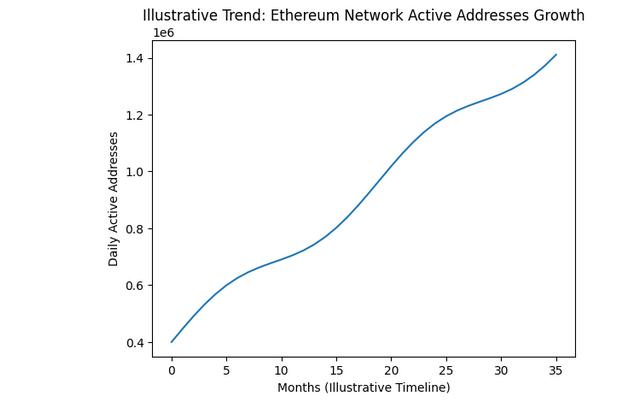
This chart illustrates the trend of rising network participation over time.
3. DeFi, Stablecoins, and Layer-2 Networks Drive Activity
Three major sectors are fueling Ethereum’s expanding activity.
Decentralized Finance (DeFi)
DeFi remains one of Ethereum’s most transformative innovations. Platforms offering lending, derivatives trading, and yield generation continue to attract billions of dollars in capital.
Protocols such as automated market makers and lending pools execute thousands of smart-contract interactions every minute. Even if market prices fluctuate, these protocols continue operating continuously.
Stablecoin Infrastructure
Ethereum is also the primary settlement layer for major stablecoins.
Stablecoins like USDC, USDT, and decentralized alternatives power payment systems, trading, remittances, and treasury operations across the crypto ecosystem.
Many transactions on Ethereum now involve stablecoins rather than ETH itself, meaning network activity can increase even if ETH’s price weakens.
Layer-2 Scaling Ecosystems
Perhaps the most important structural change is the rise of Layer-2 scaling networks.
These networks process transactions off the Ethereum main chain and later settle them back on Ethereum for security. Examples include rollup-based architectures that dramatically reduce transaction costs.
Layer-2 adoption is growing rapidly because it enables:
- High-speed payments
- Gaming transactions
- NFT interactions
- AI-driven automated trading
As these systems expand, Ethereum increasingly acts as the settlement layer of a global financial operating system.
4. The Capital Flow Problem
Despite these positive fundamentals, Ethereum’s price has struggled.
CryptoQuant analysts argue that capital flows explain price movements better than network activity in the current cycle.
One key indicator is the amount of ETH being deposited into cryptocurrency exchanges.
When large amounts of ETH move into exchanges, it often signals that investors intend to sell. Data suggests that during several recent periods, Ethereum inflows to exchanges exceeded those of Bitcoin.
These inflows coincided with a decline in the ETH/BTC price ratio, meaning Ethereum underperformed relative to Bitcoin.
Another metric reinforcing this view is realized market capitalization.
Realized market cap calculates the total value of all coins based on the price at which each coin last moved. Unlike traditional market cap, it reflects actual capital entering or leaving the network.
CryptoQuant’s data shows that Ethereum’s realized capitalization growth turned negative over the past year, suggesting that capital has been exiting the ecosystem.
In short, user activity is increasing, but investor capital is temporarily flowing elsewhere.
ETH Price vs Network Activity Divergence
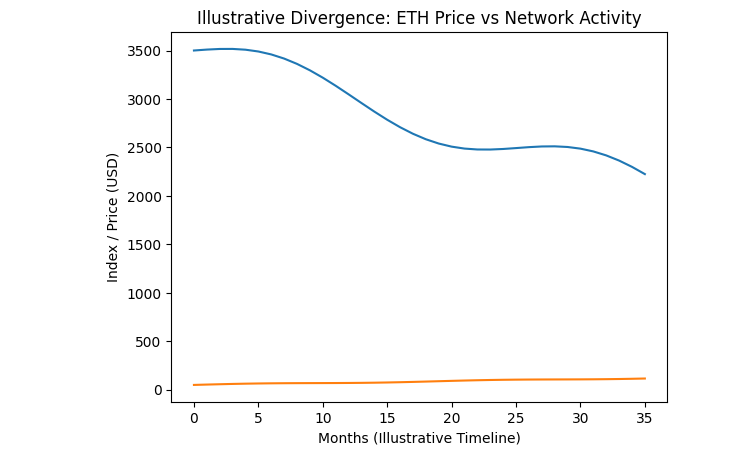
This chart illustrates how network activity has continued rising while price performance weakened.
5. A Shift Toward Fundamental Valuation
Some analysts believe this divergence could represent a healthy transition for Ethereum.
According to analysts at Citizens JMP Securities, Ethereum’s price may increasingly reflect real economic demand rather than speculative capital inflows.
In earlier crypto cycles, prices were largely driven by hype and speculative leverage. Market rallies often occurred long before meaningful adoption existed.
Today the situation may be reversing.
Instead of speculation driving adoption, adoption may begin driving price.
If this shift continues, Ethereum could evolve into something closer to a digital infrastructure asset similar to commodities like oil or computing resources like cloud capacity.
In this model, the value of ETH would derive from its role as the fuel powering decentralized applications and financial systems.
6. Institutional Adoption and AI-Driven Transactions
Two emerging trends could further accelerate Ethereum’s real-world utility.
Institutional Blockchain Integration
Large financial institutions are increasingly experimenting with blockchain infrastructure for:
- tokenized assets
- digital bond issuance
- settlement networks
- cross-border payments
Ethereum remains the dominant programmable blockchain used for these experiments.
As regulatory clarity improves—particularly in the United States—more institutions may deploy production systems on Ethereum or Ethereum-compatible networks.
AI Agents Transacting on Blockchain
Another emerging trend is AI-driven economic agents interacting with blockchain networks.
Recent proposals such as new Ethereum standards for AI-agent transaction protocols aim to enable autonomous software agents to perform financial operations.
These agents could execute tasks such as:
- automated trading
- supply-chain settlement
- decentralized service marketplaces
- algorithmic treasury management
If AI systems begin conducting large volumes of blockchain transactions, network activity could grow exponentially.
Ethereum’s programmable architecture makes it one of the most likely networks to support this emerging machine-to-machine economy.
7. What This Means for Investors and Builders
For investors searching for the next crypto opportunity, Ethereum’s current divergence presents both risks and possibilities.
On one hand, weak price performance may discourage short-term traders.
On the other hand, rising network activity suggests deepening fundamental demand.
Historically, major infrastructure platforms often experienced long periods where usage grew before prices eventually caught up.
Investors who understand the difference between speculative cycles and structural adoption may find opportunities during these transitional phases.
For developers and entrepreneurs, Ethereum’s growing activity signals that real users are arriving.
Opportunities are emerging in areas such as:
- decentralized finance tools
- stablecoin payment infrastructure
- tokenized real-world assets
- AI-driven blockchain applications
- Layer-2 ecosystems and scaling technologies
The projects that succeed in the next phase of crypto will likely focus less on speculative tokens and more on building useful decentralized services.
Conclusion
Ethereum’s current market cycle is unlike any that came before.
Network activity is reaching unprecedented levels, with millions of daily active addresses and rapidly expanding smart-contract interactions. Yet the price of ETH remains subdued due to capital outflows and broader market dynamics.
This divergence may represent more than a temporary anomaly.
It could signal the early stages of Ethereum’s transformation from a speculative crypto asset into a foundational layer of the digital economy.
If adoption continues expanding across DeFi, stablecoins, institutional finance, and AI-driven systems, Ethereum’s long-term value may increasingly be determined by real economic usage rather than market hype.
For investors, builders, and policymakers alike, this shift could define the next decade of blockchain innovation.
Ethereum’s paradox today—record activity with muted prices—may ultimately be the strongest signal yet that the technology is moving beyond speculation and toward real global utility.
