
Main Points :
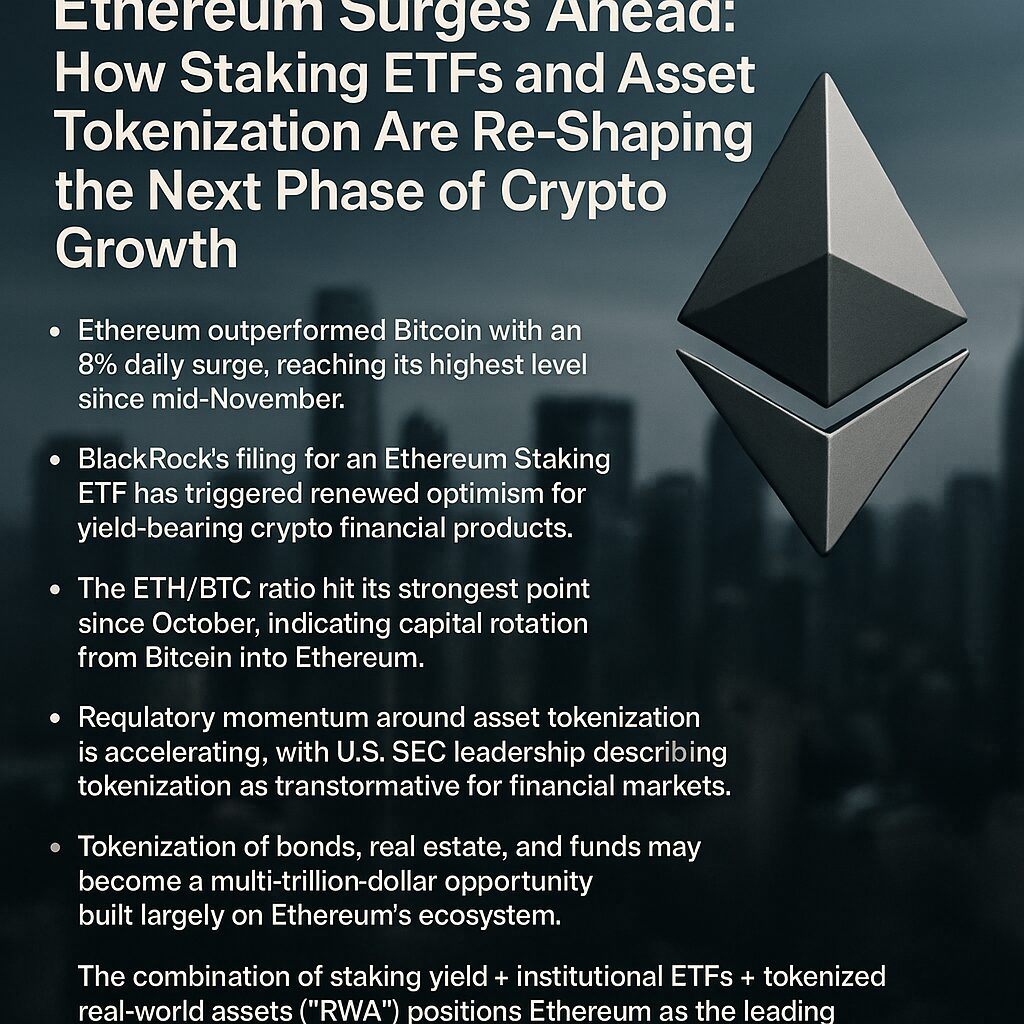
- Ethereum outperformed Bitcoin with an 8% daily surge, reaching its highest level since mid-November.
- BlackRock’s filing for an Ethereum Staking ETF has triggered renewed optimism for yield-bearing crypto financial products.
- The ETH/BTC ratio hit its strongest point since October, indicating capital rotation from Bitcoin into Ethereum.
- Regulatory momentum around asset tokenization is accelerating, with U.S. SEC leadership describing tokenization as transformative for financial markets.
- Tokenization of bonds, real estate, and funds may become a multi-trillion-dollar opportunity built largely on Ethereum’s ecosystem.
- The combination of staking yield + institutional ETFs + tokenized real-world assets (“RWA”) positions Ethereum as the leading infrastructure layer for mainstream adoption.
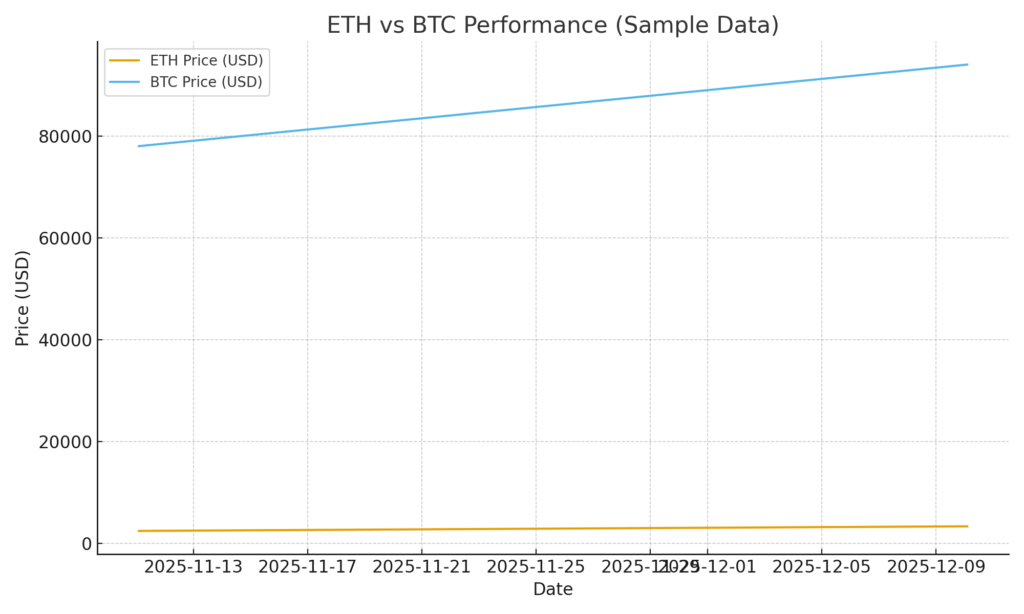
(ETH vs BTC Performance)
This chart visually supports Ethereum’s relative outperformance over the recent month.
Introduction: Ethereum Reclaims Momentum While Institutional Narratives Shift
On December 9, Ethereum (ETH) surged nearly 8.4%, reaching close to $3,400, marking its strongest price level since mid-November and outperforming Bitcoin (BTC), which rose 4.5% to surpass $94,000. The broader market, represented by the CoinDesk 20 Index, increased about 6%, yet Ethereum clearly led the rally.
The key driver behind this performance is a powerful combination of:
- Anticipation surrounding Ethereum Staking ETFs,
- Increasing regulatory acceptance of asset tokenization, and
- Capital rotation from Bitcoin as measured by rising ETH/BTC ratios.
This article analyzes why Ethereum is gaining renewed strength, how institutional developments are shaping the next phase of crypto growth, and what investors looking for new assets or revenue opportunities should pay attention to.
Section 1: Ethereum’s 8% Rally – Renewed Investor Confidence and Market Rotation
Ethereum’s sharp price increase reflects renewed market confidence. ETH’s move toward $3,400 not only pushed it to a multi-week high but also outpaced nearly all major cryptocurrencies.
The ETH/BTC Ratio Indicates a Shift in Market Leadership
The ETH/BTC ratio, a key metric for relative performance, climbed to its highest point since late October. Historically, a rising ETH/BTC ratio signals:
- Capital rotation from Bitcoin into Ethereum,
- Growing demand for Ethereum-based yield products,
- Market expectation that Ethereum will outperform in medium-term cycles.
Large trading desks such as LMAX framed this shift as driven by expectations of improved regulatory clarity and the growing likelihood that staking-based products will be approved for the broader investment market.
Section 2: BlackRock’s Ethereum Staking ETF – A Turning Point for Yield-Driven Crypto Assets
Why This ETF Matters
BlackRock—already the issuer of the most successful spot Ethereum ETF—filed for a new product:
iShares Ethereum Staking Trust, which aims to provide staking yield to investors.
This is significant because:
- Staking rewards are currently inaccessible to most traditional investors due to regulatory, custody, and technical constraints.
- A regulated ETF offering staking rewards democratizes access to Ethereum yield.
- Yield-bearing products transform Ethereum from a “growth asset” into a cash-flow-generating asset, similar to dividend stocks or bond ETFs.
LMAX strategist Joel Kruger highlighted that the ETF filing re-energizes optimism for inflows into Ethereum-focused investment products and strengthens Ethereum’s relative stability compared to Bitcoin.
Institutional Yield Demand Is Growing Fast
In TradFi markets, yield is one of the most important mechanisms for capital allocation.
By combining:
- Liquidity of ETFs
- Security of regulated custodians
- 3–5% staking yield on Ethereum
BlackRock bridges the gap between traditional investors and digital yield markets.
If approved, this could accelerate inflows from:
- Pension funds
- Registered investment advisors
- Corporate treasuries
- Sovereign wealth funds
With hundreds of trillions of dollars in traditional assets, even a tiny allocation to staking ETFs could reshape crypto markets.
Section 3: Tokenization – The Multi-Trillion-Dollar Opportunity Anchored on Ethereum
Beyond ETFs, Ethereum is gaining momentum from the expanding global push for real-world asset tokenization (RWA).
SEC Leadership Endorses Tokenization
U.S. SEC Commissioner Paul Atkins recently emphasized the transformative power of tokenization in an interview with Fox Business, highlighting benefits such as:
- Reduced settlement risk
- Lower transaction latency
- Improved transparency
- Stronger market efficiency
This level of regulatory recognition significantly accelerates institutional acceptance.
Tokenization is no longer a theoretical concept—regulators now acknowledge its operational advantages.
RWA Tokenization Markets Are Growing Rapidly
Several major financial institutions have already begun tokenization pilots or deployments:
| Institution | Asset Type Tokenized | Platform |
|---|---|---|
| JPMorgan | Money market funds | Onyx / Ethereum-based frameworks |
| BlackRock | Tokenized funds | Ethereum |
| Franklin Templeton | Mutual funds | Public blockchains |
| Société Générale | Bonds | Ethereum |
| HSBC | Gold tokens | Private ledger with public settlement bridges |
Estimates from BCG and McKinsey suggest tokenized assets may reach $10–$16 trillion by 2030, and Ethereum remains the dominant settlement layer due to:
- The largest developer ecosystem
- Mature smart-contract infrastructure
- EVM compatibility across thousands of chains
- High institutional familiarity
Ethereum’s role as the base layer for tokenization enhances its long-term value proposition far beyond the typical retail-driven price cycles.
Section 4: Market Context – How Ethereum Fits into the 2025 Macro Crypto Landscape
Bitcoin as Digital Gold vs Ethereum as Digital Yield + Digital Infrastructure
In 2025, cryptocurrency narratives are maturing:
- Bitcoin is positioned increasingly as digital gold — a hedge, a reserve asset, and a long-term store of value.
- Ethereum, by contrast, is becoming a yield-bearing infrastructure layer powering decentralized applications, RWA tokenization, and institutional settlement.
These roles are not competitive—they are complementary.
But capital allocation shifts depending on:
- Expected returns
- Active yield opportunities
- Institutional product availability
The emergence of staking ETFs dramatically improves Ethereum’s competitive standing.
Section 5: Additional Trends Supporting Ethereum’s Strength
1. Rising Staking Participation
Ethereum staking participation has been steadily increasing. As more ETH becomes locked in staking contracts, circulating supply tightens, increasing upward price pressure.
2. Institutional Demand for “Clean” Yield
Staking rewards are seen as cleaner and more transparent than many alternatives in decentralized finance. Institutions prefer predictable yields backed by transparent blockchain rules.
3. Developer Momentum in Ethereum Layer 2 Ecosystems
Networks such as Arbitrum, Optimism, Base, and zkSync continue to grow, making Ethereum the center of a multi-chain ecosystem producing:
- Lower transaction fees
- High developer adoption
- Increasing TVL inflows
- More real-world commercial applications
Conclusion: Why Ethereum’s Current Momentum Matters for Investors Seeking New Crypto Opportunities
Ethereum’s recent outperformance is not a short-term anomaly but part of a broader structural transition in digital assets. Three major forces are converging:
- Institutional yield adoption via staking ETFs
- Global regulatory support for tokenization
- Rapid integration of real-world financial products into Ethereum-based networks
These developments position Ethereum not just as a cryptocurrency but as the core financial infrastructure for the next generation of global markets.
For investors seeking:
- New crypto assets
- Sustainable revenue opportunities
- Practical blockchain use cases
Ethereum is emerging as one of the strongest candidates for long-term growth exposure.
Its mix of yield, scalability, institutional access, and regulatory alignment creates a foundation that may support multi-year expansion—well beyond the current rally.
