

Main Points :
- Ethereum spot ETFs recorded $114.7 million in net inflows on January 6, marking three consecutive days of positive inflows.
- BlackRock’s ETHA led the surge with $199 million in net inflows, while Grayscale’s ETHE continued to see outflows.
- Since the start of 2026, Ethereum ETFs have shown a clear reversal from late-2025 outflow trends, signaling renewed institutional confidence.
- Ethereum spot ETFs now hold over $20.06 billion in assets, representing 5.13% of Ethereum’s total market capitalization.
- The divergence between Ethereum and Bitcoin ETF flows suggests portfolio rebalancing rather than capital exit from crypto markets.
1. Ethereum Spot ETFs: A Strong Start to 2026
According to data from SoSoValue, Ethereum spot ETFs recorded a net inflow of $114.7 million on January 6, extending their positive streak to three consecutive trading days. This marks a notable acceleration in institutional capital entering Ethereum-linked regulated products at the start of 2026.
The inflow momentum contrasts sharply with the latter half of 2025, when Ethereum ETFs experienced persistent redemptions amid broader crypto market consolidation. The shift suggests that institutional investors are reassessing Ethereum’s role not merely as a speculative asset, but as core digital infrastructure underpinning decentralized finance (DeFi), tokenized real-world assets (RWAs), and on-chain settlement systems.
2. BlackRock vs. Grayscale: A Structural Rotation
The largest contributor to the inflows was BlackRock’s ETHA, which attracted $199 million in a single day, pushing its cumulative inflows to $12.916 billion. This reinforces ETHA’s position as the dominant Ethereum ETF vehicle for institutions seeking low-friction exposure.
In contrast, Grayscale’s ETHE recorded $53 million in net outflows, bringing its cumulative net outflows to $5.047 billion.
This divergence is not merely performance-driven. It reflects a fee-structure and product-design migration, where institutions are increasingly favoring lower-cost, spot-based ETF structures over legacy trust products. The trend mirrors what was previously observed in Bitcoin ETFs throughout 2024–2025.
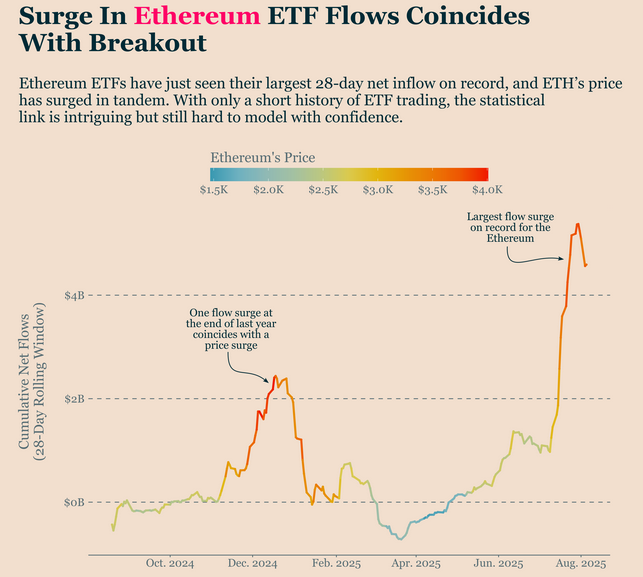
【Ethereum Spot ETF Net Flows Since December 2025】
<A line chart showing cumulative inflows/outflows of ETH spot ETFs, highlighting the inflection point in early January 2026.>
3. Institutional Context: Why Ethereum, Why Now
Several macro-level factors help explain the renewed interest in Ethereum ETFs:
First, Ethereum’s evolving monetary profile — including fee burns and staking dynamics — has made ETH increasingly attractive as a yield-bearing digital asset when combined with institutional custody and ETF wrappers.
Second, real-world asset tokenization has moved from pilot projects to early production phases. Large banks and asset managers are experimenting with tokenized bonds, funds, and settlement layers built primarily on Ethereum or Ethereum-compatible rollups.
Third, regulatory clarity in major jurisdictions has improved. While uncertainty remains, the approval and sustained operation of Ethereum spot ETFs themselves act as a regulatory signal that ETH is being treated as a commodity-like digital asset rather than a security.
4. Bitcoin ETFs Show Outflows — But Not a Bearish Signal
On the same day Ethereum ETFs recorded inflows, Bitcoin spot ETFs saw $243.24 million in net outflows. However, this should not be interpreted as a broad risk-off move.
Just one day earlier, Bitcoin ETFs recorded $697 million in net inflows, the largest daily inflow since October 2025. This pattern strongly suggests short-term rotation and profit-taking, rather than a collapse in institutional demand.
For diversified institutional portfolios, Ethereum currently offers a higher beta exposure to on-chain economic activity, while Bitcoin remains the primary macro hedge. The recent flow data implies rebalancing between these roles.
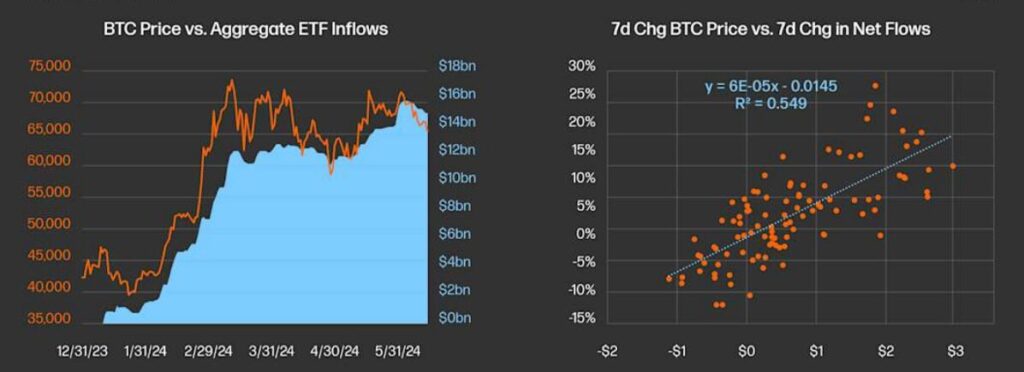
【Bitcoin vs. Ethereum ETF Daily Net Flows】
<A comparative bar chart showing daily net inflows and outflows for BTC and ETH spot ETFs.>
5. Ethereum ETFs as a Share of Market Capitalization
Ethereum spot ETFs now collectively hold $20.06 billion in net assets, equivalent to 5.13% of Ethereum’s total market capitalization.
This ratio is significant for two reasons:
- It demonstrates that ETFs are becoming a material holder class within the Ethereum ecosystem.
- It introduces a structural demand base that is less sensitive to short-term volatility than retail speculation.
Historically, when an asset’s ETF ownership surpasses the 5% threshold, liquidity dynamics begin to change — often reducing downside volatility while amplifying long-term trend persistence.
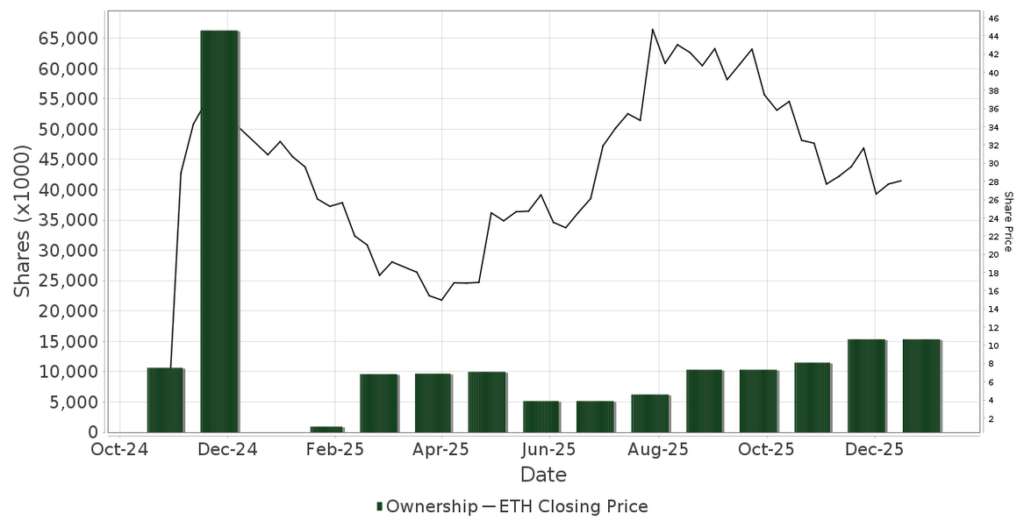
【Ethereum ETF Assets as a Percentage of ETH Market Cap】
<A pie or stacked chart illustrating ETF-held ETH versus circulating supply.>
6. Implications for Builders, Investors, and Operators
For investors, the data suggests Ethereum is entering a new phase where price appreciation may increasingly reflect fundamental network usage rather than pure narrative cycles.
For builders and startups, rising institutional exposure strengthens Ethereum’s position as the default settlement and execution layer for regulated on-chain finance.
For exchanges, VASPs, and payment operators, Ethereum ETF growth increases the importance of:
- ETH liquidity management
- Staking-related services
- Institutional-grade custody and reporting
- Cross-chain and L2 infrastructure
In short, Ethereum is no longer just “the second-largest crypto asset.” It is becoming institutional financial infrastructure.
7. Conclusion: A Structural Shift, Not a Short-Term Rally
The recent inflows into Ethereum spot ETFs should not be viewed as a temporary rebound. Instead, they reflect a structural re-allocation of institutional capital toward programmable, yield-aware, and regulation-compatible blockchain assets.
As ETFs continue to absorb ETH supply and anchor long-term holders, Ethereum’s role in the global financial system is likely to deepen — not just as an investment, but as a settlement layer for the next generation of digital finance.
