

Main Points :
- The Ethereum Foundation (EF) has begun staking ETH, starting with 2,016 ETH and planning to stake approximately 70,000 ETH in total.
- All staking rewards will be returned to the treasury and used for protocol R&D, ecosystem development, and grants.
- EF validators are running on open-source infrastructure (Dirk and Vouch) designed to maximize client diversity and avoid single points of failure.
- The move comes amid ongoing concerns about staking centralization, particularly the dominance of Lido and Coinbase.
- Institutional staking is becoming more competitive, with growing emphasis on decentralization, resilience, and performance.
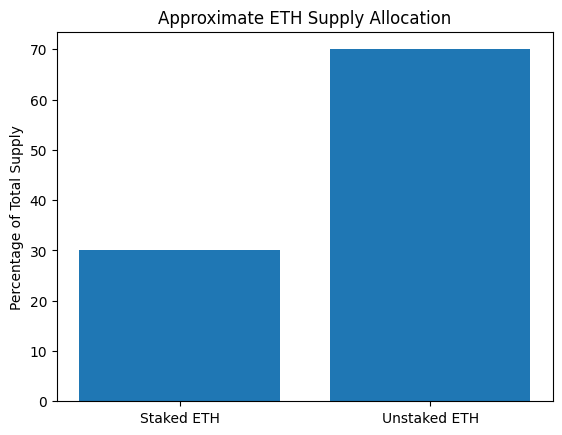
- Approximately 30% of ETH’s total supply is currently staked, making validator concentration and client diversity critical systemic issues.
1. The Ethereum Foundation Enters Direct Staking Participation
The Ethereum Foundation (EF), one of the most influential organizations within the Ethereum ecosystem, has officially begun staking its ETH holdings. According to its announcement on X (formerly Twitter), the foundation initially deposited 2,016 ETH and ultimately plans to stake around 70,000 ETH. At current market levels (for example, assuming ETH at approximately $3,000 per ETH for illustration), 70,000 ETH would represent roughly $210 million in staked assets.
This move transforms the foundation from a primarily strategic and research-focused body into a direct economic participant in Ethereum’s consensus mechanism. While EF has historically influenced the protocol through research funding and core development, staking its own treasury ETH aligns its financial incentives directly with validator performance and network security.
All staking rewards will be returned to the EF treasury. These funds will support protocol research and development, ecosystem growth initiatives, and grant programs. In effect, staking provides a sustainable, yield-generating mechanism to fund Ethereum’s long-term innovation.
For readers seeking practical blockchain opportunities, this highlights an important shift: protocol treasuries are increasingly becoming yield-generating entities rather than passive capital reserves. This may influence how future Layer-1 and Layer-2 projects manage treasury strategies.
2. Dirk and Vouch: A Model for Institutional-Grade, Decentralized Infrastructure
The Ethereum Foundation emphasized that its validators operate using open-source infrastructure known as Dirk and Vouch. These tools were originally developed by Attestant and are now part of Bitwise’s institutional staking stack.
- Dirk functions as a distributed signer.
- Vouch operates as a validator client.
The architectural design ensures that private keys and operational responsibilities are not concentrated on a single machine or cloud provider. Instead, they are distributed across multiple operators and jurisdictions. This approach reduces the risk of single points of failure (SPOF).
From an institutional standpoint, this is critical. A validator infrastructure overly dependent on one cloud provider—such as AWS or Google Cloud—introduces systemic risks. Past analyses have shown that a significant portion of Ethereum validators run on a limited set of centralized infrastructure providers. The EF’s configuration directly addresses that risk.
For blockchain builders and treasury managers, the lesson is clear: staking infrastructure must be architected with operational and jurisdictional redundancy, not merely yield optimization.
3. Client Diversity and the Minority Client Strategy
One of the most significant aspects of EF’s staking configuration is its deliberate use of minority clients. Ethereum’s consensus layer relies on multiple client implementations (such as Prysm, Lighthouse, Teku, Nimbus, etc.). However, historically, certain clients have dominated validator market share.
When one client becomes too dominant, the network faces systemic risk. A bug in a majority client could cause widespread slashing events or network instability. Ethereum’s culture strongly emphasizes client diversity as a core value.
By deploying minority clients in its validator stack, the EF is signaling that large institutions should not simply default to dominant implementations for convenience. Instead, they should consciously distribute client usage to maintain network health.
This decision is particularly relevant as institutional staking expands. Exchange-traded products (ETPs), custodians, and liquid staking protocols often prioritize operational simplicity. The EF is demonstrating that institutional-grade infrastructure can also align with decentralization principles.
For investors seeking sustainable blockchain opportunities, client diversity is not a theoretical concern—it is a foundational security parameter.
4. The Current State of ETH Staking Concentration
Approximately 30% of Ethereum’s total supply is currently staked. This is a massive proportion for a network securing hundreds of billions of dollars in value.
However, staking participation is not evenly distributed.
Major players include:
- Lido (a liquid staking protocol)
- Coinbase (a centralized exchange and custodian)
- Other institutional staking providers
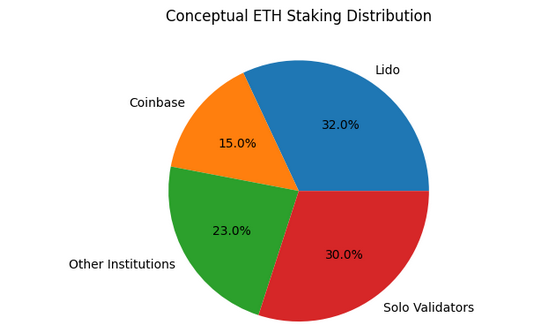
These entities collectively control a substantial share of validators and effective voting power in consensus decisions.
Below is a conceptual visualization of ETH staking distribution.
[Insert Graph 1 Here: Pie Chart of ETH Staking Distribution – Lido, Coinbase, Other Institutions, Solo Validators]
This concentration raises several questions:
- Can Ethereum maintain credible neutrality?
- What happens if regulatory pressure targets centralized operators?
- How resilient is the network if a dominant staking provider experiences failure?
The EF’s entry into staking does not directly decentralize the validator set in a numerical sense. However, by modeling best practices—minority client usage, distributed infrastructure—it influences how institutional capital may be deployed.
5. Security Mechanisms and Protocol-Level Safeguards
Chris Berry, Head of Ethereum Onchain Engineering at Bitwise Onchain Solutions, emphasized that Ethereum prioritizes decentralization and security at the protocol level.
Even if a large volume of stake exits or fails to perform validator duties, the network includes mechanisms to preserve security:
- Slashing penalties for malicious behavior
- Inactivity leak mechanisms
- Gradual exit queues
- Distributed validator requirements
Ethereum’s design assumes that large-scale validator disruptions are possible. Its resilience lies in economic incentives and distributed validator participation.
For institutional allocators evaluating staking yield, this matters. Yield is not merely a percentage return—it is compensation for participating in network security under defined risk parameters.
6. Institutional Staking: A Competitive Landscape
Institutional staking has become highly competitive. Asset allocators increasingly examine:
- Client diversity
- Infrastructure resilience
- Validator uptime and performance
- Regulatory compliance posture
- Non-custodial key management frameworks
Staking yield differentials between providers are often marginal. Therefore, qualitative infrastructure factors are becoming differentiators.
The Ethereum Foundation’s configuration may influence how future Ethereum ETFs or institutional staking mandates are structured. For example, capital allocators may require multi-client support or distributed key signing as baseline standards.
For blockchain entrepreneurs, this signals opportunity:
- Infrastructure-as-a-Service for minority clients
- Distributed validator technology
- Cross-jurisdiction staking compliance frameworks
- Institutional-grade non-custodial staking platforms
7. Yield, Treasury Strategy, and Practical Opportunities
Assuming an average staking yield of 3%–5% annually, staking 70,000 ETH could generate roughly:
- 70,000 ETH × 4% = 2,800 ETH per year
- At $3,000 per ETH = approximately $8.4 million annually
These rewards would flow directly back into protocol development and grants.

This represents a sustainable treasury model. Instead of selling ETH to fund operations (which can create market pressure), staking generates native yield.
Projects building today should consider:
- Treasury staking frameworks
- Transparent validator disclosures
- Minority client adoption strategies
- Distributed signer implementation
For investors, staking economics remain one of the most direct blockchain-native yield mechanisms—distinct from speculative token appreciation.
8. Strategic Implications for the Ethereum Ecosystem
The Ethereum Foundation’s decision has both symbolic and structural implications:
- Symbolically, it aligns EF’s treasury directly with network performance.
- Structurally, it demonstrates how institutions can stake responsibly without exacerbating centralization risks.
- Strategically, it reinforces client diversity as a non-negotiable ecosystem value.
As Ethereum scales—through rollups, Layer-2 adoption, and institutional products—validator decentralization will remain a critical trust anchor.
In a future where staking derivatives, restaking protocols, and institutional custodians grow further, infrastructure discipline becomes paramount.
Conclusion
The Ethereum Foundation’s move into direct ETH staking marks a meaningful evolution in Ethereum’s governance and economic alignment. By staking approximately 70,000 ETH and utilizing distributed, minority-client infrastructure, the EF is not merely seeking yield—it is modeling responsible institutional participation.
At a time when roughly 30% of ETH supply is staked and large providers like Lido and Coinbase command significant validator share, concerns about centralization remain valid. However, Ethereum’s protocol-level safeguards and cultural emphasis on client diversity continue to anchor its decentralization ethos.
For readers searching for new crypto assets, yield strategies, or practical blockchain opportunities, the key takeaways are clear:
- Staking infrastructure quality matters as much as yield.
- Client diversity is a security investment, not an optional feature.
- Institutional staking is entering a maturity phase where resilience and compliance are competitive advantages.
- Treasury staking models may define sustainable funding strategies for next-generation protocols.
Ethereum’s evolution is no longer just technical—it is institutional, infrastructural, and economic. Those who understand these layers will be better positioned to capture the next wave of blockchain-based value creation.
