
Main Points :
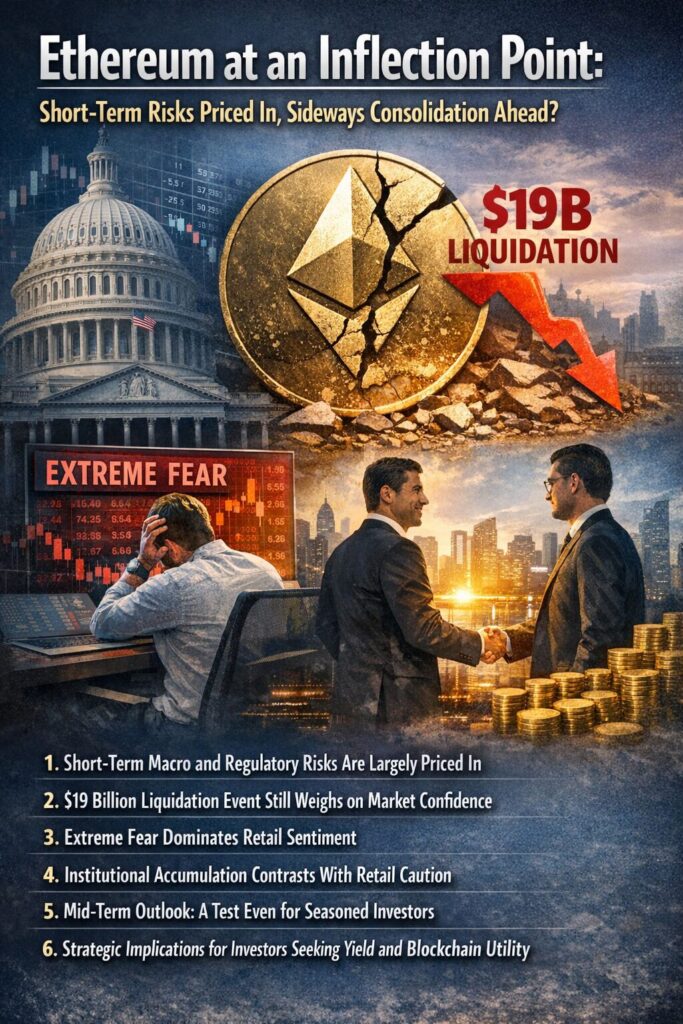
1. Short-Term Macro and Regulatory Risks Are Largely Priced In
2. $19 Billion Liquidation Event Still Weighs on Market Confidence
3. Extreme Fear Dominates Retail Sentiment
4. Institutional Accumulation Contrasts With Retail Caution
5. Mid-Term Outlook: A Test Even for Seasoned Investors
6. Strategic Implications for Investors Seeking Yield and Blockchain Utility
1. Short-Term Macro and Regulatory Risks Are Largely Priced In
According to leading cryptocurrency analysts, Ethereum (ETH) appears to have already absorbed much of the short-term macroeconomic and regulatory uncertainty currently surrounding global markets. Pav Hundal, Chief Analyst at Swyftx, recently noted that many of the immediate risks—ranging from geopolitical tensions involving Iran to developments surrounding the proposed U.S. CLARITY Act—are already reflected in Ethereum’s price.
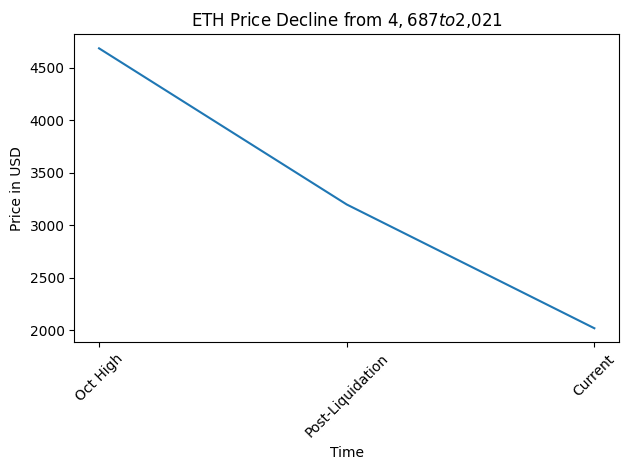
This assessment suggests that the market has transitioned from reactive volatility to a consolidation phase. In practical terms, this means ETH may trade within a relatively narrow range over the coming weeks, as traders wait for a new catalyst. At the time of writing, Ethereum is trading around $2,021, representing a substantial decline from its October high of approximately $4,687.
The pricing-in of macro risk is a critical dynamic. In prior cycles, Ethereum often reacted sharply to geopolitical events or regulatory headlines. However, the muted reaction this time implies a market that has matured—or one that is exhausted. For investors seeking new crypto assets or revenue streams, this consolidation phase may offer accumulation opportunities, but patience will likely be required.
2. The $19 Billion Liquidation Event: Structural Shock to the Ecosystem
One of the most significant overhangs on Ethereum remains the massive $19 billion liquidation cascade that occurred in October. This event wiped out leveraged positions across decentralized finance (DeFi) platforms and centralized exchanges, removing substantial liquidity from the ecosystem.
[ETH Price Decline from $4,687 to $2,021]
The liquidation chain reaction was not merely a price event—it was a structural reset. Leveraged long positions were forcibly unwound, automated liquidations triggered further sell pressure, and liquidity pools temporarily destabilized. Such events tend to have lingering psychological effects, even after price stabilization.
From a blockchain application perspective, liquidation cascades also expose weaknesses in risk management systems across DeFi protocols. For builders and operators, this represents both a cautionary tale and an opportunity: improved liquidation algorithms, better collateral models, and dynamic margin systems could become new product verticals.
3. Consumer Sentiment: The Overlooked Variable
Hundal emphasized that while traders focus on liquidity flows, they often ignore the most important factor—consumer sentiment.
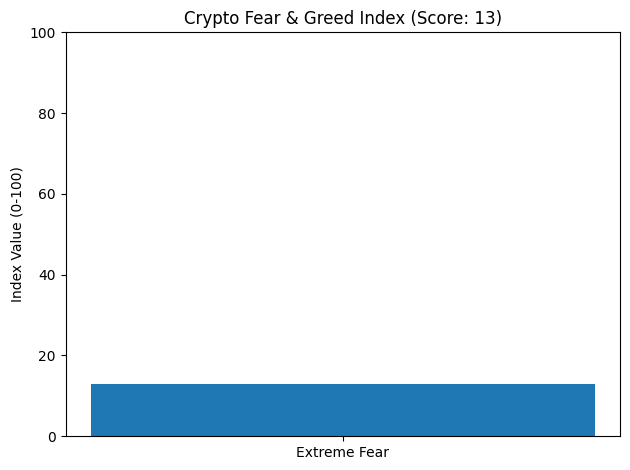
The Crypto Fear & Greed Index recently registered a score of 13, indicating “Extreme Fear.” This level of pessimism reflects widespread retail caution. Since retail participation historically drives explosive altcoin rallies, subdued sentiment implies limited short-term upside.
[Fear & Greed Index at 13 (Extreme Fear)]
Sentiment cycles tend to lag price recovery. Even if macro conditions stabilize, retail investors often wait for confirmation before re-entering the market. This creates a paradox: institutions may accumulate quietly while retail investors hesitate.
For investors seeking yield strategies, this period of fear can be advantageous. Staking ETH, providing liquidity to well-managed protocols, or exploring ETH-based structured products may offer income generation while price action remains sideways.
4. Institutional Accumulation: A Contrarian Signal
While retail investors remain cautious, institutional players are moving in the opposite direction.
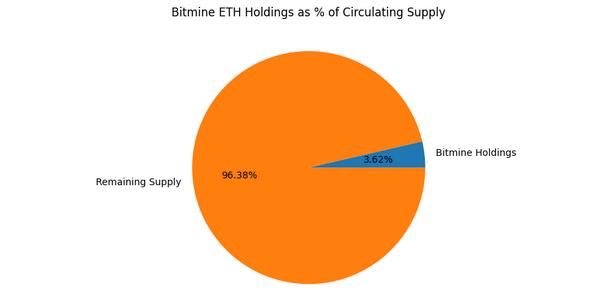
Bitmine Immersion Technologies, currently the largest Ethereum treasury company, recently acquired 45,759 ETH. Its total holdings now stand at 437,497 ETH—approximately 3.62% of the circulating supply of 120.7 million ETH.
[Bitmine ETH Holdings as % of Circulating Supply]
Such concentrated accumulation is noteworthy. Institutions typically accumulate during consolidation phases, anticipating future catalysts. Potential drivers include:
- Increased adoption of Ethereum Layer 2 scaling solutions
- Growth in tokenized real-world assets (RWA)
- Expansion of stablecoin infrastructure
- Institutional DeFi participation
Ethereum’s ecosystem remains the dominant platform for decentralized applications (dApps), token issuance, and smart contract innovation. For readers interested in practical blockchain usage, Ethereum continues to serve as the foundational settlement layer for Web3 development.
5. Mid-Term Outlook: A Trial for Experienced Investors
Ethereum has fallen approximately 56.8% from its October peak. Such drawdowns are not uncommon in crypto markets, but they test even seasoned investors.
Hundal suggests that the coming months may challenge even the most experienced market participants. However, a key metric to watch is Ethereum’s performance relative to Bitcoin. Historically, when ETH begins to outperform BTC, it signals the beginning of broader altcoin expansion.
Should ETH demonstrate sustained relative strength, market dynamics could shift rapidly. Capital rotation into smart contract platforms and application-layer tokens could follow.
6. Broader Market Context: Macro, Regulation, and Liquidity
Beyond the specific factors mentioned, several macro trends shape Ethereum’s trajectory:
- U.S. monetary policy and interest rate expectations
- Regulatory clarity under frameworks like the CLARITY Act
- Growth of spot crypto ETFs
- Tokenization of traditional financial instruments
The tokenization narrative is particularly relevant. Ethereum remains the primary infrastructure for issuing tokenized bonds, real estate shares, and on-chain treasuries. If traditional finance accelerates blockchain adoption, Ethereum stands to benefit structurally.
7. Strategic Implications for Investors and Builders
For readers seeking new crypto assets or practical blockchain revenue opportunities, this consolidation phase offers several strategic pathways:
- Accumulation During Consolidation
- Yield Generation via Staking
- Investment in Layer 2 Ecosystems
- Infrastructure and Risk-Management Solutions
Sideways markets often build the foundation for the next expansion cycle. While volatility may be subdued in the short term, infrastructure development typically accelerates during quieter phases.
Conclusion: Calm Before Expansion?
Ethereum appears to have priced in immediate macro and geopolitical risks. The $19 billion liquidation event has reset leverage and shaken confidence, while retail sentiment remains in extreme fear territory. Yet institutional accumulation suggests that experienced capital views current levels as strategic entry points.
In the short term, ETH may continue trading sideways around the $2,000 range. In the medium term, relative strength versus Bitcoin could serve as the trigger for renewed momentum. For investors focused on yield, infrastructure, and long-term blockchain utility, this period may represent less of a stagnation and more of a recalibration.
If history is any guide, extended consolidation often precedes explosive movement. Whether that movement materializes upward will depend on liquidity flows, regulatory clarity, and renewed retail confidence. For now, Ethereum stands at a critical inflection point—calm, cautious, and potentially coiled for its next phase of growth.
