
Key Takeaways :
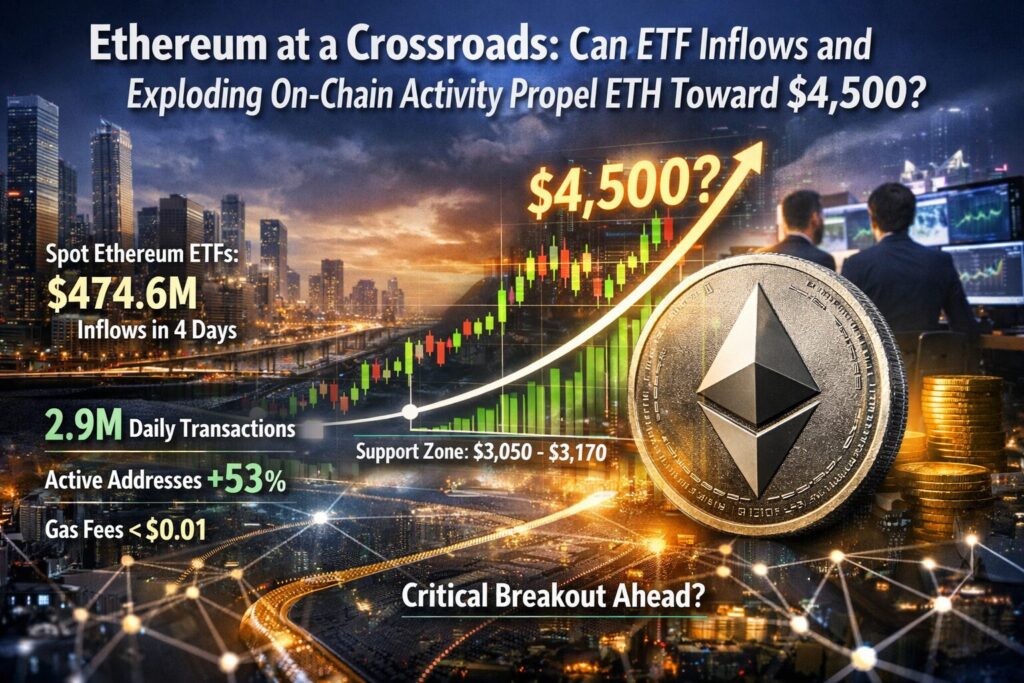
- Ethereum (ETH) is trading around $3,300, up roughly 11% year-to-date, supported by renewed institutional interest and historic on-chain activity.
- Spot Ethereum ETFs in the United States recorded approximately $474.6 million in net inflows over four consecutive days, signaling a notable return of institutional demand.
- On-chain metrics show strength: active addresses surged 53% month-on-month, and daily transactions hit a new all-time high near 2.9 million, while gas fees remained below $0.01.
- Technical analysts point to a critical $3,050–$3,170 demand zone as the foundation for a potential breakout toward $4,500, with extended targets discussed near $5,500 if momentum accelerates.
- For investors and builders seeking new revenue streams and practical blockchain use cases, Ethereum’s current phase highlights a rare convergence of capital inflows, real usage, and scalability improvements.
Introduction: Why Ethereum’s Current Moment Matters
Ethereum has entered 2026 with renewed attention from both markets and builders. Trading near $3,300, ETH has recovered meaningfully from prior volatility, yet remains well below its historical peak. What distinguishes the current rally from previous speculative cycles is the quality of demand underpinning price action. Rather than being driven solely by retail enthusiasm, Ethereum is now benefiting from institutional capital via ETFs and measurable growth in network usage.
This article synthesizes the referenced market analysis with broader industry trends, examining whether Ethereum can realistically target $4,500 in the coming weeks. We explore ETF inflows, institutional behavior, on-chain data, technical structures, and the broader implications for investors and practitioners seeking sustainable crypto-based revenue models.
Institutional Capital Returns: Ethereum ETFs Take Center Stage
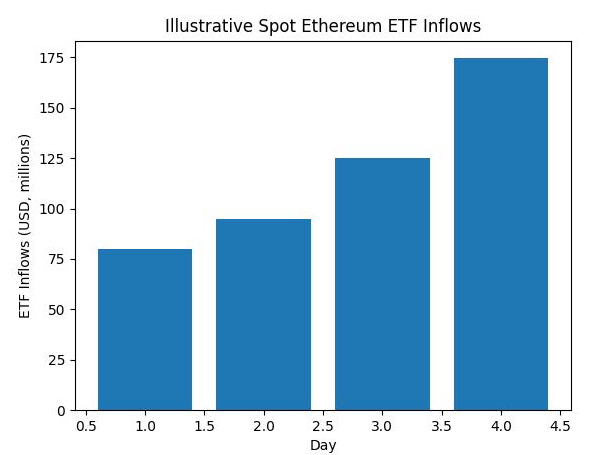
One of the most significant catalysts behind Ethereum’s recent strength is the performance of U.S.-listed spot Ethereum ETFs. According to market data, these products recorded four consecutive days of net inflows totaling approximately $474.6 million. A single-day inflow of $175.1 million marked the strongest daily performance since December 2025 and the largest inflow day so far in 2026.
This trend matters for two reasons. First, ETFs lower the operational and custody barriers for institutions that are restricted from holding native crypto assets directly. Second, ETF flows tend to be stickier than short-term speculative trades, reflecting portfolio allocation decisions rather than momentum chasing.
Complementary data from institutional tracking sources indicates that daily net purchases by institutions (including digital asset treasuries and ETFs) rose to approximately 6,964 ETH per day. While some Ethereum-holding companies have reduced trading activity on a weekly or monthly basis, aggressive accumulators—such as firms associated with well-known macro investors—continue to add ETH strategically.
However, analysts caution that short bursts of inflows are not sufficient on their own. A sustained recovery toward higher price levels requires consistent institutional demand, particularly during periods of market consolidation.
On-Chain Activity Surges: Usage, Not Just Speculation
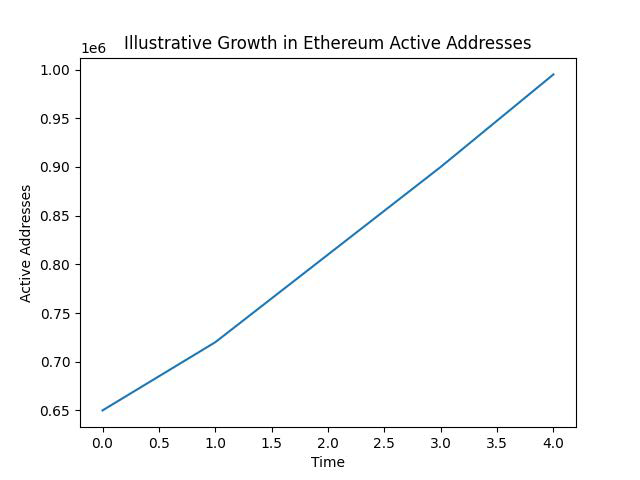
Beyond capital flows, Ethereum’s network fundamentals are sending a strong signal. On-chain analytics reveal that active addresses increased by 53% over the past 30 days, reaching nearly 1.0 million daily active addresses, the highest level in approximately 28 months.
Historically, spikes in active addresses have preceded major price expansions, especially when accompanied by genuine usage rather than congestion-driven spikes. Notably, Ethereum previously recorded higher address counts only during extraordinary periods, such as late 2022, when daily active addresses approached 1.4 million.
Transaction activity tells a similar story. Daily transaction counts reached a new all-time high of roughly 2.9 million, surpassing previous records. What makes this milestone particularly important is cost efficiency: average gas fees fell below $0.01, underscoring the impact of scalability improvements and Layer 2 adoption.
Market commentators have emphasized that this combination—record transaction volume with negligible fees—represents “real scaling,” not merely theoretical throughput. For developers and businesses, this environment significantly lowers the cost of deploying decentralized applications, payments, and settlement systems on Ethereum.
DeFi, DEX Volume, and the Fee Paradox
Decentralized finance remains a core driver of Ethereum’s transactional growth. Data from DeFi analytics platforms shows robust decentralized exchange (DEX) activity alongside relatively modest fee generation. While lower fees might seem negative from a miner or validator revenue perspective, they actually enhance Ethereum’s competitiveness against alternative Layer 1 chains.
Lower fees encourage experimentation, micro-transactions, and high-frequency use cases such as on-chain trading, gaming, and real-time settlement. For enterprises evaluating blockchain infrastructure, Ethereum’s current cost profile strengthens its position as a general-purpose financial settlement layer, rather than a niche speculative network.
Technical Structure: The Road Toward $4,500
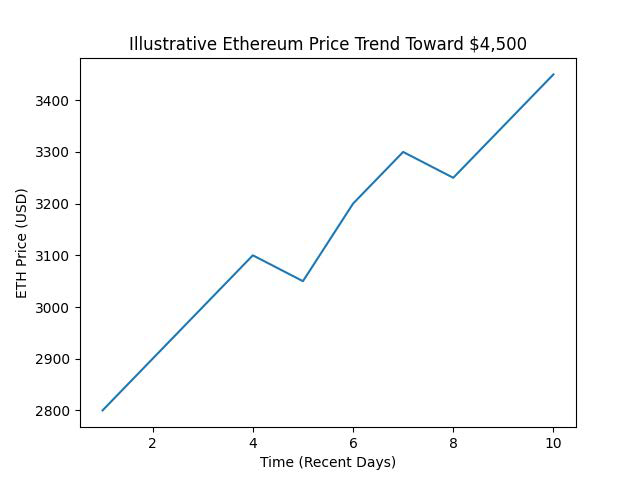
From a market structure perspective, ETH has gained approximately 7.3% over the past seven days, consolidating near $3,300. Technical analysts widely agree that the $3,050–$3,170 range represents a critical demand zone. This area coincides with the 50-week exponential moving average, often viewed as a long-term trend indicator.
As long as Ethereum maintains weekly closes above this zone, the broader bullish structure remains intact. Some analysts note that ETH has already broken out of a symmetrical triangle pattern, a formation typically associated with continuation moves. Based on daily chart projections, the measured move from this pattern points toward $4,500.
More aggressive projections use Fibonacci retracement and extension models, suggesting that if momentum accelerates and macro conditions remain supportive, ETH could potentially test $5,500. While such targets are speculative, they highlight the asymmetric upside perceived by market participants.
Macro and Industry Context: Why This Cycle Is Different
Ethereum’s current setup cannot be evaluated in isolation. Several macro and industry-level dynamics reinforce its bullish case:
- Regulatory clarity around ETFs has legitimized Ethereum exposure for institutions previously sidelined by compliance constraints.
- Layer 2 rollups and protocol upgrades have transformed Ethereum’s cost and throughput profile, directly addressing past criticisms.
- Enterprise and financial experimentation, including tokenized assets, stablecoin settlement, and on-chain treasury management, increasingly relies on Ethereum-compatible infrastructure.
For investors seeking new digital assets or revenue opportunities, this convergence suggests that Ethereum is transitioning from a high-beta speculative asset toward a core digital infrastructure play.
Implications for Investors and Builders
For capital allocators, Ethereum’s ETF-driven demand provides a transparent signal of institutional confidence. For builders and operators, the surge in low-cost transactions opens practical avenues for monetization: payment rails, DeFi protocols, asset tokenization, and cross-border settlement systems.
Crucially, Ethereum’s ecosystem maturity means that revenue models are no longer theoretical. They are observable on-chain, supported by real usage, and increasingly integrated with traditional finance.
Conclusion: Can Ethereum Reach $4,500?
Ethereum’s path toward $4,500 is not guaranteed, but the current evidence is compelling. Strong ETF inflows, record-breaking on-chain activity, and constructive technical structures together form one of the most robust bullish setups Ethereum has seen in recent years.
If institutional demand remains consistent and network usage continues to grow without a corresponding rise in fees, Ethereum may not only test higher price levels but also solidify its role as the backbone of programmable finance. For readers seeking the next revenue opportunity or practical blockchain application, Ethereum’s present phase deserves close attention.
