
Main Points :
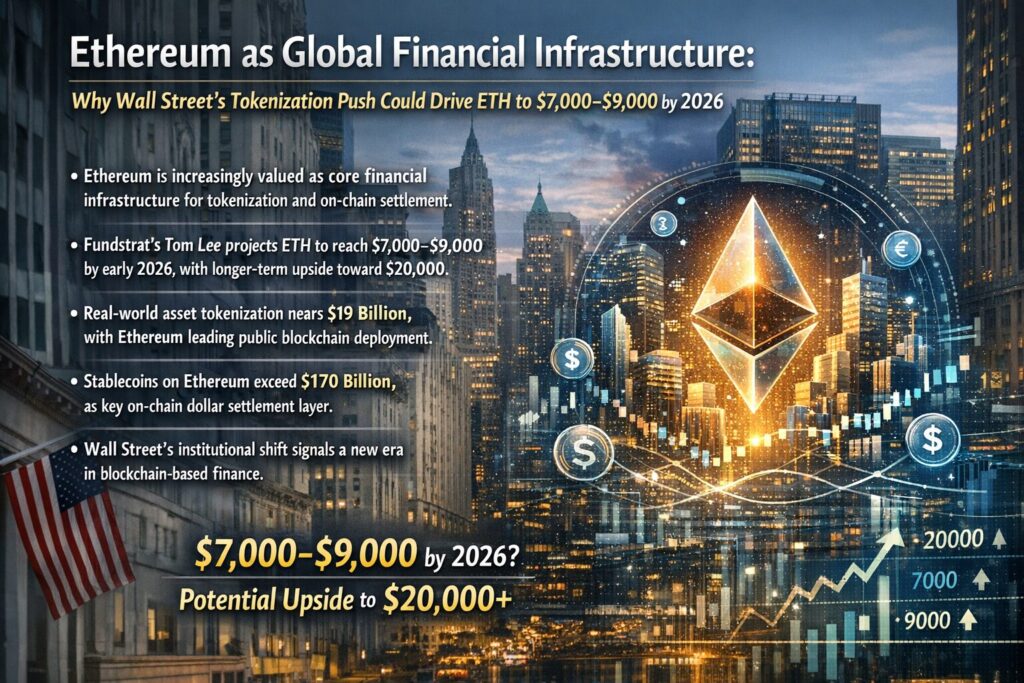
- Ethereum is increasingly valued not as a speculative crypto asset, but as core financial infrastructure for tokenization and on-chain settlement.
- Fundstrat’s Tom Lee projects ETH could reach $7,000–$9,000 by early 2026, with a longer-term upside toward $20,000 if adoption accelerates.
- Real-world asset (RWA) tokenization has surged to nearly $19 billion, with Ethereum dominating public blockchain deployment.
- Stablecoins issued on Ethereum exceed $170 billion, reinforcing its role as the primary on-chain dollar settlement layer.
- Institutional experiments by Wall Street firms signal a structural, not cyclical, shift toward blockchain-based finance.
1. Ethereum’s Shift From “Crypto Asset” to Financial Infrastructure
Ethereum is undergoing a profound transformation. What began as a decentralized platform for smart contracts is now increasingly recognized as foundational infrastructure for the next generation of global finance.
According to Tom Lee, co-founder and head of research at Fundstrat Global Advisors, Ethereum’s valuation is becoming inseparable from its real-world utility. Speaking on CNBC’s Power Lunch, Lee argued that as Wall Street accelerates tokenization and on-chain financial activity, Ethereum’s network effects could push ETH prices to $7,000–$9,000 by early 2026.
This view marks a significant departure from earlier crypto narratives driven primarily by retail speculation. Instead, Ethereum is now positioned as a neutral settlement and execution layer—a programmable base layer upon which traditional financial institutions can rebuild processes that have remained inefficient for decades.
2. Wall Street’s Tokenization Drive: Why Ethereum Matters
“Wall Street wants to tokenize everything,” Lee said, referencing initiatives by major financial platforms experimenting with tokenized securities, on-chain settlement, and blockchain-based clearing.
Tokenization—the representation of real-world assets such as bonds, equities, commodities, or funds on a blockchain—offers tangible efficiency gains:
- Near-instant settlement instead of T+2 or longer cycles
- Reduced counterparty and reconciliation risk
- Lower operational and custody costs
- Programmable compliance and automation
Ethereum has emerged as the default public blockchain for these experiments due to its security track record, developer ecosystem, and deep liquidity.
Firms like BlackRock have already launched tokenized fund products, while brokerage platforms such as Robinhood have openly discussed tokenized equity trading. These are not isolated pilots; they represent early stages of a structural migration of financial activity on-chain.
3. Ethereum Price Outlook: $7,000–$9,000 Is a Base Case
Lee’s projection of $7,000–$9,000 is grounded less in speculative cycles and more in Ethereum’s evolving role as infrastructure.
If Ethereum becomes:
- the dominant platform for tokenized securities,
- the primary settlement layer for stablecoins,
- and a critical rail for institutional finance,
then its valuation begins to resemble that of infrastructure monopolies, not high-beta tech assets.
Lee also suggested that under broader adoption scenarios, ETH could eventually approach $20,000, reflecting Ethereum’s position as a global financial backbone rather than merely a smart-contract network.
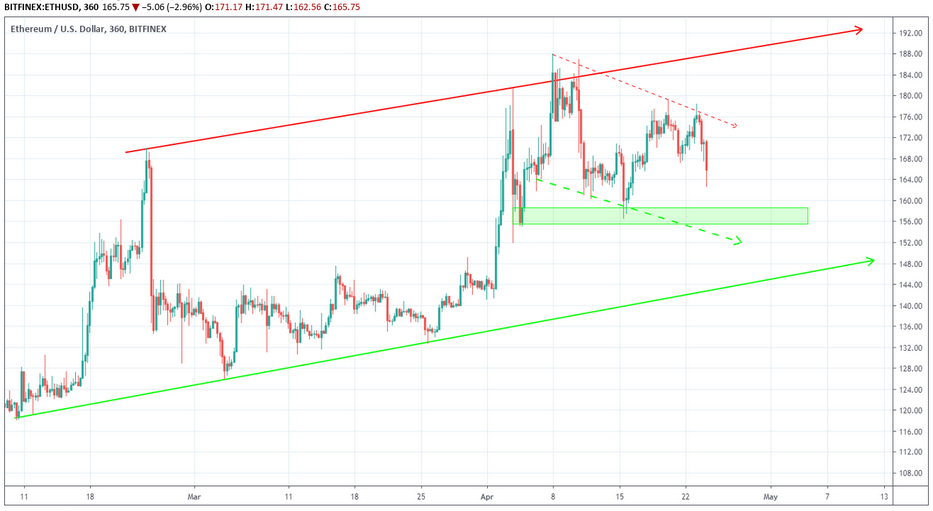
“Ethereum Price Scenarios Based on Infrastructure Adoption”
(Line chart showing conservative, base, and aggressive adoption scenarios through 2026)
4. Ethereum Treasury Companies and Institutional Alignment
Ethereum’s growing institutional relevance is also reflected in corporate treasury strategies.
Lee serves as chairman of BitMine Immersion Technologies, one of the largest Ethereum-focused treasury companies. According to CoinGecko data, the firm holds over 4 million ETH, underscoring confidence in Ethereum as a strategic reserve asset, not merely a trading position.
This mirrors a broader trend previously seen with Bitcoin, where corporate balance sheets validated long-term narratives. In Ethereum’s case, however, the narrative is not digital gold, but programmable finance.
5. Real-World Asset (RWA) Tokenization: Ethereum’s Stronghold
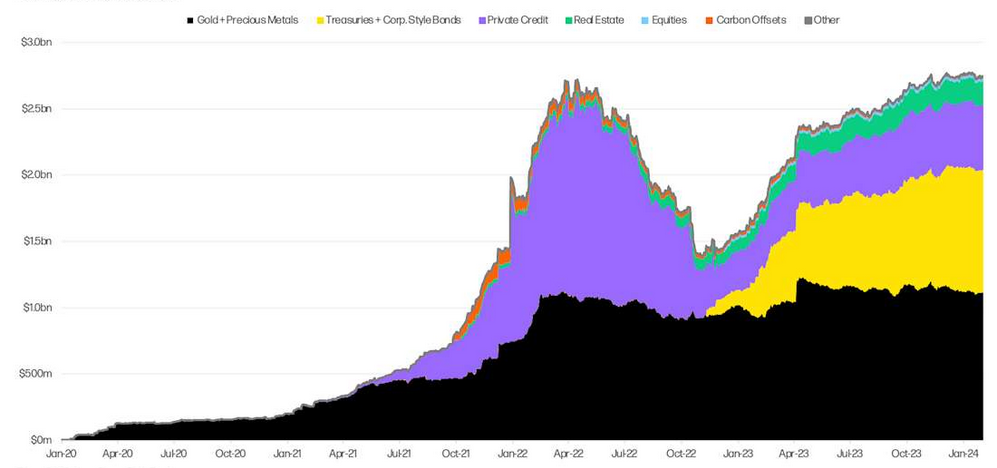
The real-world asset tokenization market has expanded rapidly in 2025. Market size grew from approximately $5.6 billion at the start of the year to nearly $18.9 billion, according to industry data.
Among tokenized assets:
- U.S. Treasuries dominate at roughly $8.5 billion
- Commodities follow at around $3.4 billion
- Other categories include private credit, real estate, and structured products
Ethereum hosts over $12 billion of tokenized assets—far exceeding other networks such as BNB Chain, Solana, or Arbitrum.
“Tokenized Asset Distribution by Blockchain Network”
6. Stablecoins: Ethereum as the Global Dollar Layer
Stablecoins are arguably the most successful real-world blockchain application to date—and Ethereum remains their primary home.
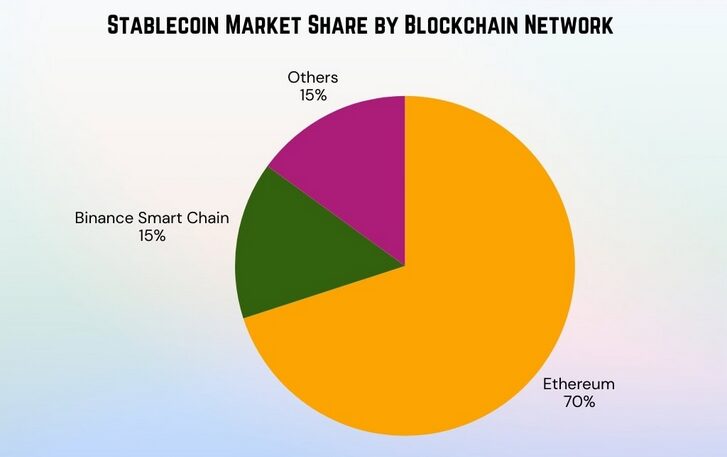
As of late 2025, stablecoins issued on Ethereum exceed $170 billion in total circulating supply. This cements Ethereum’s role as the dominant on-chain dollar settlement layer, facilitating:
- cross-border payments,
- on-chain trading,
- DeFi liquidity,
- and institutional cash management.
In practical terms, Ethereum increasingly functions as a programmable correspondent banking layer, operating 24/7 without intermediaries.
“Stablecoin Supply by Blockchain Network”
7. Institutional Validation: DTCC and On-Chain Settlement
Perhaps the clearest signal of institutional intent came when DTCC, the backbone of U.S. securities clearing and settlement, announced plans to tokenize portions of U.S. Treasury collateral through the Canton Network.
While these initiatives may not yet operate directly on Ethereum mainnet, they reinforce a critical point: blockchain-based settlement is no longer theoretical. Ethereum’s architecture, security model, and composability make it a natural reference model—even when private or hybrid networks are used.
8. Ethereum vs. Bitcoin: Complementary, Not Competitive
Lee also reiterated his bullish stance on Bitcoin, calling it a “true store of value” and suggesting that a move toward $200,000 is plausible under favorable macro conditions.
However, Ethereum occupies a fundamentally different role. While Bitcoin competes with gold, Ethereum competes with financial infrastructure itself.
In this sense, Ethereum’s opportunity set may be broader—but also more execution-dependent. Adoption, regulation, and institutional trust matter far more than narrative cycles.
9. Risks and Constraints: What Could Go Wrong?
Despite its momentum, Ethereum faces real challenges:
- Regulatory fragmentation across jurisdictions
- Scaling and user experience complexity
- Competition from purpose-built institutional chains
- Fee volatility during network congestion
Nevertheless, Ethereum’s continued dominance in RWA, stablecoins, and developer activity suggests that these risks are manageable rather than existential.
10. Conclusion: Ethereum’s Infrastructure Thesis
Ethereum’s long-term value proposition is no longer hypothetical. It is already being tested—and increasingly adopted—by the world’s largest financial institutions.
If Wall Street continues to move assets, settlement, and liquidity on-chain, Ethereum stands to benefit disproportionately as the neutral, programmable base layer of global finance.
Under this framework, price targets such as $7,000–$9,000 by 2026 appear less like bold speculation and more like reasonable outcomes of structural adoption.
