

Main Points :
- BitMine purchased roughly 60,976 ETH in one week, accelerating its Ethereum treasury strategy.
- The company’s total ETH holdings have reached 4,534,563 ETH, about 3.76% of total Ethereum supply.
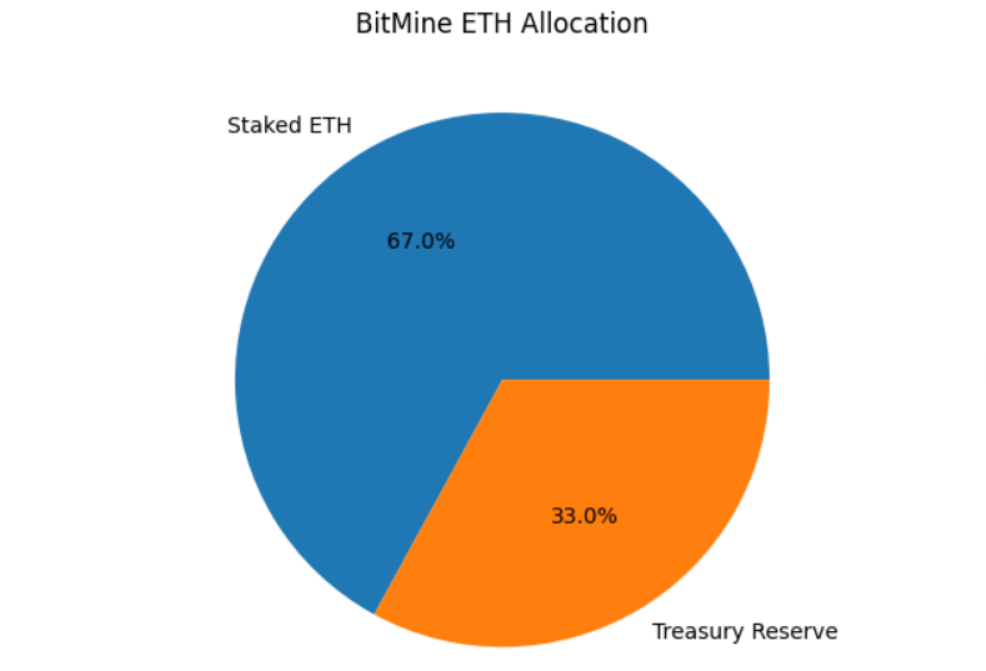
- Over 3.04 million ETH are staked, creating an ongoing yield stream despite market volatility.
- BitMine currently carries an unrealized loss estimated at about $8 billion due to price fluctuations.
- Chairman Tom Lee believes the market is entering the final phase of a “mini crypto winter”, viewing the current price environment as a buying opportunity.
1. BitMine’s Aggressive Ethereum Treasury Strategy
American crypto infrastructure company BitMine announced on March 9 that it had significantly expanded its Ethereum treasury reserves, bringing its total holdings to 4,534,563 ETH. This move followed the purchase of 60,976 ETH within a single week, signaling that the company is accelerating accumulation during the current market cycle.
At current exchange rates, this purchase represents hundreds of millions of dollars in additional investment into Ethereum. The company explicitly stated that it considers the current market environment a strategic accumulation phase, reinforcing its long-term conviction in Ethereum as a foundational blockchain asset.
This strategy mirrors the corporate Bitcoin treasury strategy pioneered by companies such as MicroStrategy, but BitMine is focusing on Ethereum instead of Bitcoin. That distinction is important because Ethereum’s economic structure allows holders not only to speculate on price appreciation but also to generate yield through staking.
From a supply perspective, BitMine’s holdings now represent approximately 3.76% of the entire circulating ETH supply, making it one of the largest institutional Ethereum holders in the world.
BitMine ETH Holdings Growth Over Time
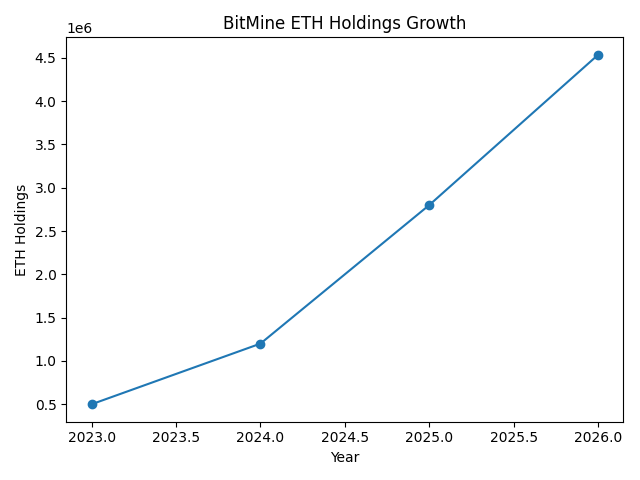
Description:Line graph showing ETH accumulation from early treasury adoption to 4.53M ETH.
2. A Massive Position Despite $8 Billion in Unrealized Losses
Despite its aggressive buying, BitMine currently holds an estimated unrealized loss of approximately $8 billion.
This loss results from the difference between the company’s average acquisition price and Ethereum’s current market value. Although the company did not publicly disclose the exact average purchase price, analysts estimate that a large portion of BitMine’s ETH was acquired during previous higher market phases.
However, BitMine’s leadership has shown little concern about short-term volatility. Chairman Tom Lee described the current market phase as the “final stage of a mini crypto winter.”
This concept refers to a temporary contraction cycle within a broader long-term crypto bull market, rather than a multi-year bear market like the one experienced between 2018 and 2020.
Lee argues that Ethereum’s fundamentals—including institutional adoption, staking yields, and network usage—remain strong, and therefore the current price level represents a long-term accumulation opportunity.
This approach resembles classic value-investing strategies in traditional finance, where investors accumulate assets during periods of market pessimism.
3. Staking as a Corporate Yield Engine
One of the most important aspects of BitMine’s strategy is its use of staking.
Out of the total 4.53 million ETH holdings, the company has allocated more than 3.04 million ETH to staking operations.
Staking allows Ethereum holders to participate in network validation and earn rewards for securing the blockchain. In return, validators receive ETH rewards that function similarly to interest income.
Typical institutional staking yields currently range between 3% and 5% annually, depending on validator performance and network conditions.
If we assume a conservative 4% staking yield, BitMine’s staking operation could generate:
3,040,000 ETH × 4% = 121,600 ETH per year
At an ETH price of $3,000, this represents roughly:
$364 million in annual staking revenue.
This mechanism transforms Ethereum from a purely speculative asset into something closer to a yield-generating digital infrastructure investment.
BitMine ETH Allocation
4. Institutional Ethereum Treasuries: A Growing Trend
BitMine’s strategy reflects a broader shift within the crypto industry: corporate crypto treasuries are expanding beyond Bitcoin.
For many years, Bitcoin dominated institutional adoption because of its reputation as “digital gold.”
However, Ethereum offers additional advantages:
- Staking income
- Smart contract infrastructure
- DeFi ecosystem exposure
- Tokenized asset settlement layers
As a result, some institutions are beginning to view Ethereum as a productive financial asset rather than a passive store of value.
Recent developments strengthening Ethereum’s institutional appeal include:
- Expansion of Ethereum ETFs
- Growth of tokenized real-world assets (RWAs)
- Rapid adoption of Layer-2 scaling networks
- Institutional custody infrastructure improvements
These developments have significantly increased the utility of Ethereum in financial infrastructure applications.
5. Supply Pressure and Market Implications
A company controlling 3.76% of Ethereum’s supply inevitably raises questions about market influence.
Large-scale accumulation can tighten market supply, particularly when assets are locked in staking contracts and therefore removed from liquid circulation.
This creates a dynamic similar to stock buybacks, where circulating supply decreases while demand remains constant or increases.
The Ethereum ecosystem already has substantial supply constraints:
- Over 27% of ETH supply is currently staked
- Millions of ETH are locked in DeFi protocols
- Long-term institutional holders rarely sell quickly
When a single company continues purchasing ETH weekly, it can contribute to structural supply tightening.
This dynamic may amplify future price movements if market demand increases.
6. Is the “Mini Crypto Winter” Ending?
Tom Lee’s description of the current market as a “mini crypto winter” reflects a broader debate within the crypto industry.
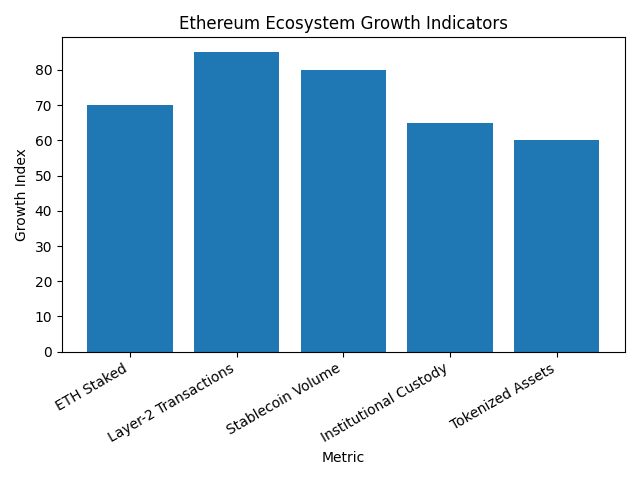
Several indicators suggest the market could be transitioning toward the next growth phase:
Institutional Adoption
Major financial institutions are increasingly integrating blockchain infrastructure into payment systems, custody solutions, and tokenized asset markets.
Stablecoin Growth
Stablecoin transaction volumes have surpassed many traditional payment networks, demonstrating the growing role of blockchain in global financial settlement.
Layer-2 Expansion
Ethereum’s scaling ecosystem—including rollups such as Optimism and Arbitrum—has significantly reduced transaction costs while increasing network throughput.
Real-World Asset Tokenization
Banks and asset managers are experimenting with tokenized bonds, treasury products, and real estate assets on Ethereum networks.
These trends suggest that Ethereum’s economic utility continues expanding even during price downturns.
Ethereum Ecosystem Growth Indicators
7. Risks of the Strategy
While BitMine’s strategy is bold, it is not without risk.
Holding such a large Ethereum position exposes the company to several potential challenges:
Market volatility – Crypto assets remain highly volatile, and prolonged price declines could deepen unrealized losses.
Liquidity constraints – Large positions can be difficult to liquidate quickly without affecting market prices.
Regulatory developments – Changes in crypto regulations could affect staking operations or institutional holdings.
Technological competition – Alternative blockchain platforms could challenge Ethereum’s dominance.
However, BitMine appears to be betting that Ethereum’s network effects and developer ecosystem will sustain its leadership.
Conclusion: A High-Conviction Bet on Ethereum’s Future
BitMine’s decision to accumulate over 4.5 million ETH represents one of the most aggressive institutional bets on Ethereum to date.
Even while carrying an estimated $8 billion unrealized loss, the company continues to purchase ETH weekly and stake the majority of its holdings to generate yield.
This strategy highlights a fundamental shift in how institutions view crypto assets:
- Bitcoin as digital gold
- Ethereum as productive financial infrastructure
If Ethereum’s ecosystem continues expanding through DeFi, tokenization, and Layer-2 scaling, large institutional treasuries like BitMine’s could become increasingly common.
Whether Tom Lee’s prediction proves correct—that the market is approaching the end of a mini crypto winter—remains to be seen.
But one thing is clear:
BitMine is positioning itself for the possibility that the next phase of the crypto economy will be built on Ethereum.
