
Main Points :
- The Depository Trust & Clearing Corporation (DTCC), the core post-trade infrastructure of U.S. capital markets, is preparing to tokenize U.S. Treasuries on a permissioned blockchain.
- The initiative begins with selected U.S. government securities and is designed to expand toward a broad range of real-world assets (RWAs).
- DTCC has received a rare three-year “no-action letter” from the U.S. Securities and Exchange Commission (SEC), significantly reducing regulatory uncertainty.
- The project uses the Canton Network, a regulated, permissioned blockchain designed for institutional finance.
- While this move does not immediately transform decentralized finance (DeFi), it lays essential groundwork for future on-chain capital markets.
- For investors and builders, tokenized Treasuries represent a new yield-bearing, low-risk digital asset class with long-term strategic implications.
1. DTCC: The Invisible Giant of Global Finance
To understand why DTCC’s announcement matters, one must first understand what DTCC is.
DTCC is not a fintech startup, a crypto exchange, or a blockchain laboratory. It is the central market infrastructure that clears, settles, and safeguards most U.S. securities transactions. Through its subsidiaries, including the Depository Trust Company (DTC), DTCC processed securities transactions worth approximately $37 quadrillion in 2023 alone.
Every trading day, trillions of dollars in equities, bonds, ETFs, and derivatives quietly pass through DTCC systems. When DTCC experiments, Wall Street pays attention—even if the experiment begins cautiously.
By announcing plans to tokenize U.S. Treasuries, DTCC is signaling that blockchain is no longer an “edge innovation.” It is being considered as a foundational upgrade to the plumbing of global finance.
2. Tokenizing U.S. Treasuries: What Exactly Is Being Built?
DTCC has confirmed that it is preparing to make certain U.S. Treasury securities held at DTC mintable on-chain. These tokenized Treasuries will be issued on the Canton Network, a permissioned blockchain developed by fintech firm Digital Asset.
This means:
- The underlying securities remain legally recognized U.S. government obligations.
- Ownership records are mirrored or represented by blockchain tokens.
- Transfers, settlement, and lifecycle events can be managed digitally and programmatically.
The initial scope is deliberately limited. DTCC has emphasized that the project will start with a subset of highly liquid assets, including:
- U.S. Treasury bills
- U.S. Treasury notes
- U.S. Treasury bonds
Later phases may include exchange-traded funds (ETFs), such as those tracking major indices like the Russell 1000, representing large-cap U.S. equities.
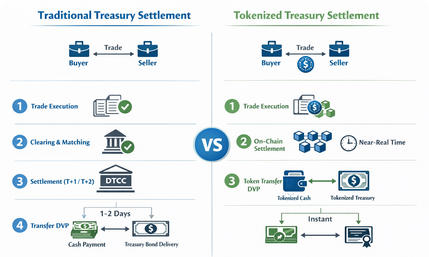
Title: Traditional Treasury Settlement vs. Tokenized Treasury Settlement
3. Why Canton Network? Permissioned Does Not Mean Regressive
The choice of the Canton Network has sparked debate among crypto purists. Canton is not a public blockchain like Ethereum or Solana. It is a permissioned blockchain designed specifically for regulated institutions.
However, this design choice is intentional and pragmatic.
Canton allows:
- Privacy-preserving transactions between regulated entities
- Compliance with KYC, AML, and securities laws
- Interoperability between institutions without exposing sensitive data publicly
From DTCC’s perspective, public DeFi infrastructure is not yet compatible with the operational, legal, and risk requirements of systemically important financial institutions.
Rather than rejecting decentralization outright, DTCC is sequencing innovation—starting with compliance-first infrastructure and expanding outward as regulation and technology mature.
4. The SEC No-Action Letter: A Quiet Regulatory Breakthrough
Perhaps the most significant development is regulatory rather than technical.
DTCC has received a three-year no-action letter from the U.S. Securities and Exchange Commission. This letter confirms that, as long as the tokenization service operates as described, the SEC will not take enforcement action against DTCC.
Such letters are rare, especially for infrastructure-level innovation involving securities.
The implications are profound:
- Regulatory uncertainty, the biggest barrier to tokenized securities, is temporarily reduced.
- Institutional participants can experiment without fear of immediate compliance backlash.
- The SEC is signaling conditional openness to on-chain capital markets.
SEC Chair Paul Atkins described DTCC’s initiative as “an important step toward on-chain capital markets,” adding that U.S. financial markets are preparing for an on-chain future.
5. Expanding Beyond Treasuries: The Long-Term Vision
DTCC has made clear that U.S. Treasuries are only the starting point.
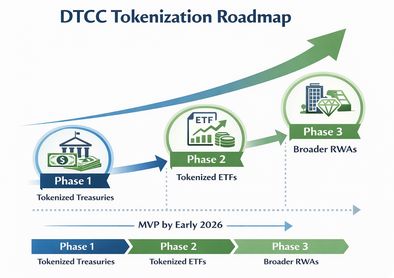
The roadmap envisions expansion to:
- Additional DTC-eligible securities
- ETFs and index-linked products
- Potentially other real-world assets with sufficient liquidity and regulatory clarity
The initial minimum viable product (MVP) is expected by early 2026, followed by gradual scaling based on customer demand.
This is not a speculative pivot. It is a multi-year infrastructure transformation, executed conservatively and incrementally.
Title: DTCC Tokenization Roadmap
6. Market Impact: Why This Is Bigger Than Crypto Prices
Some market commentators have downplayed the immediate impact on cryptocurrency markets. NYDIG’s global research head, Greg Cipolaro, noted that tokenized securities still rely heavily on traditional financial structures.
This assessment is accurate—but incomplete.
In the short term:
- Tokenized Treasuries do not replace stablecoins.
- They do not immediately flow into DeFi protocols.
- They do not create instant demand for public blockchain tokens.
In the long term, however, the implications are transformative.
Tokenized Treasuries could become:
- On-chain collateral for institutional lending
- Yield-bearing settlement assets
- Building blocks for programmable financial products
Once real-world assets are natively digital, integration becomes a matter of policy, not possibility.
7. A New Asset Class for Digital Finance
For investors seeking new income sources, tokenized U.S. Treasuries are especially compelling.
They offer:
- Low credit risk (U.S. government-backed)
- Transparent yield (currently among the highest in decades, in dollar terms)
- Programmability and composability
In a future where tokenized Treasuries can be used as collateral or settlement assets, they may serve as the risk-free rate of on-chain finance.
This positions them not as competitors to crypto assets, but as infrastructure that stabilizes and legitimizes digital markets.
8. Strategic Implications for Builders and Institutions
For blockchain developers, fintech firms, and financial institutions, DTCC’s move sends a clear message:
- Tokenization is no longer theoretical.
- Institutional standards will define early architectures.
- Compliance-aware design is a competitive advantage.
Projects aligned with real-world asset tokenization, institutional custody, and regulated settlement infrastructure are likely to benefit disproportionately from this shift.
Conclusion: A Quiet Revolution in Motion
DTCC’s tokenization of U.S. Treasuries will not generate overnight hype or speculative rallies. That is precisely why it matters.
This is a quiet revolution, driven by the institutions that already move tens of trillions of dollars every day. By starting with the safest and most liquid assets in the world, DTCC is laying the foundation for a future where capital markets operate on-chain by default.
For investors, builders, and policymakers, the message is clear:
the future of blockchain is not replacing finance—it is becoming finance.
