
Main Points :
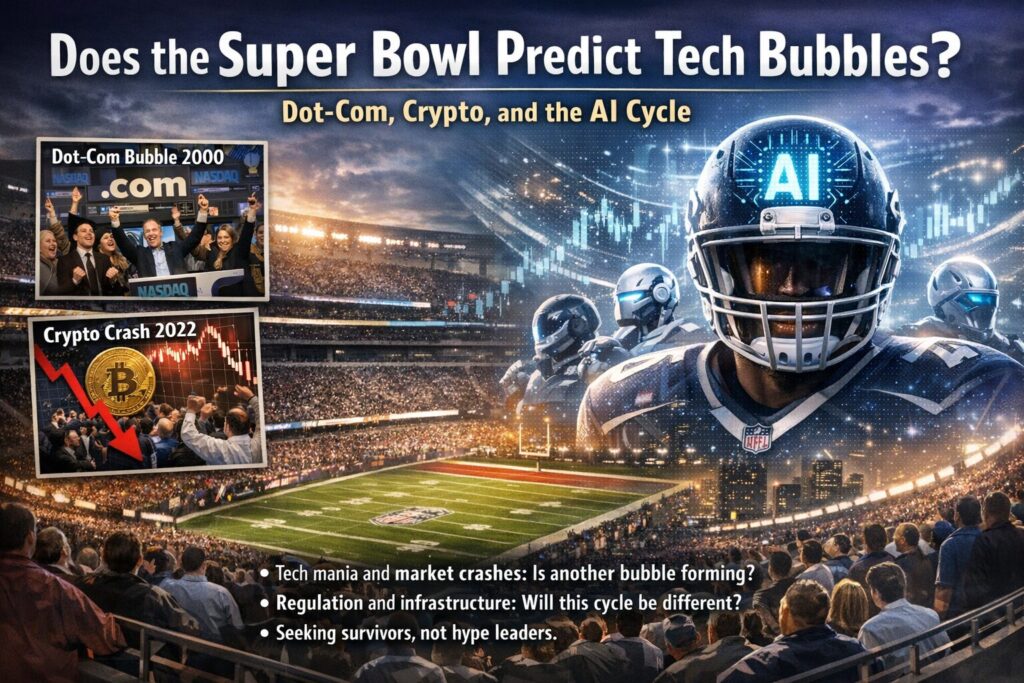
- Super Bowl advertising has historically coincided with late-stage technology hype cycles.
- The 2000 “Dot-Com Bowl” and the 2022 “Crypto Bowl” were followed by severe market corrections.
- AI dominated 2026 Super Bowl ads, raising questions about whether another speculative peak is forming.
- Unlike past cycles, regulatory progress and infrastructure maturity may alter outcomes.
- For investors and builders, the real opportunity lies in identifying survivors—not hype leaders.
1. The Super Bowl as a Market Sentiment Indicator
The Super Bowl is not only the championship game of the National Football League (NFL); it is also one of the most expensive and widely viewed advertising platforms in the world. The 2026 game attracted approximately 127 million viewers in the United States, making it the most watched Super Bowl in history. Thirty-second ad slots reportedly cost up to $4 million.
For decades, analysts have noticed a peculiar pattern: when emerging technologies dominate Super Bowl advertising, markets are often near euphoric peaks. This phenomenon has become a kind of informal contrarian signal. When startups are willing to spend millions of dollars for mass-market branding, it may suggest easy capital, inflated valuations, and late-cycle optimism.
While correlation does not equal causation, historical episodes deserve attention—particularly for readers searching for the next revenue source in blockchain, AI, or decentralized infrastructure.
2. 2000: The “Dot-Com Bowl” and the Internet Bubble
In January 2000, the dot-com boom was at full throttle. That year’s Super Bowl featured 17 internet-related advertisements, earning it the nickname “Dot-Com Bowl.”
Among the most memorable was an ad by E*TRADE, featuring a dancing chimpanzee followed by the line: “Well, we just wasted $2 million. What are you doing with your money?”
Within two months, the Nasdaq Composite began collapsing. Between 2000 and late 2002, the index lost approximately 78% of its value. Countless internet startups disappeared. However, key survivors—Amazon, eBay, and Google—emerged stronger and more dominant.
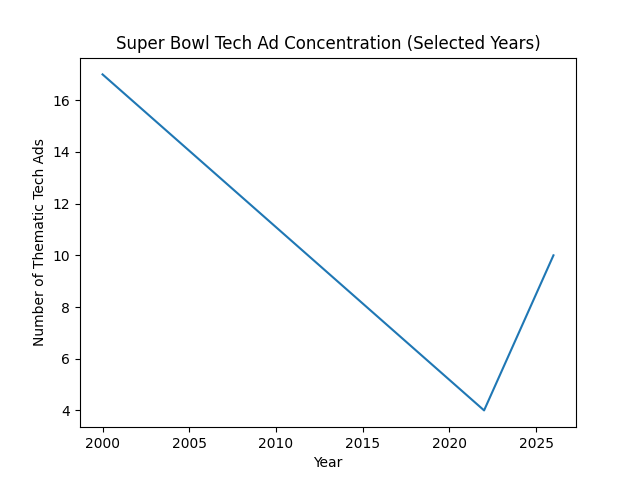
The chart above illustrates the concentration of thematic tech advertisements in selected bubble years. Notice how peaks in ad intensity coincide with subsequent drawdowns.
The lesson was not that the internet failed. Instead, capital allocation had outrun sustainable business models.
3. 2022: The “Crypto Bowl” and the Collapse
History repeated itself in 2022. Super Bowl LVI became widely known as the “Crypto Bowl.” Four major crypto platforms—Coinbase, Crypto.com, eToro, and FTX—ran advertisements.
FTX famously featured Larry David urging viewers not to miss “the next big thing.” Crypto firms reportedly paid approximately $6.5 million for 30 seconds.
Months later, the Terra stablecoin ecosystem collapsed. By year-end, FTX, Celsius, Voyager Digital, and BlockFi had entered bankruptcy. The total crypto market capitalization fell by more than 60%.
The Super Bowl had once again coincided with peak narrative intensity.
However, unlike the dot-com crash, blockchain infrastructure did not vanish. Developers continued building. Stablecoin adoption expanded. Institutional custody services improved. Bitcoin’s hash rate reached new highs. Regulatory frameworks began forming in the U.S., EU, and Asia.
4. 2026: AI Dominates the Stage
After two years of minimal crypto presence, 2026 saw the return of crypto advertising. Coinbase aired a karaoke-style commercial featuring the Backstreet Boys. Yet reviews were lukewarm. Marketing analysts from Kellogg School of Management rated the ad poorly for weak value-proposition clarity.
But the dominant theme was not crypto—it was AI.
Approximately 10 ads featured artificial intelligence. Anthropic promoted its Claude model. Meta showcased AI-powered Oakley smart glasses. Google demonstrated generative image remodeling tools. Amazon introduced Alexa Plus.
For some observers, this raised red flags. Professors Gary Smith and consultant Jeffrey Funk argued that AI-dependent firms such as OpenAI and Anthropic carry valuations in the hundreds of billions of dollars while still reporting large losses.
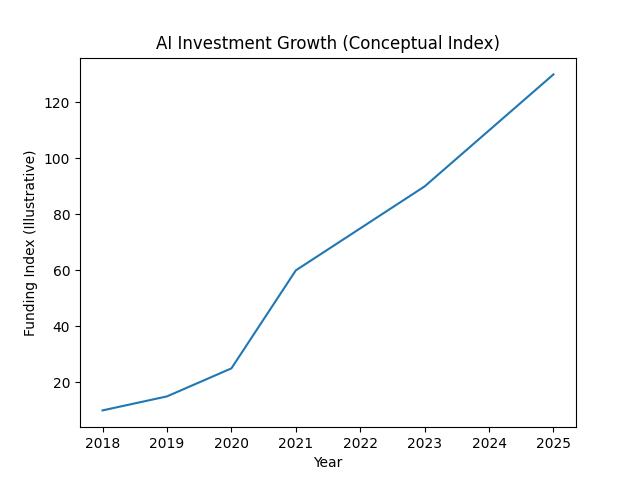
The conceptual chart above illustrates the rapid rise in AI funding relative to profitability gaps. The widening divergence between investment and earnings echoes earlier bubbles.
5. Is AI in a Bubble?
AI investment has surged dramatically since 2022. Large language models require enormous compute resources, driving multi-billion-dollar GPU purchases and data center expansion. Venture capital and sovereign wealth funds continue deploying capital aggressively.
The bubble thesis rests on three arguments:
- Valuation Disconnect – Companies priced on user growth rather than earnings.
- Capital Intensity – High operating costs for training and inference.
- Narrative Overextension – AI being inserted into every product category.
However, unlike many dot-com firms of 2000, today’s AI leaders control real infrastructure, enterprise contracts, and API ecosystems.
The key question: Will margins eventually materialize?
6. Crypto’s Quiet Institutional Shift
While AI captured advertising headlines, crypto’s real story in 2026 is regulatory normalization.
- U.S. spot Bitcoin ETFs have expanded access to traditional investors.
- Stablecoins are increasingly used in cross-border remittances.
- Tokenization of real-world assets (RWAs) is accelerating.
- Layer-2 scaling solutions reduce transaction fees dramatically.
For readers seeking the next revenue source, this is critical: advertising hype may fade, but infrastructure monetization often continues quietly.
After the dot-com crash, cloud computing emerged. After the crypto crash, custody, compliance tooling, and institutional DeFi have grown.
The survivors are those who convert hype into durable cash flow.
7. Advertising as Late-Cycle Capital Deployment
Why do bubbles coincide with Super Bowl ads?
When capital is abundant:
- Customer acquisition costs become less relevant.
- Growth metrics overshadow profitability.
- Branding becomes defensive moat-building.
In late cycles, startups spend heavily to capture mindshare before capital tightens. Super Bowl ads become symbolic of that excess.
But they also serve another function: signaling legitimacy.
Coinbase’s 2026 presence suggests confidence in long-term regulatory integration. AI firms advertising nationally suggest mainstream normalization, not fringe experimentation.
8. Strategic Implications for Investors and Builders
For readers exploring new crypto assets, AI tokens, or blockchain-AI integrations, the pattern offers a framework:
1. Avoid Pure Narrative Plays
Tokens or AI startups without revenue pathways are most vulnerable.
2. Focus on Infrastructure Layers
- GPU marketplaces
- Decentralized storage
- Compliance rails
- On-chain identity systems
3. Track Capital Efficiency
Which firms can reduce inference cost per user?
Which chains can lower settlement cost?
4. Look for Post-Crash Consolidation
The best long-term gains historically occur after speculative washouts.
9. Could AI Follow Crypto’s Path?
If AI valuations compress:
- Smaller API-dependent startups may fail.
- GPU supply could outpace demand.
- Enterprise adoption may plateau temporarily.
But foundational models and infrastructure providers are likely to survive—just as Amazon survived 2000 and Coinbase survived 2022.
The collapse of hype does not equal the collapse of technology.
Conclusion: Bubble or Evolution?
Super Bowl advertising has coincided with speculative peaks in 2000 and 2022. In 2026, AI dominated the stage, raising understandable concerns.
Yet history shows something more nuanced:
- Bubbles destroy weak balance sheets.
- They consolidate strong infrastructure.
- They reset valuation expectations.
- They create generational investment opportunities.
The question is not whether AI—or crypto—will experience volatility. It almost certainly will.
The real question is:
Which companies are building durable cash-flow engines beneath the marketing?
For investors and blockchain practitioners, the Super Bowl may not predict collapse—but it may mark the emotional top of hype cycles. And that is precisely when disciplined capital allocation becomes most important.
