

Main Points :
- On-chain indicators suggest potential near-term correction in Bitcoin and Ethereum, implying the market may be approaching a ceiling.
- Former Binance CEO Changpeng Zhao (“CZ”) forecasts that AI agents will adopt crypto assets as their native currency, highlighting blockchain’s role in the AI-driven economy.
- The United States maintains a Strategic Bitcoin Reserve composed of seized BTC, with debates on whether it will hold or expand it using budget-neutral approaches.
- Recent developments reinforce institutional and governmental acknowledgment of cryptocurrencies: stablecoin legislation (e.g., the U.S. GENIUS Act), increasing AI–crypto fundraising, education, and policy frameworks.
Section 1: Is the Crypto Market Peaking?
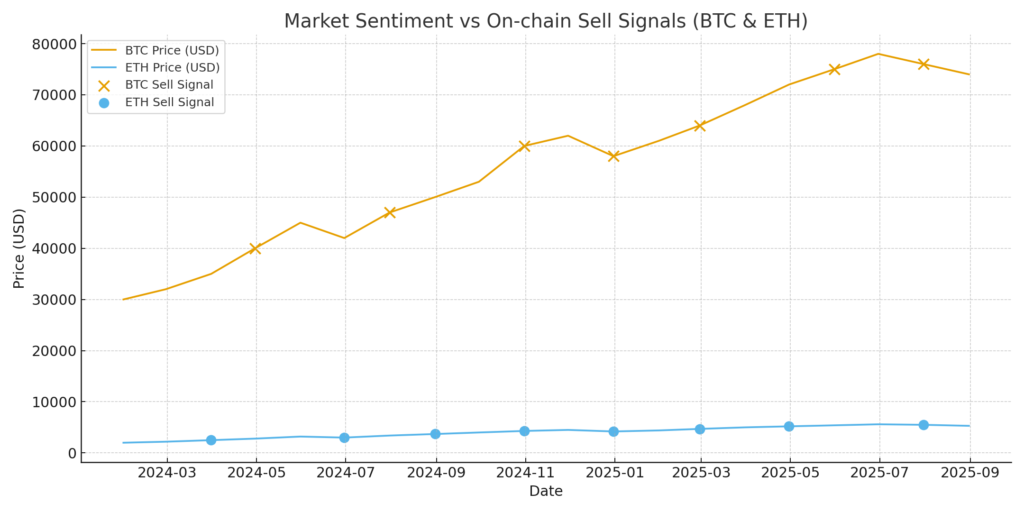
On‑chain analytics from firms like Santiment have flagged signs that both Ethereum and Bitcoin may be entering a corrective phase. Historical patterns in wallet behavior and trading volume—such as profit-taking by large holders—suggest that the upward momentum could be stalling. In practical terms, this signals that investors should assess longer-term risk rather than chase rising prices, especially in overheated markets.
Section 2: AI’s Next Frontier—Crypto as Its Native Currency
At a global summit held over Webex, Changpeng Zhao (“CZ”), ex-CEO of Binance, posited a compelling vision: AI agents may naturally transact using decentralized crypto assets. Since AI-driven systems could autonomously trade services or data across borders, decentralized digital currencies—unrestricted by nation-state control and verifiable via blockchain—offer a powerful medium. If widely adopted, this trend could redefine both economic infrastructure and trust mechanisms.
Section 3: The Strategic Bitcoin Reserve—A New U.S. Policy Tool
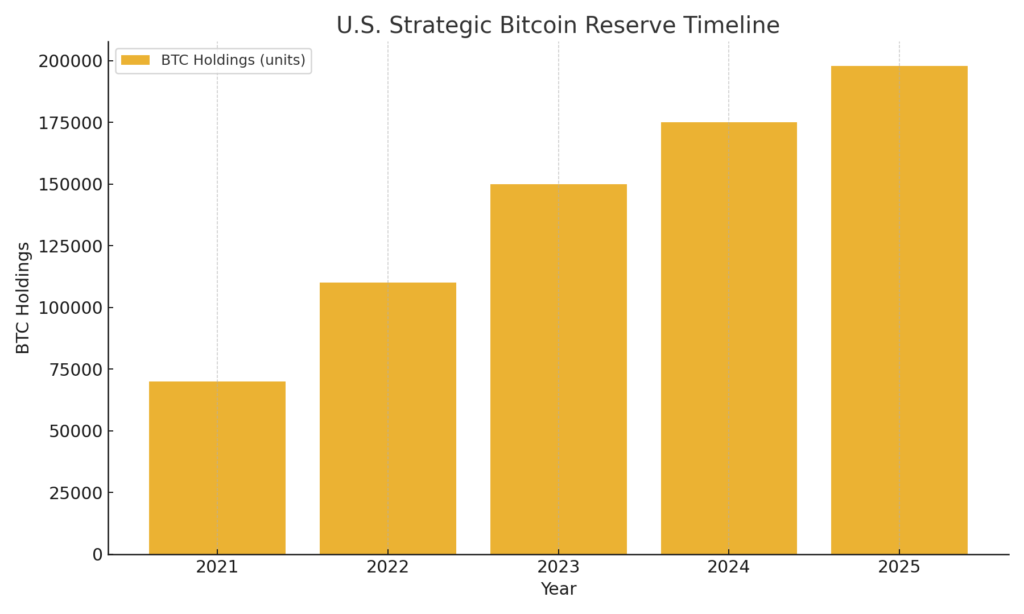
The U.S. government, via seizures stemming from criminal enforcement, now holds an estimated ~198,000 BTC in its Strategic Bitcoin Reserve as of August 2025. According to official directives, these assets are not to be sold, while Treasury and Commerce may pursue “budget-neutral” means to augment holdings (i.e., no taxpayer cost). Current reserves are valued between $15 billion and $20 billion This dual stance of accumulation without active purchase underlines how BTC is now being treated—strategically like national reserve assets.
Section 4: Broader Momentum—AI–Crypto Convergence and Regulatory Momentum
Beyond these core developments, notable shifts reinforce cryptocurrencies’ traction:
- AI-focused crypto initiatives raised over $516 million in 2025 alone, reflecting investor enthusiasm in blending blockchain with intelligent systems.
- Recent academic assessments highlight both the potential and limitations of decentralized AI tokens, with issues like off‑chain reliance, scalability, and business model alignment requiring caution.
- Meanwhile, the U.S. GENIUS Act has firmly positioned stablecoins into regulatory frameworks, prompting accelerated moves toward digital currencies—such as the EU fast-tracking its digital euro project to compete.
Taken together, these signals underscore a pivotal moment: tokenized finance, AI interoperability, and governmental strategy are converging.
Overall Summary
Crypto markets are at a crossroads. On-chain signals hint at possible corrections, prompting investors to reassess near-term risk. Simultaneously, visionary leaders like CZ suggest a revolutionary future where AI ecosystems transact via decentralized crypto. The U.S., meanwhile, is anchoring BTC as a strategic reserve asset, signaling long-term institutional embrace without direct purchase. Coupled with rapid AI–crypto fundraising, academic scrutiny, and regulatory progress, we witness a maturing ecosystem—one where digital assets, intelligent automation, and state-level strategy converge to reshape financial norms.
