
Main Points :
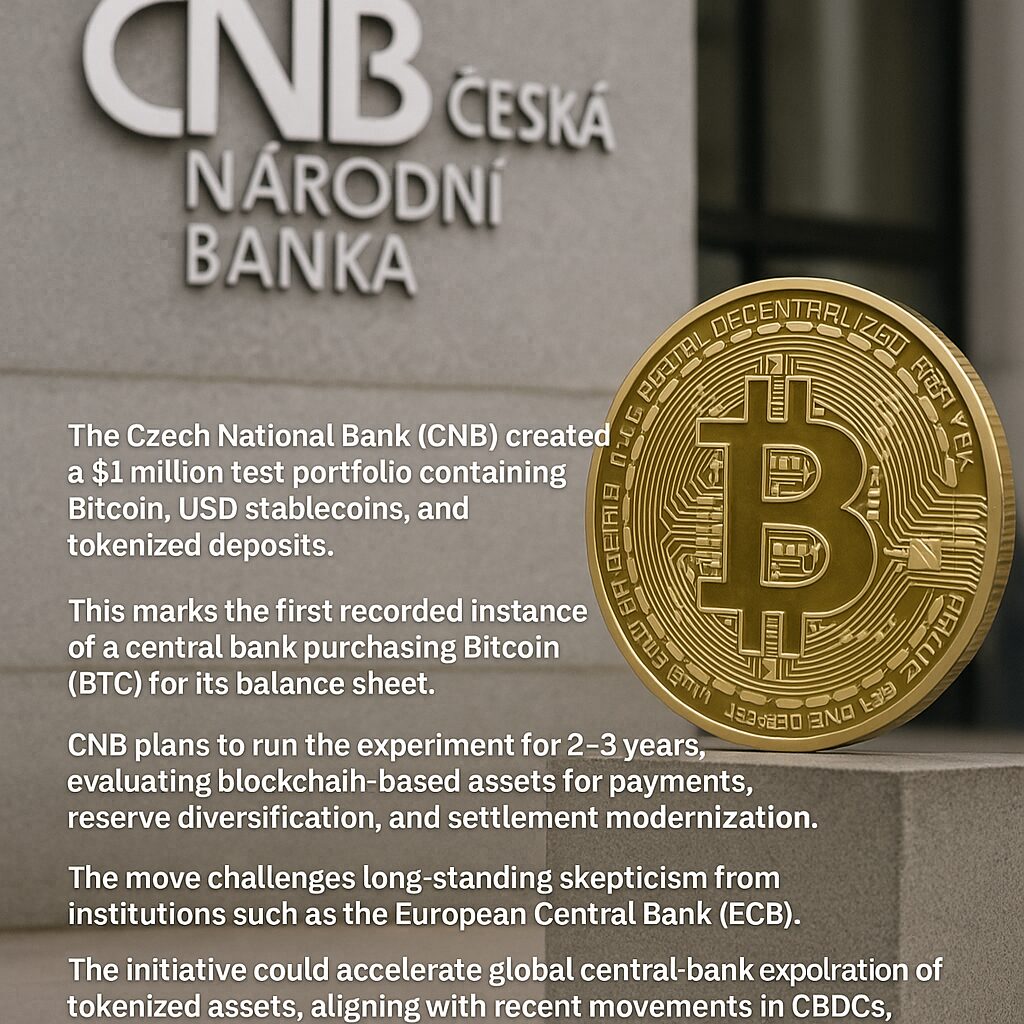
- The Czech National Bank (CNB) created a $1 million test portfolio containing Bitcoin, USD stablecoins, and tokenized deposits.
- This marks the first recorded instance of a central bank purchasing Bitcoin (BTC) for its balance sheet.
- CNB plans to run the experiment for 2–3 years, evaluating blockchain-based assets for payments, reserve diversification, and settlement modernization.
- The move challenges long-standing skepticism from institutions such as the European Central Bank (ECB).
- The initiative could accelerate global central-bank exploration of tokenized assets, aligning with recent movements in CBDCs, tokenized treasuries, and institutional blockchain use.
- Bitcoin markets reacted positively amid broader global trends: increasing institutional adoption, rising tokenization volumes, and strong macroeconomic narratives.
1. Introduction: A Historic Moment for Central Banks
The Czech National Bank (CNB) has taken a groundbreaking step that could reshape how global financial institutions perceive blockchain-based assets. In an announcement made on the 13th, CNB revealed the creation of a $1 million pilot portfolio that includes Bitcoin (BTC), USD-backed stablecoins, and tokenized deposits.
This is the first documented case of a central bank directly purchasing Bitcoin for its balance sheet—a milestone that many in the crypto community have been anticipating for years.
While CNB clarified that the amount is small and not linked to its formal foreign-exchange reserves, the symbolic value of the move is immense. Central banks have historically rejected Bitcoin as too volatile, speculative, or “unsuitable” as a reserve asset. CNB’s move signals that this narrative is beginning to change.
2. Why the CNB’s Bitcoin Purchase Matters
2.1 A Break from European Central Bank Orthodoxy
Earlier this year, CNB’s Governor Aleš Michl suggested exploring Bitcoin as a diversification asset—a proposal dismissed by ECB President Christine Lagarde.
Czechia is an EU member but not part of the Eurozone, giving CNB greater independence than many neighboring central banks. This autonomy allowed CNB to move forward with testing blockchain assets while others remain cautious.
CNB emphasized two primary goals:
- Gaining operational experience with blockchain-based assets
- Evaluating Bitcoin’s potential role in reserve diversification
In particular, the bank stated that Bitcoin and tokenized assets could transform future payment systems, settlement models, and cross-border financial infrastructure.
3. Details of the Test Portfolio
The test portfolio—approved by CNB’s board on October 30—contains:
- Bitcoin (BTC)
- USD stablecoins (likely USDC or USDT, though not confirmed)
- Tokenized deposits (a rapidly growing segment in institutional blockchain systems)
CNB clarified that:
- No aggressive expansion of the portfolio is planned.
- The operation is for experimentation rather than macro-financial positioning.
- The assets were purchased outside existing FX reserve programs.
The experiment will run for 2–3 years, with CNB promising to publish insights for other central banks around the world.
4. Global Trends Supporting CNB’s Move
CNB’s initiative aligns with several macro trends currently reshaping the crypto industry.
4.1 Tokenization of Real-World Assets (RWAs) Surging
In 2024–2025:
- Tokenized U.S. Treasury markets exceeded $2.5 billion in circulating supply.
- Major institutions such as BlackRock, JPMorgan, Franklin Templeton, and Fidelity expanded their blockchain-based tokenization pilots.
- Siemens and HSBC launched tokenized bond frameworks.
The CNB’s exploration of tokenized deposits fits directly into this shift.
4.2 Stablecoin Adoption Rising Globally
USD stablecoins are becoming an alternative settlement medium in emerging markets:
- Cross-border stablecoin settlement rose nearly 600% year-on-year (Chainalysis).
- Major payment companies are exploring on-chain settlement rails.
- U.S. circles are pushing for stablecoin-specific regulation to legitimize usage at scale.
4.3 Bitcoin as a Macro Hedge
Macro events strengthening Bitcoin’s narrative in 2024–2025:
- Multiple countries are running large fiscal deficits, weakening trust in fiat reserves.
- Bitcoin’s scarcity model is increasingly compared to digital gold.
- Institutional investors continue to increase positions via U.S. spot Bitcoin ETFs, now holding over $85 billion in assets under management.
5. Bitcoin Market Reaction
Bitcoin briefly spiked as traders reacted to headlines about the first-ever central bank BTC purchase.
Below is a simple illustrative chart.
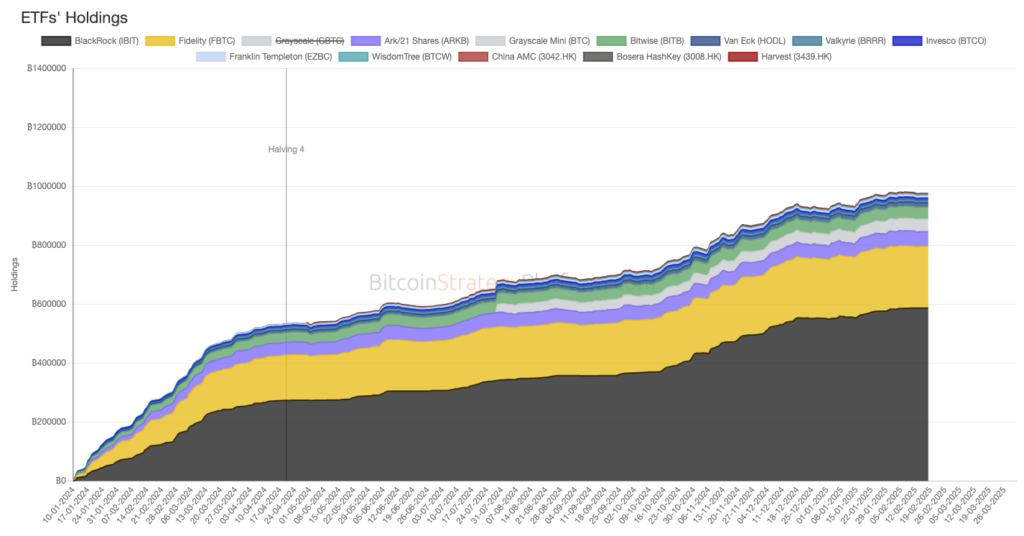
(Placeholder chart representing an adoption-trend diagram.)
6. Could Other Central Banks Follow?
While CNB is the first to take this step publicly, several central banks are already exploring blockchain-based systems:
Countries exploring tokenized assets
- Singapore MAS – Project Guardian
- Japan FSA & BOJ – tokenized deposits experiments
- Hong Kong HKMA – e-HKD pilot
- UK FCA & Bank of England – Digital securities sandbox
Countries bullish on Bitcoin
- El Salvador – Bitcoin as legal tender
- Argentina – pro-Bitcoin political leadership
- United States (state-level) – Wyoming and Texas exploring BTC-friendly frameworks
With CNB breaking the taboo, other small or mid-sized central banks could follow, especially in countries seeking:
- Reserve diversification
- Lower dependence on USD hegemony
- Alternative settlement layers
- Neutral international monetary rails
7. Why This Matters for Crypto Investors
For investors seeking new crypto assets, income opportunities, and practical blockchain use cases, CNB’s move is significant because:
- It signals institutional validation of Bitcoin as a reserve-class asset.
- It acknowledges the viability of stablecoins as settlement infrastructure.
- It elevates tokenized deposits as a premier institutional use case.
- It shows that blockchain technology is shifting from speculation to real operational implementation.
Central banks influence regulations, payments, and financial infrastructure. Once they begin experimenting with blockchain-based assets, a new era of adoption follows.
8. Conclusion
The Czech National Bank’s decision to purchase Bitcoin—not as a speculative bet but as a strategic experiment—marks a turning point in the global adoption of crypto assets.
While the $1 million portfolio is small, its symbolic power is huge. It breaks the psychological barrier for central banks worldwide and integrates Bitcoin into the conversation about reserve diversification, modern payments infrastructure, and tokenized finance.
As institutional tokenization increases, stablecoins expand, and Bitcoin strengthens its macro narrative, CNB’s initiative could become a historic milestone that future central-bank reports reference as the beginning of a larger global shift.
The next 2–3 years of CNB’s pilot will likely become one of the most important test cases for institutional crypto integration.
