
Main Points :
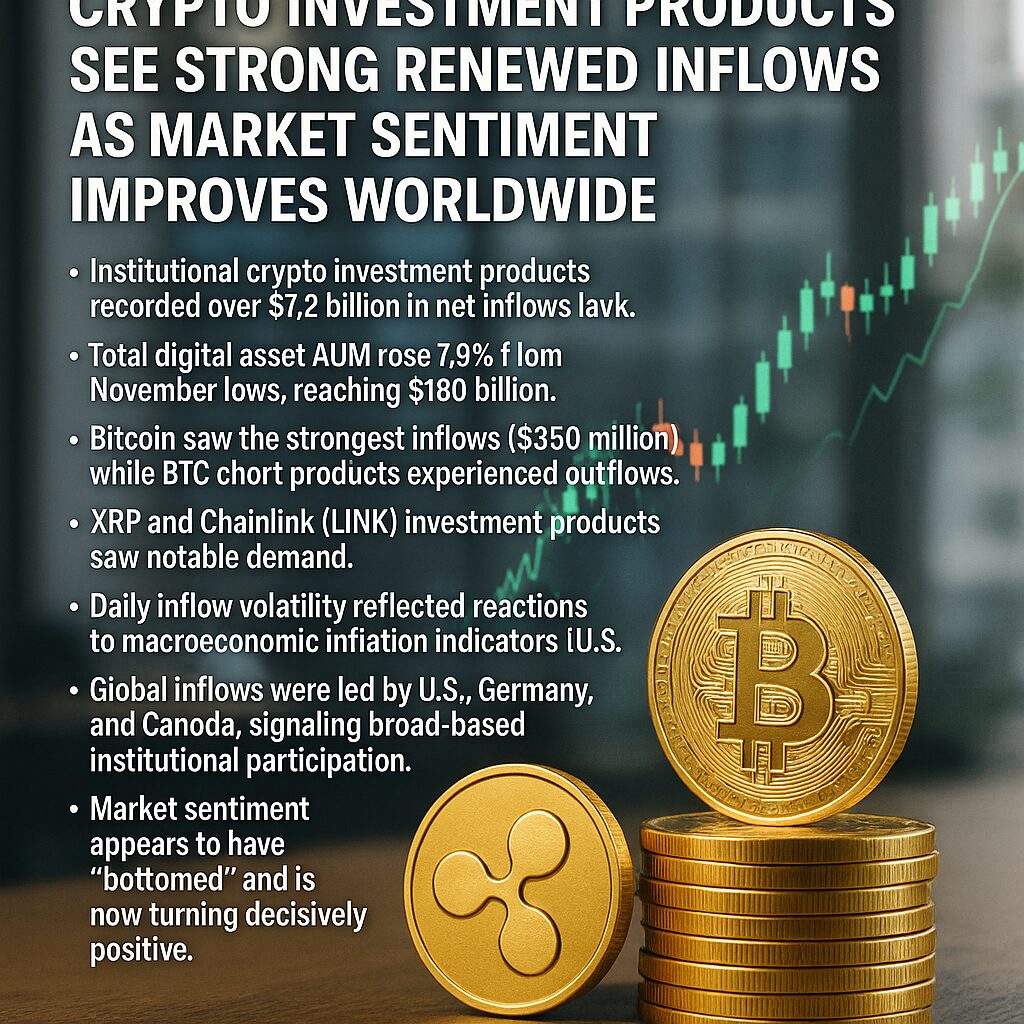
- Institutional crypto investment products recorded over $7.2 billion in net inflows last week.
- Total digital asset AUM rose 7.9% from November lows, reaching $180 billion.
- Bitcoin saw the strongest inflows ($350 million), while BTC short products experienced outflows.
- XRP and Chainlink (LINK) investment products saw notable demand.
- Daily inflow volatility reflected reactions to macroeconomic inflation indicators in the U.S.
- Global inflows were led by the U.S., Germany, and Canada, signaling broad-based institutional participation.
- Market sentiment appears to have “bottomed” and is now turning decisively positive.
1. Introduction: A Renewed Wave of Optimism in the Digital Asset Market
The global digital asset investment landscape has entered a renewed period of strength, with institutional inflows rising for the second consecutive week. According to the latest report from CoinShares, more than $7.2 billion flowed into exchange-traded funds (ETFs) and other crypto investment vehicles last week. This sharp increase represents a noteworthy shift in market sentiment, one that analysts say signals sustained optimism among institutional participants.
While the digital asset market has faced months of volatility—marked by inflation concerns, regulatory uncertainty, and fluctuating asset prices—the latest inflow data suggests that investors are increasingly positioning themselves ahead of potential macro and structural catalysts. These catalysts include easing U.S. monetary policy prospects, improving liquidity conditions, and broader acceptance of digital assets within traditional finance.
This article summarizes the CoinShares report, integrates additional insights from recent market developments, and analyzes what these trends mean for investors seeking new crypto opportunities, revenue sources, and blockchain-based applications.
2. Overview of Institutional Flows: Sentiment Shows Meaningful Improvement
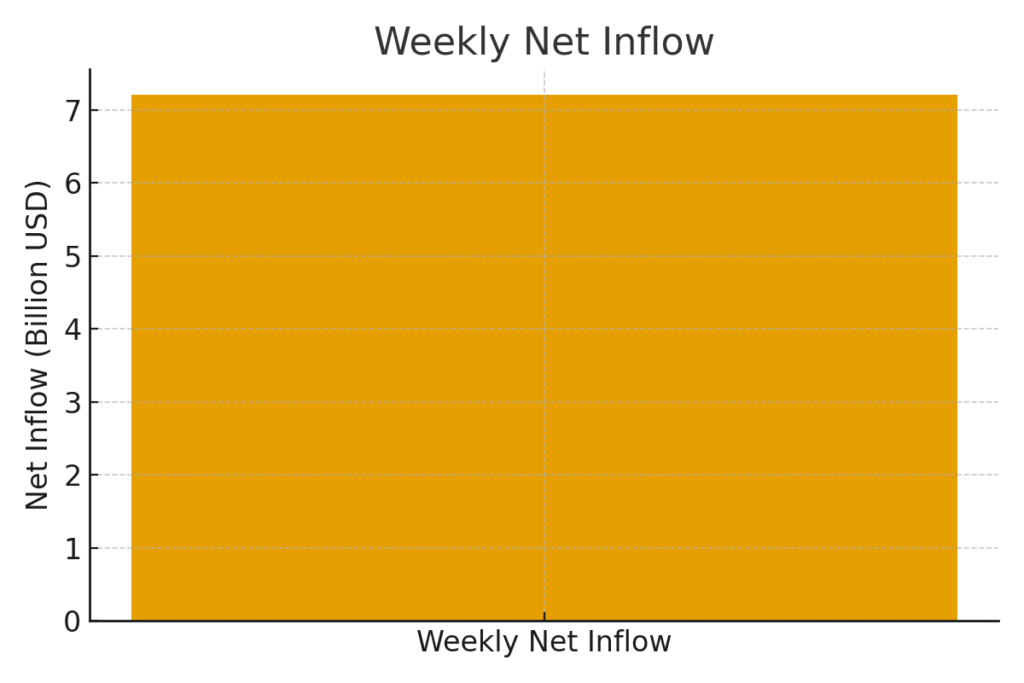
CoinShares reports that digital asset investment products saw $7.2 billion in net inflow last week. This marks the second consecutive week of strong institutional participation, further reversing outflows recorded earlier in the quarter.
In markets where sentiment often swings rapidly, two consecutive weeks of institutional inflows carry significant meaning. Historically, multi-week inflow periods have correlated with medium-term bullish reversals in the broader crypto market.
The improving sentiment is especially notable given lingering macroeconomic uncertainties. Analysts point to moderating U.S. inflation expectations and anticipation of renewed Federal Reserve guidance as key drivers behind shifting investor psychology.
3. Total AUM Surges Nearly 8% to $180 Billion
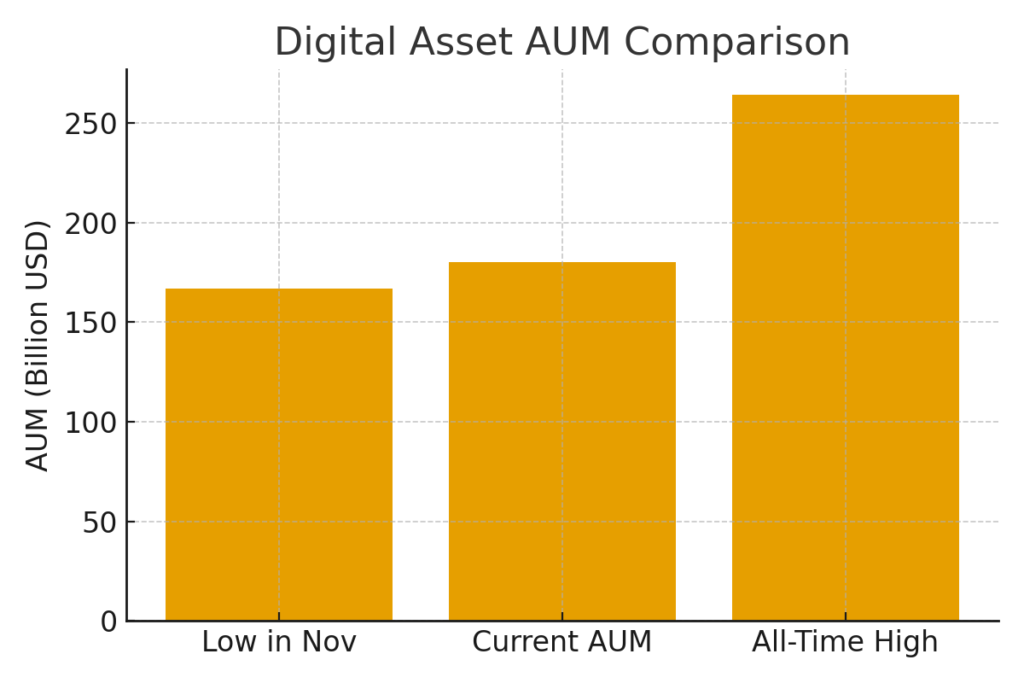
Perhaps the clearest indicator of renewed confidence is the rise in total assets under management (AUM) for digital asset investment products:
- November Low: ~$167 billion
- Current AUM: ~$180 billion
- Increase: 7.9%
- Previous All-Time High: ~$264 billion
Even though AUM remains below the all-time peak of $264 billion, the rapid rebound underscores accelerating institutional engagement.
One of the reasons AUM is rising faster than spot prices alone can explain is a shift in portfolio allocation behavior. Institutions appear to be increasing their percentage of crypto exposure relative to equities and fixed income—another reflection of growing confidence.
4. Daily Flow Data Shows Reactions to U.S. Inflation Indicators
Interestingly, CoinShares notes that December 4 and 5 saw minor net outflows, which analysts attribute to reactions to U.S. macroeconomic data—specifically, inflation readings indicating persistent pricing pressure.
The release of the PCE (Personal Consumption Expenditures) price index, a key inflation gauge watched by the Federal Reserve, shaped investor positioning around risk assets. In this environment:
- Bitcoin and major altcoins saw temporary cooling in demand.
- ETFs experienced modest outflows as short-term traders reduced exposure.
- Long-term institutional allocators, however, continued accumulating throughout the week.
This behavior demonstrates a split between long-term strategic investors and short-term tactical traders, a dynamic increasingly common in digital asset markets.
5. Bitcoin Leads With Over $350 Million in Weekly Net Inflows
Bitcoin remained the dominant focus of institutional investment products.
BTC Key Figures:
- Net Inflow: +$350 million
- Short Bitcoin Products: Net outflows
The outflow from BTC-short products is particularly telling: investors appear to be reducing bearish bets, interpreting recent price corrections as temporary pullbacks rather than the start of a broader downturn.
The CoinShares analysis suggests that ETP investors believe:
“Market sentiment deterioration may have already bottomed out.”
This reinforces a broader narrative that Bitcoin is entering an accumulation phase backed by strong institutional conviction.
6. Altcoin Trends: XRP and Chainlink Show Strong Institutional Demand
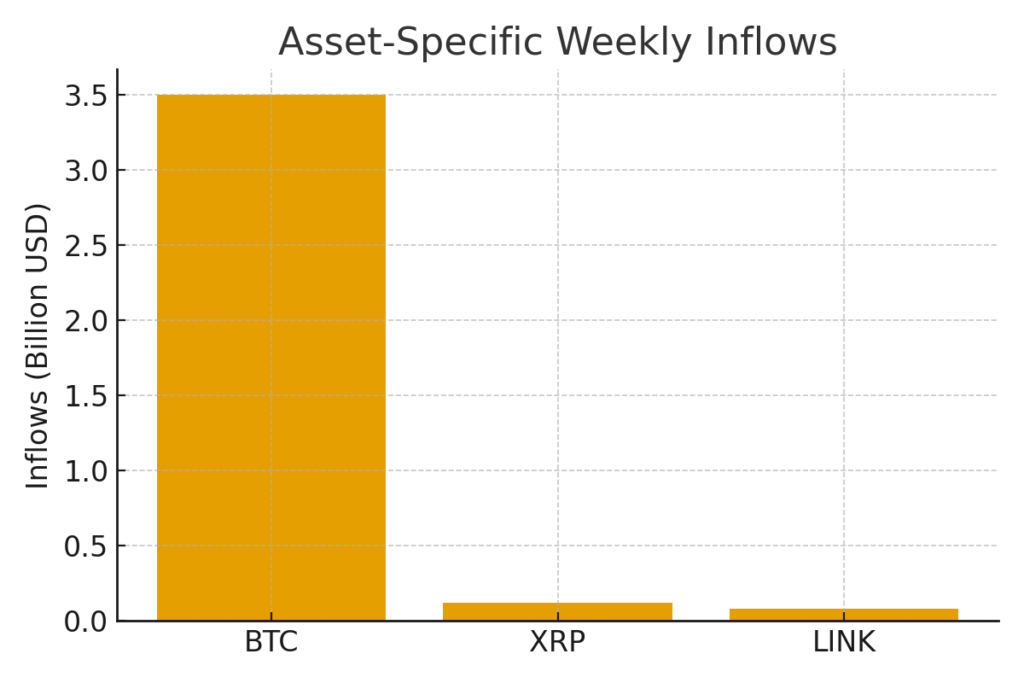
Beyond Bitcoin, two altcoins stood out:
XRP
- Continued interest from institutions following ongoing global adoption narratives
- Rising demand for payment-based and liquidity-focused use cases
Chainlink (LINK)
- Strong inflows associated with:
- Real-world asset (RWA) tokenization growth
- Oracle demand expansion
- Launch of regulated financial market integrations
LINK’s success also follows the launch of a Chainlink Spot ETF, which saw approximately $64 million in inflows during its initial trading period, according to related reports.
These movements reflect a shift where institutional investors are no longer focusing solely on Bitcoin and Ethereum but are diversifying toward assets with specific utility narratives.
7. Geographic Breakdown: Inflows Spread Across the U.S., Europe, and Canada
CoinShares data shows that inflows originated from multiple major markets:
- United States – Strongest inflow region
- Germany – Significant institutional activity
- Canada – Steady accumulation, particularly in Bitcoin ETFs
The global distribution of inflows indicates that last week’s sentiment shift was not isolated to one region—it was a coordinated global trend driven by macroeconomic expectations and growing institutional confidence.
8. Latest Industry Trends from Additional Sources
To contextualize the CoinShares report, here are broader market trends from Bloomberg, The Block, and other major crypto analytics outlets:
Trend 1: Renewed Interest in Tokenization of Real-World Assets (RWA)
Financial giants such as BlackRock, Franklin Templeton, and Citi are accelerating blockchain-based RWA programs. This is driving demand for infrastructure tokens, particularly Chainlink (LINK).
Trend 2: Spot ETFs Expanding Beyond Bitcoin
Following strong performance of BTC spot ETFs, new filings for altcoin ETFs—including SOL, LINK, and XRP—are gaining regulatory discussion in Europe and Canada.
Trend 3: Institutional Yield Strategies are Rising
With traditional fixed-income yields stabilizing, institutions are turning to:
- Staking
- On-chain treasury bills
- Liquidity-providing products
as alternative yield avenues.
Trend 4: Demand for Transparent, Regulated Crypto Platforms Is Increasing
Compliance-first exchanges and VASPs benefit as governments push Travel Rule enforcement, proof-of-reserves, and standardized risk disclosures.
9. What This Means for Investors Seeking New Opportunities
For readers actively exploring new crypto assets or revenue-generating strategies, this market moment offers several actionable insights:
1. Institutions Enter Early in Accumulation Phases
Rising AUM and net inflows suggest that major players believe the market is undervalued relative to upcoming macro conditions.
2. Bitcoin Remains the Anchor Asset
BTC continues to dominate institutional flows due to liquidity depth and regulatory clarity.
3. Select Altcoins Have Strong Utility Narratives
XRP and LINK stand out as assets benefiting from real-world applications, not just price speculation.
4. Yield-Generating Crypto Products Are Gaining Legitimacy
Regulated staking ETFs, on-chain treasury platforms, and tokenized fixed-income products are expanding globally.
5. Diversification Is Returning
Institutional investors no longer limit themselves to BTC and ETH; they are building multi-asset crypto portfolios.
10. Conclusion: A Meaningful Turning Point for Digital Asset Markets
The latest CoinShares data provides compelling evidence that the market’s sentiment is shifting decisively. With more than $7.2 billion in institutional inflows, rising AUM, and strong participation across the U.S., Europe, and Canada, the digital asset sector appears to be entering a new expansion phase.
Bitcoin continues to lead the narrative, but altcoins with practical utility—particularly XRP and Chainlink—are beginning to capture institutional attention. Meanwhile, macroeconomic conditions and improving inflation outlooks are supporting broader risk-asset demand.
For investors seeking the next opportunities in crypto—whether new assets, yield strategies, or blockchain business applications—this period represents a critical moment to observe. Institutional behavior often leads market cycles, and current data strongly suggests renewed confidence in the digital asset ecosystem.
