
Main Points :
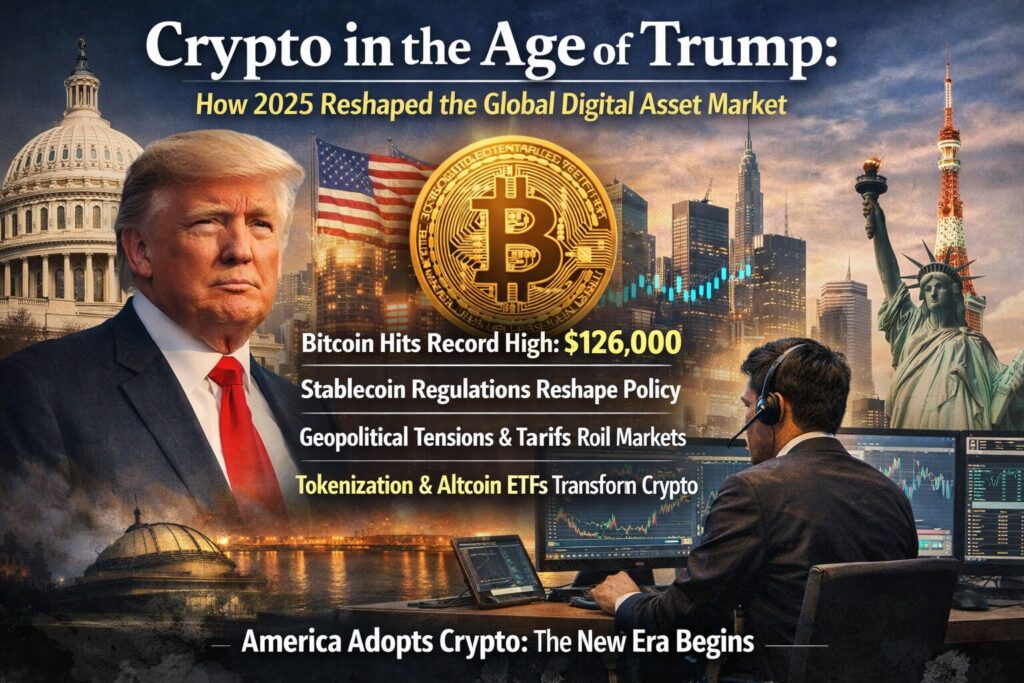
- 2025 marked the first year in which the United States openly integrated crypto into national policy under President Donald Trump.
- Bitcoin reached a new all-time high above $126,000, driven by institutional adoption, ETF flows, and sovereign-level narratives.
- Stablecoins became a central policy battleground, culminating in comprehensive U.S. legislation and parallel moves in Japan.
- Market volatility intensified due to tariffs, geopolitical risk, and regulatory uncertainty, reinforcing Bitcoin’s role as a macro asset.
- Tokenization (RWA), ETFs for altcoins, and Ethereum’s scalability upgrades defined the next phase of crypto’s real-world utility.
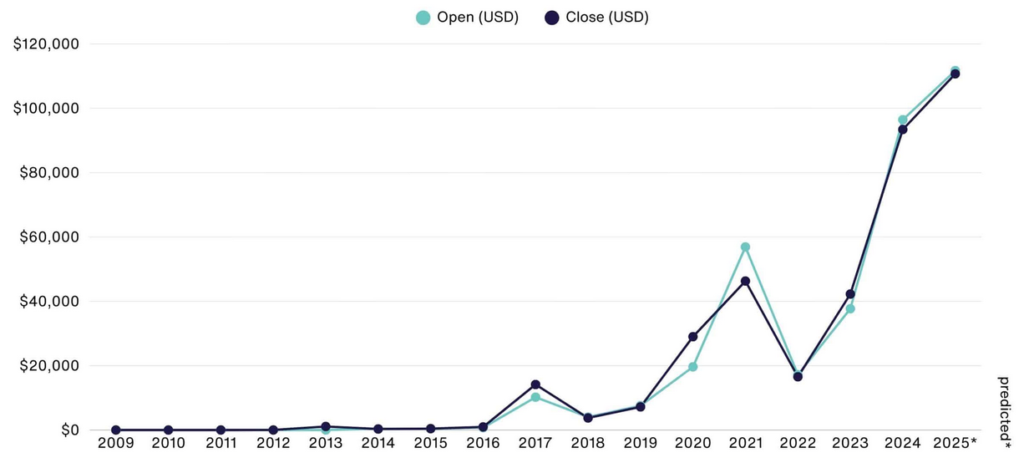
Bitcoin Price Trend in 2025 (USD, Monthly)
Introduction: 2025 as a Turning Point for Crypto
The year 2025 will be remembered as a structural inflection point for the global cryptocurrency market. With Donald Trump formally returning to the White House, digital assets moved from the periphery of policy debates to the center of economic and geopolitical strategy.
This was not merely another bull market. Instead, 2025 represented the moment when cryptocurrencies—particularly Bitcoin and stablecoins—became instruments of statecraft, regulatory reform, and institutional balance sheets.
For investors seeking new assets, for builders searching for practical blockchain use cases, and for policymakers navigating financial innovation, 2025 provided critical signals about what comes next.
January: Trump’s Inauguration and the Birth of a Presidential Meme Coin
January began with disbelief. On January 18 (JST), it was revealed that President-elect Trump had officially launched a meme coin named TRUMP. Initial skepticism quickly turned into frenzy as authenticity was confirmed, sending prices surging more than 20x within days.
While meme coins are typically dismissed as speculative excess, this event carried symbolic weight: it was the first time a sitting or incoming U.S. president had directly issued a crypto asset. The message was unmistakable—crypto was no longer fringe culture.
On January 20, Trump was formally inaugurated. Bitcoin soon reclaimed the $100,000 level, reflecting renewed optimism that regulatory hostility would ease under the new administration.
February: Tariffs, State-Level Bitcoin Reserves, and a Historic Hack
February underscored crypto’s sensitivity to macroeconomic shocks. Trump announced sweeping tariffs: 25% on imports from Canada and Mexico, and 10% on Chinese goods. Risk assets sold off sharply, and Bitcoin fell to the $91,000 range, triggering approximately $1.5 billion in liquidations.
At the same time, several U.S. states began debating the creation of Bitcoin strategic reserves. While inspired by federal rhetoric, multiple proposals were rejected, temporarily dampening market sentiment.
The month’s most severe blow came when Bybit disclosed a hack of its multi-signature cold wallet, resulting in losses exceeding $1.4 billion in ETH-related assets—the largest theft in crypto history. The incident reignited debates about custody, security architecture, and institutional risk.
March: The U.S. Bitcoin Reserve Becomes Reality
March delivered one of the most consequential developments in crypto history. President Trump signed an executive order establishing a U.S. Bitcoin Strategic Reserve.
According to Crypto and AI Czar David Sacks, the reserve would consist solely of Bitcoin seized through civil and criminal forfeiture, ensuring zero taxpayer burden. Crucially, the government committed to never selling these holdings, positioning Bitcoin as a long-term store of value.
Later that month, the White House hosted the first-ever U.S. Crypto Summit. While expectations were high, markets reacted cautiously due to a lack of concrete policy timelines.
Another milestone followed when the U.S. Securities and Exchange Commission dropped its appeal against Ripple, effectively ending its legal battle with Ripple. XRP’s regulatory cloud finally lifted.
April: Tariff Shock and Bitcoin’s Macro Stress Test
In April, the Trump administration announced cumulative tariffs of 104% on Chinese goods, reigniting fears of global economic slowdown. Equity volatility surged, and Bitcoin suffered another sharp correction.
This period reinforced Bitcoin’s evolving role: while often framed as “digital gold,” it remained deeply intertwined with liquidity cycles and risk sentiment.
Discussions also emerged around how the U.S. could expand its Bitcoin holdings without taxpayer funding. Analysts suggested swapping government-held altcoins for BTC—a concept that may shape future sovereign crypto strategies.
May: Corporate Bitcoin Treasuries and Valuation Distortions
In May, Arizona Governor Katie Hobbs vetoed a bill that would have allowed state pension funds to invest in digital assets. Bitcoin briefly retraced from $97,800 to $96,400.
Meanwhile, Japanese Bitcoin treasury firm Metaplanet captured investor attention. Analysts at 10x Research revealed that Metaplanet’s stock implied a Bitcoin valuation of nearly $596,000 per BTC, representing a 447% premium over spot prices.
This phenomenon mirrored earlier U.S. cases like MicroStrategy, highlighting how equity markets price “Bitcoin exposure” differently from direct ownership.
June: Ethereum Accumulation and Japan’s Regulatory Shift
June spotlighted Ethereum. On-chain data showed wallets linked to Consensys acquiring over $320 million worth of ETH, much of it subsequently staked—signaling confidence in Ethereum’s yield-driven future.
Metaplanet’s shares surpassed ¥1,800 as the firm announced Japan’s largest-ever issuance of stock warrants, targeting long-term Bitcoin accumulation.
Another landmark event occurred when Circle, issuer of USDC, went public. Its stock surged above $290, fueled by optimism around U.S. stablecoin regulation.
In Japan, the Financial Services Agency of Japan formally began reviewing the transition of crypto oversight from the Payment Services Act to the Financial Instruments and Exchange Act—potentially paving the way for Bitcoin ETFs and separate taxation.
July: Stablecoin Legislation and XRP’s New High
July marked the passage of the GENIUS Act, the first comprehensive U.S. crypto regulatory framework, signed by President Trump. Stablecoins were officially recognized as strategic financial infrastructure.
That same month, XRP surged to $3.50, surpassing its previous all-time high and overtaking USDT to become the world’s third-largest crypto asset by market cap.
August: Retirement Funds and Japan’s First Yen Stablecoin
Trump signed an executive order allowing 401(k) retirement accounts—worth over $12.5 trillion—to invest in crypto and alternative assets. This dramatically expanded crypto’s institutional addressable market.
In Japan, fintech firm JPYC received regulatory approval to issue the country’s first yen-denominated stablecoin, marking a breakthrough in domestic blockchain payments.
September: Tokenized Assets and the Rise of Crypto Wealth
September saw renewed interest in Real World Asset (RWA) tokenization, exemplified by tokenized Pokémon cards capturing global attention.
A report by Henley & Partners revealed that the number of crypto millionaires worldwide had risen 40% year-over-year to 241,700, underscoring the rapid accumulation of digital wealth.
October: Bitcoin’s All-Time High and the “Trump Shock”
Bitcoin reached a historic peak of $126,198 on October 7. However, renewed tariff threats against China triggered a sharp reversal, sending BTC down toward $105,000.
Certain altcoins experienced extreme dislocations, reminding investors that liquidity risk remains acute outside Bitcoin and major assets.
Japan also began exploring regulatory reforms that would allow banks to hold cryptocurrencies for investment purposes—a major shift in institutional adoption.
November: Altcoin ETFs and Banking Friction
While Bitcoin and Ethereum ETFs saw outflows, Solana (SOL) and XRP spot ETFs attracted inflows, highlighting selective risk appetite.
Texas became the first U.S. state to directly purchase Bitcoin, allocating $5 million initially.
Conversely, reports emerged that JPMorgan Chase had closed accounts linked to crypto businesses, reviving concerns over banking access.
December: Ethereum’s “Fusaka” Upgrade and Monetary Tightening
Ethereum completed its Fusaka upgrade, introducing Peer Data Availability Sampling (PeerDAS), significantly reducing Layer 2 transaction costs.
Japan’s central bank raised interest rates to 0.75%, the highest level in nearly 30 years, reinforcing macro headwinds for risk assets.
Meanwhile, SBI Holdings and Startale announced plans for a regulated yen stablecoin in 2026.
Conclusion: What 2025 Means for the Future of Crypto
The events of 2025 confirmed that crypto is no longer an experimental asset class. It is now embedded in sovereign policy, institutional finance, and global macro strategy.
As 2026 approaches, attention will focus on U.S. midterm elections, monetary policy, tax reform in Japan, and the maturation of RWA tokenization, stablecoins, and AI-integrated blockchain systems.
For investors and builders alike, the lesson is clear: crypto’s next phase will reward those who understand not only technology—but regulation, macroeconomics, and real-world utility.
