
Main Points :
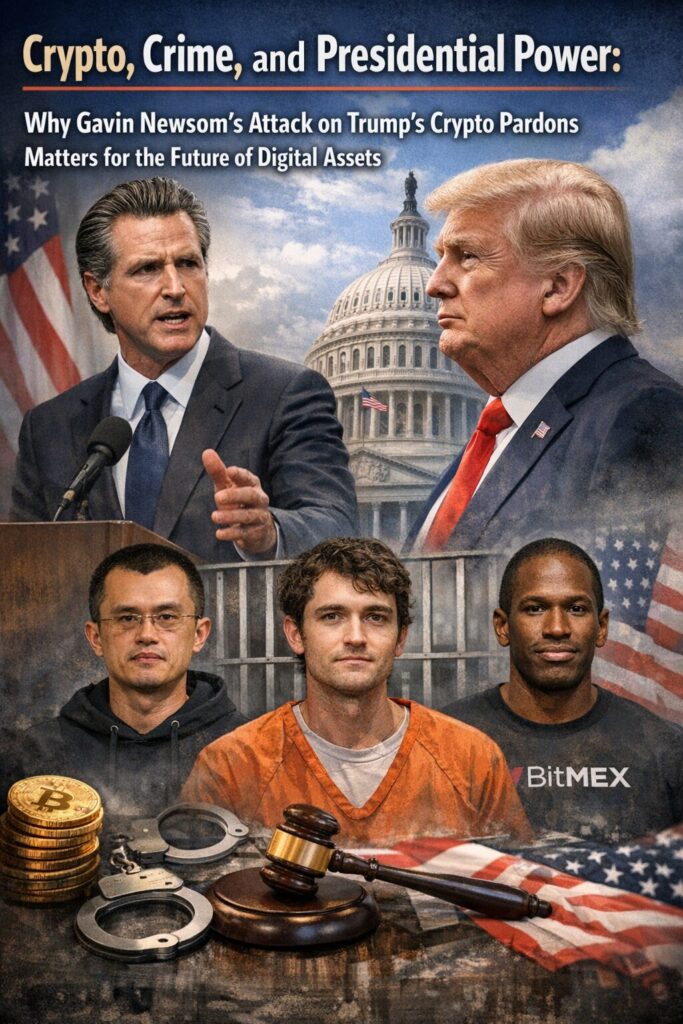
- California Governor Gavin Newsom has launched a direct political and symbolic attack on former President Donald Trump by highlighting his pardons of convicted crypto figures.
- The controversy surrounding Changpeng Zhao (CZ), Ross Ulbricht, and BitMEX founders exposes unresolved tensions between crypto innovation, criminal liability, and political power.
- These developments arrive at a critical moment when crypto regulation, institutional adoption, and public trust are simultaneously accelerating.
- For investors and builders seeking new crypto assets, revenue opportunities, and real-world blockchain use, this political clash signals deeper structural risks and opportunities ahead.
Introduction: When Crypto Meets Presidential Politics
The cryptocurrency industry has long positioned itself as a technological and financial revolution—borderless, neutral, and resistant to political interference. Yet in December 2025, that narrative collided head-on with American electoral politics.
California Governor Gavin Newsom publicly accused former President Donald Trump of surrounding himself with convicted criminals, launching a dedicated page on a California state website that tracks what Newsom calls “Trump’s Top 10 Criminal Allies.” Notably, several figures from the cryptocurrency industry appear prominently on that list.
At the center of the controversy are Changpeng Zhao (CZ), the former CEO of Binance; Ross Ulbricht, the founder of Silk Road; and co-founders of BitMEX—each of whom received presidential pardons or clemency from Trump. Newsom’s move is more than a political stunt: it reframes crypto’s public image at a moment when the industry is striving for regulatory legitimacy and mainstream adoption.
The California Website: A New Form of Political Messaging
Governor Newsom’s team launched the webpage as part of a broader campaign to contrast California’s declining crime rates with Trump’s record of pardoning convicted individuals. The page features stylized “mugshot-like” images of Trump and the pardoned figures, stamped with the word “FELON.”
Newsom stated that the purpose was to provide Americans with a centralized, factual resource that shows “who Trump chooses to protect and prioritize.”
This is an unprecedented use of state infrastructure for narrative framing—and crypto has become one of its most visible symbols.
Crypto Figures at the Center of the Storm
Changpeng Zhao (CZ): Binance and the Cost of Scale
Changpeng Zhao, founder and former CEO of Binance, pleaded guilty to U.S. federal charges related to violations of anti-money laundering requirements. Binance itself paid multibillion-dollar penalties, reshaping the global compliance landscape for exchanges.
Trump’s pardon of CZ reignited debate over whether regulatory violations in crypto are “technical failures” or systemic risks.
For investors, CZ’s case underscores a key lesson: scale without compliance eventually attracts sovereign power.
Ross Ulbricht: Ideology, Crime, and Crypto’s Original Sin
Ross Ulbricht’s Silk Road marketplace is inseparable from Bitcoin’s early history. While Ulbricht championed libertarian ideals, Silk Road facilitated illegal drug trade at scale.
Trump’s pardon of Ulbricht during his first month in office symbolized, to supporters, redemption and ideological freedom—and to critics, tolerance of criminal enterprise.
The Ulbricht case continues to divide the crypto community between those who view decentralization as moral resistance and those who see it as infrastructure that must coexist with law.
BitMEX: Derivatives, Leverage, and Regulatory Arbitrage
The founders of BitMEX built one of the earliest and most profitable crypto derivatives platforms. However, U.S. authorities charged them with failing to implement proper KYC and AML controls.
Their pardons highlight a recurring theme: crypto innovation often outpaces regulation—but enforcement eventually follows.
Why This Matters for Crypto Investors and Builders
This controversy is not merely historical or political. It has direct implications for:
- Regulatory Risk Pricing: Markets increasingly price political exposure into token valuations.
- Institutional Adoption: Banks, ETFs, and payment providers require reputational clarity.
- Jurisdictional Arbitrage: Companies must assess not only laws, but political sentiment.
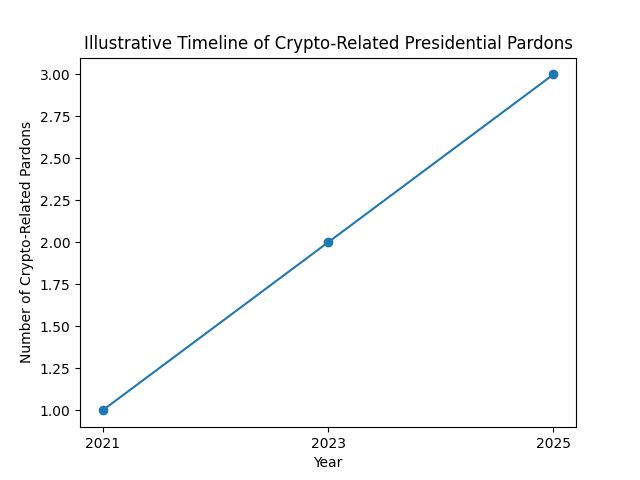
Illustrative Timeline of Crypto-Related Presidential Pardons
This chart visualizes how crypto-related pardons have increased over time, reinforcing the perception that digital asset enforcement is entangled with political cycles rather than purely legal standards.
Recent Global Trends: Crypto Is No Longer Politically Neutral
Beyond the U.S., similar patterns are emerging:
- The EU is enforcing MiCA with strict licensing requirements.
- Asian financial hubs are prioritizing “compliant innovation.”
- Major institutions are entering crypto only through heavily regulated channels.
The Newsom–Trump clash accelerates a global realization: crypto is now a political asset class.
Opportunities Hidden Inside the Controversy
For readers seeking new revenue sources and practical blockchain applications, this shift creates opportunities:
- Compliance-First Infrastructure: RegTech, on-chain AML, and Travel Rule tooling.
- Asset-Backed Tokens: Structures aligned with traditional finance expectations.
- Decentralized but Accountable Systems: Hybrid models bridging autonomy and regulation.
Political scrutiny often precedes capital inflows—once standards stabilize.
Conclusion: Crypto’s Maturity Test
Gavin Newsom’s attack on Trump’s crypto pardons is not fundamentally about personal rivalries. It is a signal that cryptocurrency has reached a level of societal impact where politics, law, and finance can no longer be separated.
For investors, builders, and institutions, the lesson is clear:
The next phase of crypto growth will not be driven by ideology alone, but by the ability to operate transparently within—and sometimes despite—political power structures.
Crypto’s future belongs to those who understand both code and governance.
