
Main Points :
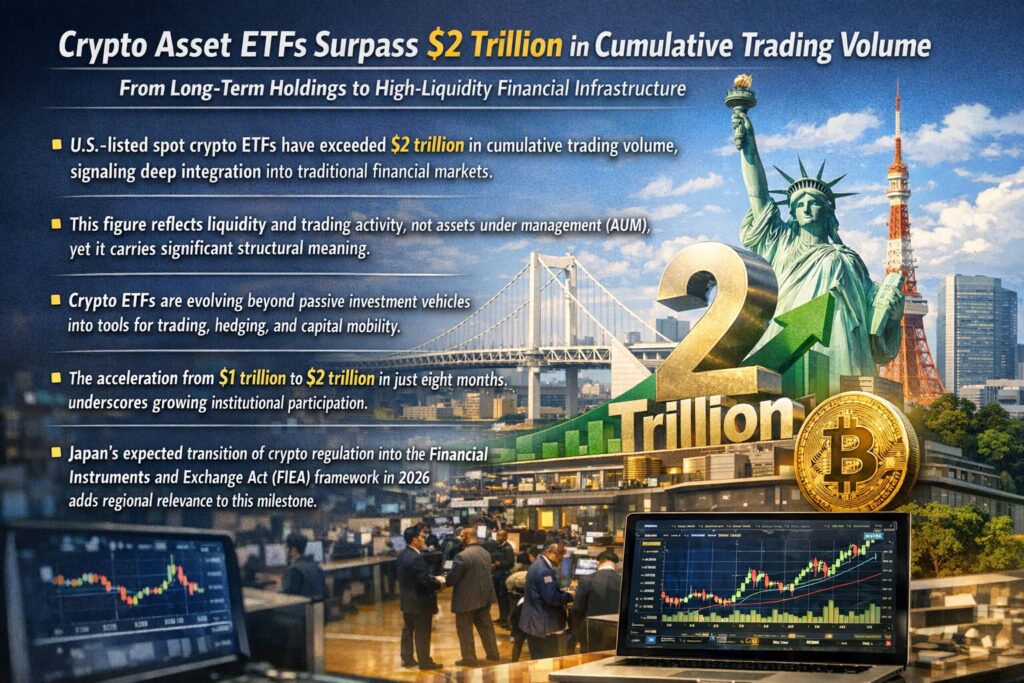
- U.S.-listed spot crypto ETFs have exceeded $2 trillion in cumulative trading volume, signaling deep integration into traditional financial markets.
- This figure reflects liquidity and trading activity, not assets under management (AUM), yet it carries significant structural meaning.
- Crypto ETFs are evolving beyond passive investment vehicles into tools for trading, hedging, and capital mobility.
- The acceleration from $1 trillion to $2 trillion in just eight months underscores growing institutional participation.
- Japan’s expected transition of crypto regulation into the Financial Instruments and Exchange Act (FIEA) framework in 2026 adds regional relevance to this milestone.
1. What Does “$2 Trillion in Cumulative Trading Volume” Really Mean?
In early January 2026, multiple overseas media outlets reported that cumulative trading volume for U.S.-listed spot crypto ETFs had surpassed $2 trillion. At first glance, this number appears staggering—and it is—but its meaning is often misunderstood.
Cumulative trading volume refers to the total value of all buy and sell transactions executed since these ETFs were listed. It does not represent assets under management, market capitalization, or the amount of capital currently invested. Instead, it measures how actively these products are used by market participants.
This distinction matters. AUM tells us how much capital is “parked.” Trading volume tells us how often capital moves. In financial markets, movement equals liquidity, and liquidity equals usability.
The fact that crypto ETFs have generated $2 trillion in cumulative trades strongly suggests that they are no longer niche instruments for long-only investors. They are becoming infrastructure-level financial products embedded in daily market operations.
2. The Rapid Acceleration: From $1 Trillion to $2 Trillion in Eight Months
The pace of growth is as revealing as the headline number itself.
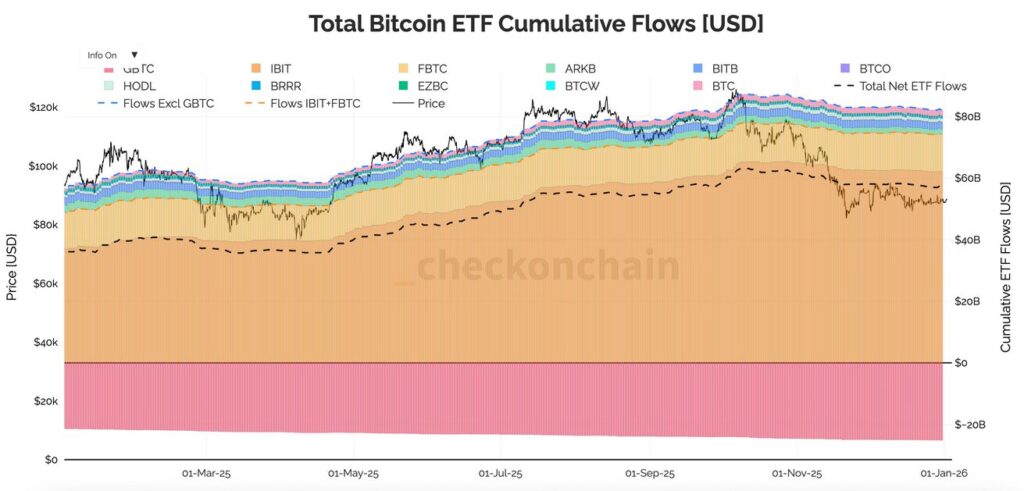
After the launch of the first U.S. spot Bitcoin ETFs in January 2024, daily trading volumes frequently ranged from several billion to tens of billions of dollars. According to aggregated data cited by overseas media and analytics firms such as Bloomberg Intelligence, cumulative trading volume crossed $1 trillion around May 2025, roughly 16 months after launch.
What followed was even more striking: the next $1 trillion was added in just eight months.
This acceleration reflects several overlapping dynamics:
- Increased institutional participation
- Broader use of ETFs for short-term positioning and hedging
- Greater comfort among traditional asset managers with crypto-linked products
- Improved market infrastructure and tighter spreads
In traditional finance, such a trajectory typically marks the transition from “experimental” to “essential.”
3. From Store of Value to Liquidity Engine
Early narratives around Bitcoin ETFs focused heavily on long-term holding: pension funds, family offices, and conservative allocators seeking exposure without custody risk.
That use case still exists. But cumulative trading volume tells a different, broader story.
Crypto ETFs are increasingly used for:
- Tactical trading around macro events
- Portfolio hedging against inflation, currency risk, or equity volatility
- Short-term capital rotation between asset classes
- Intraday liquidity management by sophisticated investors
In other words, crypto ETFs are functioning less like static vaults and more like high-speed financial highways.
This transformation mirrors what happened historically with gold ETFs. Initially designed as simple exposure vehicles, they eventually became core components of global liquidity flows. Crypto ETFs appear to be following the same path—at a faster pace.
4. Why Liquidity Matters More Than AUM
In emerging asset classes, AUM often dominates headlines. But for market professionals, liquidity is the true signal of maturity.
High liquidity means:
- Lower transaction costs
- Tighter bid-ask spreads
- Reduced market impact for large trades
- Greater confidence for institutional-scale participation
A $2 trillion cumulative trading volume indicates that crypto ETFs are already operating at a scale where large capital movements are feasible without destabilizing the market.
For hedge funds, proprietary trading desks, and treasury managers, this changes the risk calculus entirely. Crypto exposure is no longer synonymous with illiquidity.
5. The Role of Traditional Finance (TradFi)
Perhaps the most important implication of this milestone is symbolic.
Crypto has often been framed as an alternative to traditional finance. But the success of crypto ETFs shows a different reality: integration, not replacement.
By packaging crypto exposure into regulated, exchange-traded instruments:
- Compliance barriers are lowered
- Accounting and reporting become standardized
- Risk management tools can be applied more easily
This is why cumulative trading volume matters. It shows that crypto is being actively used within TradFi workflows, not merely observed from the sidelines.
6. Implications for Japan and Global Regulation
In Japan, 2026 is expected to mark a major regulatory shift, with crypto-related frameworks moving under the Financial Instruments and Exchange Act.
Seen from this perspective, the $2 trillion figure announced on January 5—the first business day of the year for many Japanese firms—is more than a data point. It is a signal.
It suggests that:
- Crypto-linked financial products are becoming unavoidable in global markets
- Regulatory alignment with TradFi is accelerating
- Japanese institutions will increasingly face pressure to engage, not abstain
For policymakers and corporate strategists alike, ignoring this trend is no longer a viable option.
7. Where the Next Opportunities May Lie
For readers seeking new crypto assets, revenue sources, or practical blockchain applications, the evolution of crypto ETFs opens several avenues:
- Derivative products built on ETF liquidity
- Cross-market arbitrage between spot crypto, ETFs, and futures
- Tokenization of ETF-like structures on blockchain rails
- Institutional-grade DeFi integrations leveraging ETF price discovery
Crypto ETFs are not the endgame. They are a bridge—one that connects decentralized assets with centralized capital at unprecedented scale.
8. Conclusion: A Structural, Not Speculative, Milestone
The $2 trillion cumulative trading volume milestone should not be interpreted as hype or excess. It is a structural indicator.
It tells us that crypto has crossed a threshold:
- From alternative asset to financial instrument
- From speculative exposure to liquidity tool
- From outsider to integrated component of global markets
As crypto regulation tightens, infrastructure improves, and institutional participation deepens, cumulative trading volume—not price alone—may become the most important metric to watch.
Crypto ETFs are no longer just about holding digital assets. They are about moving capital efficiently in a world where blockchain and traditional finance are converging.
