

Main Points :
- The FBI dismantled E-Note, an unlicensed crypto exchange allegedly operated by Russian nationals, which laundered over $70 million in illicit crypto proceeds.
- Rather than focusing solely on hackers, authorities are now targeting intermediaries—exchanges, mixers, and mule networks.
- The case highlights how unlicensed “shadow exchanges” still operate parallel to regulated platforms.
- For crypto investors and builders, this signals rising compliance expectations and new opportunities for regulated infrastructure.
- The takedown reflects a broader global trend toward financial chokepoint enforcement in the crypto economy.
1. Overview of the E-Note Case
In a significant escalation of global crypto enforcement, the Federal Bureau of Investigation (FBI) announced the seizure and shutdown of E-Note, an unlicensed cryptocurrency exchange allegedly operated by Russian nationals. According to U.S. prosecutors in the Eastern District of Michigan, the platform and its associated money mule network facilitated the laundering of more than $70 million in illicit digital assets between 2017 and its shutdown.
E-Note was not merely a passive exchange. Authorities describe it as a core laundering hub for ransomware groups, account-takeover rings, and other cybercriminal organizations. These groups relied on E-Note to convert traceable cryptocurrencies into cash or alternative assets that were significantly harder for law enforcement to track.
The FBI, working in coordination with European law-enforcement agencies and multiple U.S. state and federal bodies, seized servers, mobile applications, and domains including e-note.com and e-note.ws, effectively dismantling the platform’s operational infrastructure.
2. How Crypto Laundering Works in Practice
Unlike traditional money laundering, crypto laundering does not necessarily begin with cash. Instead, illicit proceeds often originate directly in digital form, such as Bitcoin or stablecoins obtained through ransomware payments or online fraud.
E-Note allegedly operated at the critical midpoint of this laundering cycle.
[“Simplified Crypto Laundering Flow ($ Millions)”]
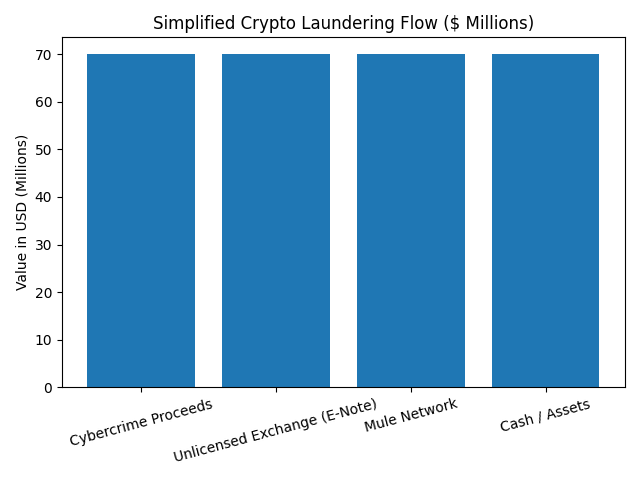
The typical laundering flow involved:
- Illicit Crypto Generation – Ransomware or hacking victims pay in cryptocurrency.
- Unlicensed Exchange Conversion – Funds are sent to E-Note, bypassing KYC and AML controls.
- Money Mule Networks – Human intermediaries move funds through multiple accounts.
- Cash-Out or Asset Conversion – Crypto is converted into cash, gift cards, or other assets.
By providing both exchange services and mule coordination, E-Note reduced friction for criminals and increased the scalability of cybercrime operations.
3. Why Intermediaries Are the New Target
Historically, law enforcement focused on individual hackers or ransomware operators. However, these actors are often anonymous, geographically dispersed, and technically sophisticated.
U.S. authorities now argue that targeting intermediaries—the services that enable monetization—delivers a higher systemic impact.
As stated in official FBI communications, dismantling cash-out mechanisms:
- Raises the cost of cybercrime
- Increases operational risk for criminals
- Discourages new entrants into ransomware ecosystems
[“Law Enforcement Focus Shift Toward Intermediaries”]
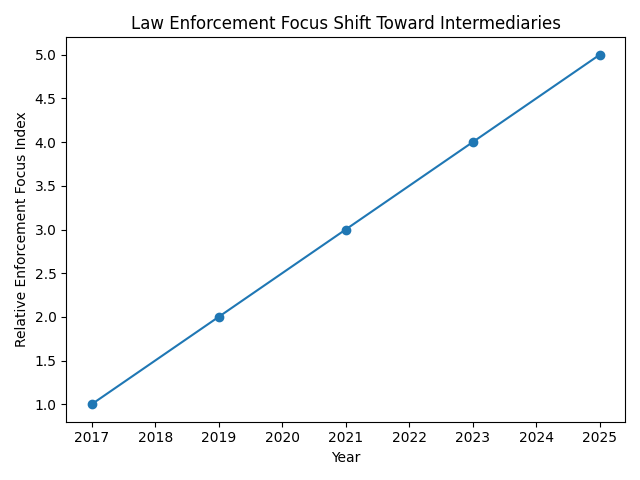
This shift mirrors earlier strategies used against drug trafficking and terrorism financing, where cutting off financial rails proved more effective than arresting individual operatives.
4. The Role of Unlicensed Exchanges in the Shadow Economy
E-Note represents a class of platforms often referred to as “shadow exchanges.” These entities:
- Operate without licenses
- Avoid KYC/AML obligations
- Market themselves through underground forums
- Offer “privacy” as a selling point
While decentralized finance (DeFi) protocols often raise regulatory questions, E-Note was not decentralized. It was centrally operated, controlled infrastructure—making it fully subject to existing financial-crime laws.
For regulators, this distinction matters: the case reinforces that centralized operators cannot hide behind crypto terminology.
5. Implications for Crypto Investors
For investors searching for the “next crypto opportunity,” this case delivers several important signals:
- Regulatory Risk Is Real
Projects linked—directly or indirectly—to laundering risk face existential threats. - Compliance-First Infrastructure Gains Value
Regulated exchanges, compliant wallets, and on-chain analytics firms stand to benefit. - Privacy Coins and Mixers Face Scrutiny
Even legitimate privacy tools may experience reduced liquidity or delistings.
Investors increasingly need to assess not only tokenomics, but also regulatory survivability.
6. Lessons for Blockchain Builders and Operators
For entrepreneurs and system architects, the E-Note takedown underscores several operational realities:
- Licensing is no longer optional for custodial services.
- Audit trails and transaction monitoring are essential.
- “Offshore” or “gray-market” positioning does not guarantee safety.
Ironically, enforcement pressure is also creating new market demand—for compliant on-ramps, regulated stablecoin settlement, and cross-border crypto-fiat infrastructure.
7. A Global Enforcement Trend, Not a One-Off
The E-Note case aligns with broader actions:
- U.S. sanctions against Tornado Cash–linked entities
- European AMLD6 enforcement expansions
- Asian regulators tightening VASP licensing
Taken together, these moves suggest a structural shift: crypto is no longer treated as an experimental edge case, but as core financial infrastructure subject to full enforcement.
8. Conclusion: The End of the Easy Cash-Out Era
The FBI’s dismantling of E-Note marks more than the shutdown of a single platform. It signals the end of an era in which illicit crypto proceeds could be easily laundered through unlicensed intermediaries.
For criminals, the cost of operating is rising.
For investors, regulatory clarity is increasing.
For builders, the opportunity lies in trust-native, compliant blockchain systems.
In this new phase, the future of crypto belongs not to those who evade the system—but to those who build within it.
