
Main Points :
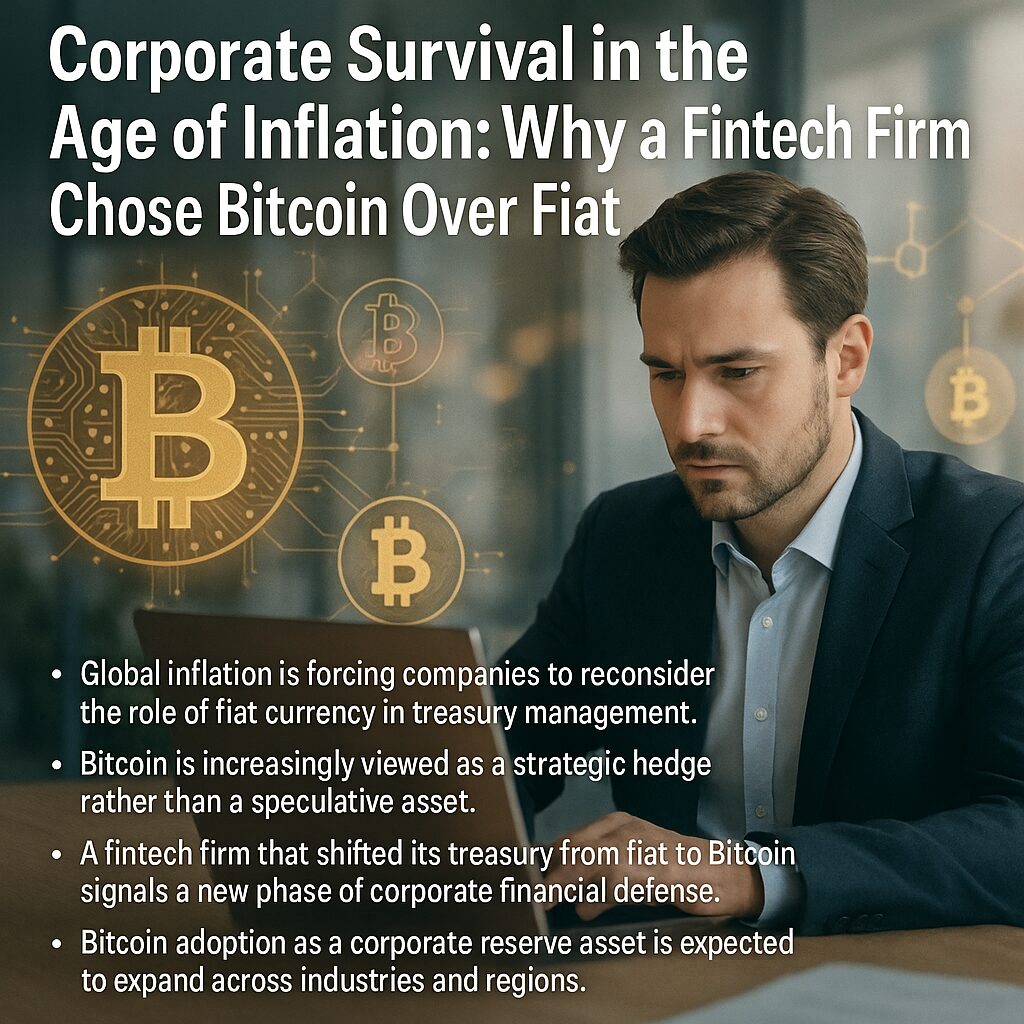
- Global inflation is forcing companies to reconsider the role of fiat currency in treasury management.
- Bitcoin is increasingly viewed as a strategic hedge rather than a speculative asset.
- A fintech firm that shifted its treasury from fiat to Bitcoin signals a new phase of corporate financial defense.
- Bitcoin adoption as a corporate reserve asset is expected to expand across industries and regions.
- Blockchain’s practical use cases—beyond speculation—are emerging as essential tools for corporate risk management and asset preservation.
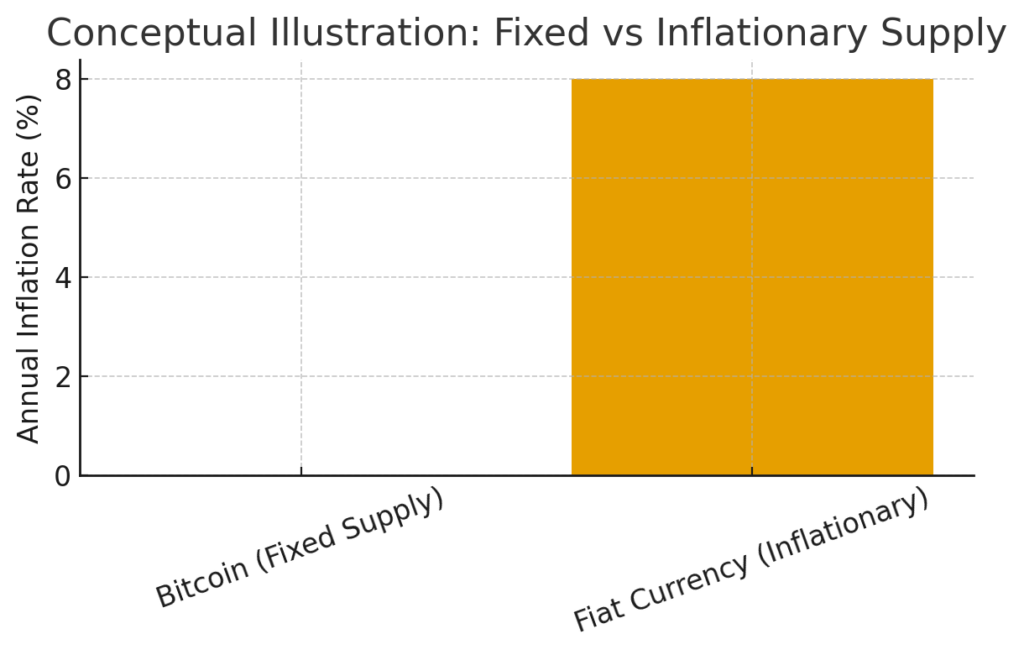
“Fiat inflation vs Bitcoin fixed supply”
1. Introduction: The New Corporate Fear—Fiat Erosion
In recent years, global financial markets have entered an era of persistent inflation, currency debasement, and growing distrust in central bank policy. For corporations—particularly those operating across volatile or emerging markets—the deterioration of fiat currency purchasing power has become more than an economic trend; it is now an existential risk.
A particularly symbolic event occurred when a fintech company, whose enterprise value had plummeted to nearly zero, publicly declared its intention to convert the majority of its treasury assets into Bitcoin (BTC). The company justified this move by stating that “holding fiat is equivalent to melting corporate assets.”
This extreme stance illustrates a broader reality: corporations are beginning to acknowledge that the traditional “cash is king” strategy no longer applies in an environment where inflation outpaces economic growth and capital preservation is no longer guaranteed through savings.
Bitcoin, once dismissed as a speculative instrument, has now entered boardrooms as a legitimate form of financial defense.
2. The Global Shift: Why Corporations No Longer Trust Fiat
Inflation in many advanced countries has exceeded 6–8% annually, with some regions experiencing even steeper declines in real purchasing power. When governments deploy aggressive monetary expansion, corporate treasuries—often held in cash or cash equivalents—become unintended collateral damage.
Many CFOs now confront uncomfortable truths:
- Cash reserves lose real value every year.
- Traditional hedging instruments (bonds, money markets) no longer reliably preserve value.
- Currency risk cannot be diversified away when all fiat currencies are simultaneously inflating.
The fintech firm’s move to Bitcoin represents an extreme but increasingly understandable reaction to these systemic weaknesses. Their logic is straightforward:
- Fiat supply expands indefinitely.
- Bitcoin supply is capped at 21 million, with a predictable issuance schedule and decreasing inflation rate.
- Fiat is centralized and policy-driven; Bitcoin is decentralized and market-driven.
From this perspective, switching to Bitcoin becomes a form of long-term asset insurance—a hedge against the erosion of purchasing power and government-driven monetary unpredictability.
3. Bitcoin as the “Last Line of Defense” for Corporate Survival
The story of the fintech firm—evaluated at effectively zero before pivoting to a BTC-based treasury—symbolizes a broader theme: when traditional business models and fiat-denominated savings begin to fail, Bitcoin becomes the last remaining asset with defensible long-term value.
Bitcoin’s value proposition as a corporate treasury asset includes:
● 1. Predictable Supply and Fixed Monetary Policy
Bitcoin’s issuance schedule is immune to political cycles, election promises, or emergency monetary interventions.
● 2. Decentralization and Trust Minimization
Companies do not need to trust any state actor or financial institution; they rely only on cryptographic verification and global consensus.
● 3. Global Liquidity and 24/7 Market Access
Unlike traditional markets, Bitcoin trades continuously across borders with deep liquidity levels, especially after institutional adoption.
● 4. Optionality for Future Use Cases
Beyond storage of value, Bitcoin’s network can integrate with treasury automation, collateralization, and payment settlement systems.
For corporations facing stagnation, devaluation, and declining margins, Bitcoin serves not only as a treasury asset but as a potential catalyst for revitalization—a statement that the company is preparing for a post-fiat economic era.
4. Global Momentum: Bitcoin Treasury Adoption Across Industries
The fintech company in the article is not alone. In fact, it is part of a growing wave:
MicroStrategy
With over $12+ billion worth of BTC (as of late 2025), MicroStrategy demonstrates that Bitcoin can be a functional treasury reserve asset for a public company.
Tesla
Although Tesla trimmed its holdings in earlier cycles, it continues to hold Bitcoin as an alternative store of value.
Regional Banks and Emerging-Market Corporations
Inflation-hit regions such as Latin America, Southeast Asia, and parts of Africa have begun integrating Bitcoin into treasury frameworks for:
- Inflation hedging
- International settlement
- Operational liquidity
- Diversification away from weakening local currencies
Institutional Funds and Asset Managers
Following the approval of U.S. and Asian Bitcoin ETFs, institutional flows have grown significantly—pushing Bitcoin further into the realm of mainstream corporate finance.
These developments demonstrate a shift from viewing Bitcoin as speculative to understanding it as a defensive monetary instrument, comparable to gold but more portable, divisible, verifiable, and globally transferable.
5. Inflation as the Ultimate Catalyst: Why Companies Are Acting Now
The corporate rationale for Bitcoin adoption intensifies with rising inflation.
Key factors:
● Monetary Dilution
Global M2 money supply expanded at unprecedented rates between 2020 and 2025, leaving corporations with rapidly depreciating balance sheets.
● Bond Market Volatility
Government bonds—previously the most stable institutional asset—have lost value due to interest rate hikes.
● The Erosion of “Safe Assets”
Treasury bills, time deposits, and cash equivalents no longer preserve value in real terms.
This dynamic leads to a simple equation:
If fiat ≈ depreciating asset → Bitcoin becomes attractive by default.
Corporations striving to stabilize their capital structure increasingly see Bitcoin not as aggressive speculation but as passive protection.
6. Beyond Finance: Practical Corporate Use Cases of Bitcoin and Blockchain
For readers seeking new income streams and practical blockchain use, Bitcoin and related technologies present multiple opportunities:
1. Treasury Optimization
Holding BTC as a portion of corporate reserves.
2. Blockchain-Based Settlements
Lower-cost alternatives to SWIFT, credit networks, or remittance rails.
3. Tokenized Assets
Representing invoices, payments, and treasury positions on-chain.
4. Cross-Border Liquidity Management
Reducing exchange fees and delays via BTC rails.
5. Yield Generation Through Institutional Lending Platforms
While risk-managed, corporations can generate additional income by lending BTC to regulated institutional borrowers.
Blockchain’s value extends far beyond speculation—it provides efficiency, transparency, and operational resilience.
7. Looking Forward: The Future of Corporate Bitcoin Adoption
Trends from 2024–2025 strongly indicate accelerated corporate adoption:
- Increasing regulatory clarity in Asia and Europe
- Mainstream ETF infrastructure providing easy access
- Growing mistrust in government monetary policy
- A new generation of CFOs familiar with digital asset management
Additionally, the argument that “Bitcoin protects long-term corporate value better than fiat” resonates strongly in inflation-heavy economies.
The more inflation persists globally, the more companies will adopt Bitcoin—not for growth—but for survival.
8. Conclusion: A New Standard for Corporate Value Preservation
The fintech firm that shifted its entire treasury strategy toward Bitcoin encapsulates a pivotal moment in global economics. What once seemed extreme is quickly becoming rational as corporations confront the limitations of fiat-denominated financial systems.
Bitcoin is emerging as:
- A hedge
- A defensive asset
- A treasury stabilizer
- A cross-border liquidity tool
- A long-term value preservation mechanism
In an age where fiat loses purchasing power year after year, Bitcoin offers corporations a radically different path—one that prioritizes sovereignty, durability, and financial resilience.
As inflation continues to reshape global business environments, Bitcoin may soon become not the exception, but the new foundation of corporate treasury policy.
