

Main Points :
- Q4 2025 saw a sharp slowdown in the number of new corporations adding Bitcoin to their balance sheets.
- Small and mid-sized companies halted accumulation, while major institutional holders increased their Bitcoin exposure.
- Public companies now hold more than 1 million BTC ($90.2B), representing 4.7% of total supply.
- Spot Bitcoin ETFs collectively hold 1.49M BTC, or 7% of circulating supply.
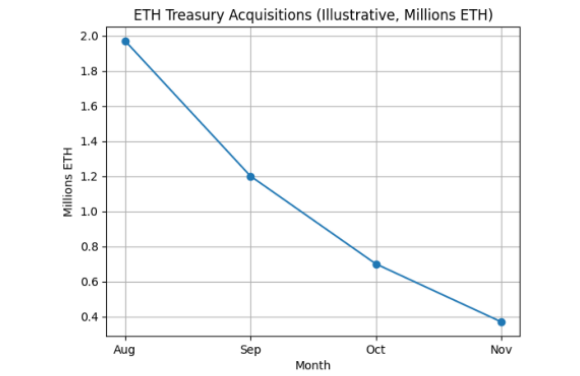
- ETH treasury demand dropped dramatically—down 81% from August to November.
- Ripple-backed entities and other digital asset treasuries also slowed purchases, reflecting market uncertainty.
1. Introduction: A Quarter of Divergence in Corporate Crypto Strategy
The fourth quarter of 2025 marks one of the clearest divergences in institutional digital asset behavior seen in recent years.
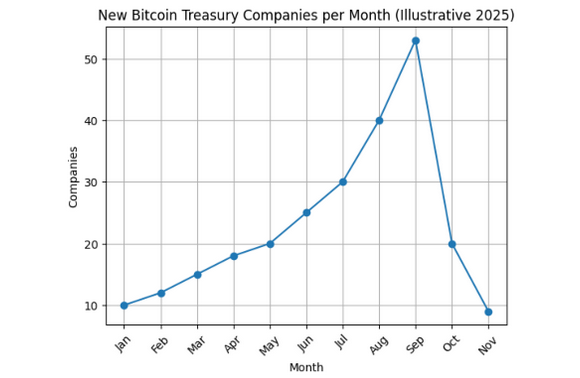
While Bitcoin adoption surged earlier in 2025—reaching a peak of 53 new treasury-adopting companies in Q3—the pace collapsed to just 9 new companies in Q4.
This slowdown, however, hides a deeper trend. Major Bitcoin-accumulating corporations—especially the largest holder, Strategy—continued expanding their positions, even as smaller entities paused or reduced exposure.
In effect, Q4 2025 highlights the beginning of a new market structure:
→ A consolidation of Bitcoin ownership under financially stronger institutions.
This dynamic has meaningful implications for investors, miners, and builders searching for new opportunities in blockchain markets.
2. Declining Corporate Adoption: A Q4 Snapshot
CryptoQuant’s latest blockchain data shows a steep decline in new corporate Bitcoin treasuries.
Where Q3 saw rapid acceleration in adoption, Q4 shows caution, hesitation, and even liquidation among several previous buyers.
2.1 The Numbers Behind the Trend
- Q3 2025: 53 new companies added BTC to their balance sheets
- Q4 2025: Only 9 new companies
- 2025 year-to-date: 117 total new adopters
While total participation increased throughout the year, the majority of new adopters held small amounts, suggesting exploratory exposure rather than long-term treasury strategy.
2.2 Example Cases: Halting and Liquidation
Several companies publicly paused or reversed accumulation:
Metaplanet (Japan) — Pause
Metaplanet, once a vocal BTC advocate, has not purchased Bitcoin for more than two months.
This pause aligns with rising financing pressure and market volatility.
Satsuma Technology (UK) — Partial liquidation
Satsuma sold 579 BTC for approximately $53M, reducing its holdings to 620 BTC.
These actions reinforce the broader narrative:
→ smaller companies are more sensitive to market downturns and regulatory uncertainty.
3. Major Institutional Holders Are Still Accumulating
Even as smaller entities pause, large corporations with deep capital reserves are behaving very differently.
3.1 Strategy’s Massive Accumulation Continues
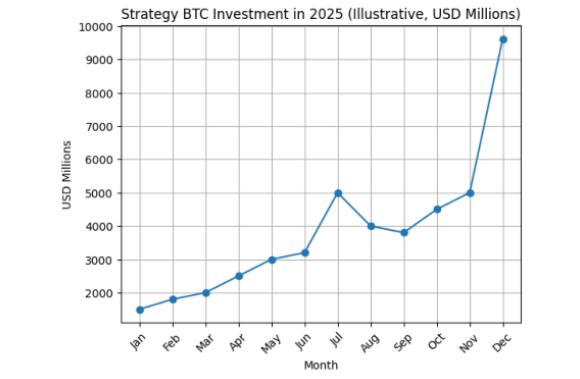
The largest publicly known corporate Bitcoin holder, Strategy, made one of its biggest 2025 purchases in December:
- $962M worth of BTC—its largest buy since July
- Bringing its total 2025 purchases within $500M of its 2024 record of $21.97B
These figures suggest Strategy is continuing its long-term accumulation philosophy regardless of short-term volatility.
3.2 Public Companies Now Hold 4.7% of Bitcoin’s Total Supply
According to BitcoinTreasuries.NET:
- Corporate treasuries hold over 1,000,000 BTC
- Valued at $90.2B
- Representing 4.7% of the total supply
Combined with ETFs:
- Spot Bitcoin ETFs hold 1.49M BTC
- Equivalent to 7% of circulating supply
Combined Institutional Ownership
→ Public companies + ETFs = 11.7% of all Bitcoin in existence
This concentration has profound implications:
- Bitcoin scarcity increases
- Long-term price resilience strengthens
- Smaller market participants may face higher entry costs
- Supply shocks become more likely during future bull cycles
4. Digital Asset Treasuries (DATs) Show Sharp Decline
The slowdown is not limited to Bitcoin.
Digital asset treasury strategies across XRP and ETH also weakened in Q4.
4.1 Ripple-Backed Evernorth Halts Purchases
Evernorth Holdings, a major DAT player, has made no purchases since late October after acquiring 950M XRP earlier that month.
Within weeks, market pressure resulted in a floating loss of nearly $80M, contributing to strategic hesitation.
4.2 Massive Decline in ETH Treasury Activity
The ETH treasury segment saw the single largest contraction:
ETH Treasury Acquisition Volume
- August: 1.97M ETH
- November: 370,000 ETH
- Decline: 81% in three months
The largest institutional ETH buyer, Bitmine Immersion Technologies, dramatically reduced purchases:
- July: $2.6B in ETH
- December: $296M
This suggests a reassessment of Ethereum’s corporate treasury role, driven by:
- Decreasing staking yields (USD terms)
- Competitive returns from BTC ETFs
- Slowing DeFi expansion
- Energy-intensive market downturn pressures
5. Why This Matters for Crypto Investors and Builders
The data reveals a realignment in institutional digital asset strategy.
5.1 Bitcoin’s Institutional Maturity Is Strengthening
Large corporations and ETFs are increasing control over BTC supply.
This signals:
- A belief in Bitcoin’s long-term macro role
- A shift toward viewing BTC as “digital strategic reserves”
- Declining sell-pressure from institutions
5.2 Smaller Companies Are More Sensitive to Market Cycles
Pauses and liquidations from smaller companies typically indicate:
- Tightening financing conditions
- Higher short-term volatility concerns
- Exposure to quarterly reporting constraints
- Uncertainty about monetary policy
This creates opportunities for investors who monitor treasury behavior as a leading indicator of market cycles.
5.3 Ethereum’s Reduced Treasury Appeal Raises Questions
An 81% decline in ETH treasury accumulation suggests fragility in ETH’s narrative as:
- A “yield-bearing asset”
- A “corporate blockchain resource”
Companies may be waiting for:
- Regulatory clarity for staking
- Improved L2 economics
- Cheaper accumulation conditions
5.4 Opportunity for New Crypto Assets
With companies stepping back from ETH and altcoin treasuries, the market gap opens for:
- New enterprise-grade tokens
- Stablecoin-integrated treasury products
- Real-world-asset (RWA) backed tokens
- Programmable liquidity solutions
For readers seeking new revenue streams and emerging crypto assets, monitoring corporate treasury flows offers powerful insights into future demand patterns.
6. Conclusion: A Market Defined by Divergence
Q4 2025 marks a pivotal turning point in institutional crypto behavior.
While corporate Bitcoin adoption slowed dramatically, this headline obscures the true underlying trend:
Large institutions are accumulating more aggressively than ever, while smaller companies retreat.
Additionally:
- Bitcoin continues solidifying its role as a global macro-reserve asset.
- Ethereum faces a temporary decline in institutional relevance.
- Digital asset treasuries overall are cooling—but may pivot depending on market catalysts in 2026.
For investors, builders, and analysts, one strategic message stands out:
→ Bitcoin’s structural scarcity is deepening, institutional ownership is rising, and new opportunities in emerging tokens and treasury-grade digital assets are opening.
