

Main Points :
- Despite Bitcoin’s price remaining largely flat around $88,000, U.S. publicly listed companies are steadily increasing their Bitcoin treasury holdings.
- Corporate accumulation is no longer limited to crypto-native firms; it now spans AI infrastructure, healthcare, and traditional industries.
- Strategy continues to dominate corporate Bitcoin ownership, accelerating purchases even during market stagnation.
- This trend reflects a structural shift: Bitcoin is increasingly treated as a strategic treasury reserve and financial infrastructure asset, not a speculative trade.
- For investors and operators, corporate balance-sheet behavior offers critical signals about Bitcoin’s long-term role in global finance.
1. A Quiet but Meaningful Shift in Corporate Bitcoin Strategy
In early 2026, Bitcoin markets appear calm on the surface. Prices have hovered in a relatively narrow range near $88,000, showing little of the explosive volatility that once defined the asset. To casual observers, this sideways movement may suggest a lack of momentum or diminishing interest.
Yet beneath this calm exterior, a significant and telling trend is unfolding: U.S. publicly listed companies are quietly but consistently expanding their Bitcoin holdings.
Recent regulatory filings and corporate disclosures reveal that multiple firms—across technology, infrastructure, and even healthcare—are increasing their Bitcoin treasury allocations. This behavior stands in sharp contrast to earlier cycles, when corporate Bitcoin purchases tended to coincide with euphoric bull markets.
What makes this moment different is precisely the absence of hype. These companies are accumulating Bitcoin not because prices are rising rapidly, but because they increasingly view Bitcoin as a long-term strategic asset.
This article examines the recent disclosures, explores why corporations are buying Bitcoin during a flat market, and analyzes what this trend means for investors, entrepreneurs, and practitioners seeking new revenue sources and practical blockchain applications.
2. American Bitcoin Corporation: Steady Accumulation Without Noise
One of the most notable disclosures this week came from American Bitcoin Corporation, a Nasdaq-listed firm that has steadily climbed the ranks of corporate Bitcoin holders.
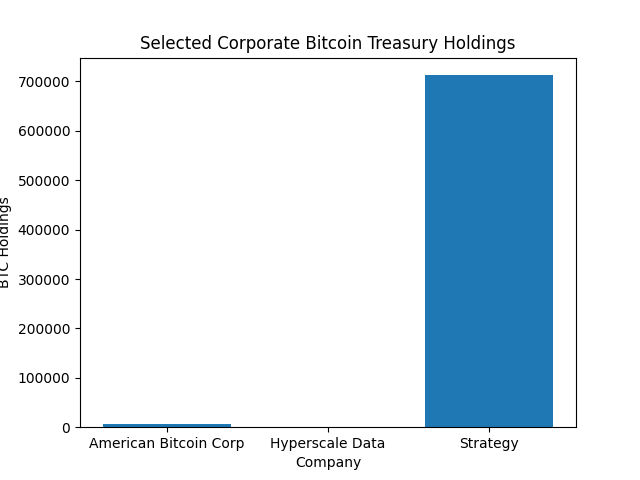
The company announced that it had increased its Bitcoin holdings to 5,843 BTC, adding 416 BTC to its treasury compared with its previous disclosure. While modest relative to the largest holders, this accumulation is meaningful given the broader market conditions.
American Bitcoin Corporation traces its operational roots to mining infrastructure originally associated with Hat 8, and it now operates as one of Hat 8’s key subsidiaries. Since its Nasdaq listing in September 2025, the company has positioned itself as a Bitcoin-centric treasury vehicle rather than a pure mining play.
Notably, the firm counts Eric Trump as a co-founder, a detail that has drawn media attention but is arguably less important than the company’s financial metrics. According to the company, its “BTC Yield”—a measure of the increase in Bitcoin exposure per share—reached 116% as of January 25, 2026.
This metric underscores a crucial shift: companies are no longer judged solely by the absolute amount of Bitcoin they hold, but by how efficiently they increase Bitcoin exposure for shareholders.
[Selected Corporate Bitcoin Treasury Holdings]
3. Bitcoin Beyond Crypto: AI Data Centers and Healthcare Join In
American Bitcoin Corporation is not alone. Other firms—many of them far removed from traditional crypto narratives—are also increasing their Bitcoin exposure.
Hyperscale Data and the AI–Bitcoin Nexus
On the same day as American Bitcoin’s disclosure, Hyperscale Data, an AI-focused data center operator, announced that its subsidiary, Alt Capital Group, had purchased an additional 10 BTC on the open market. This brought the group’s consolidated Bitcoin holdings to 560 BTC.
Hyperscale Data explicitly describes Bitcoin as a “core asset,” a notable statement from a company operating at the intersection of artificial intelligence, cloud infrastructure, and energy-intensive computing.
This alignment is not accidental. AI data centers and Bitcoin share several economic characteristics: high capital intensity, long-term infrastructure planning, and sensitivity to energy markets. For such firms, Bitcoin serves both as a treasury reserve and as a hedge against monetary debasement in capital-heavy operations.
SRX Health Solutions: Crypto Enters Healthcare Balance Sheets
Perhaps more surprising is the disclosure from SRX Health Solutions, a healthcare services provider that announced it now holds approximately $18 million worth of digital assets, including both Bitcoin (BTC) and Ether (ETH).
Healthcare is traditionally conservative in treasury management, favoring cash and government securities. SRX’s move signals that Bitcoin is crossing a psychological threshold: it is becoming acceptable even in sectors where regulatory risk and balance-sheet stability are paramount.
4. A Flat Market, but Strategic Buying Continues
These corporate purchases are taking place against a backdrop of market stagnation. Over the past 30 days, Bitcoin prices have moved largely sideways around $88,000, and at the time of writing, Bitcoin was down more than 12% year-on-year, according to CoinGecko.
[Bitcoin Price (Illustrative 30-Day Flat Movement)]

In previous cycles, such price behavior might have discouraged new entrants. Today, however, it appears to be encouraging disciplined accumulation.
This pattern mirrors behavior traditionally seen in commodities and foreign exchange markets, where institutional players accumulate during periods of low volatility and reduced media attention. For corporations with long-term horizons, flat prices reduce timing risk and allow for structured treasury planning.
5. Strategy: Relentless Accumulation as a Corporate Doctrine
No discussion of corporate Bitcoin holdings is complete without Strategy, the company that has effectively redefined what a Bitcoin treasury strategy can look like.
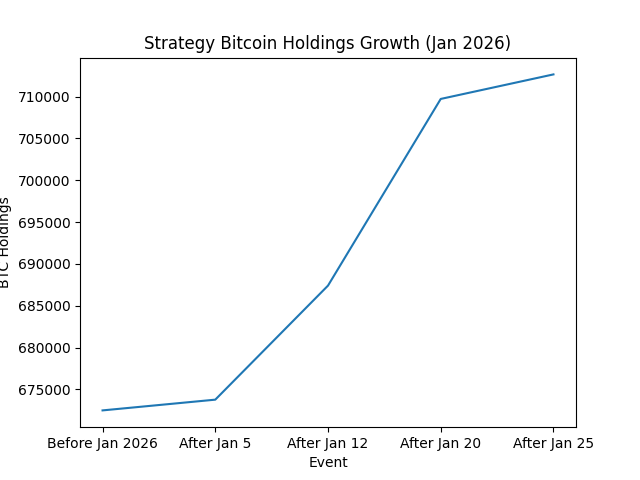
In January 2026 alone, Strategy executed four separate Bitcoin purchases, dramatically increasing its already massive holdings.
- On January 5, the company acquired 1,283 BTC for approximately $116 million.
- Roughly one week later, it purchased 13,627 BTC for $1.25 billion, its largest acquisition since July.
- This was followed by the purchase of 22,305 BTC for approximately $2.13 billion.
- Finally, Strategy added another 2,932 BTC for $264 million.
As a result, Strategy’s total Bitcoin holdings reached 712,647 BTC, an amount that dwarfs all other corporate treasuries combined.
[Strategy Bitcoin Holdings Growth (January 2026)]
Strategy’s approach is unapologetically aggressive. Rather than diversifying, the company has embraced Bitcoin as its primary treasury reserve, financing purchases through equity issuance and debt instruments.
While controversial, this strategy sends a powerful signal: at least one major public company views Bitcoin not as a hedge, but as the core of its financial identity.
6. Not Everyone Is Buying: Diverging Corporate Strategies
Importantly, not all companies are moving in the same direction. Market stagnation has also prompted reassessment.
Last week, GameStop transferred its entire 4,710 BTC holdings to Coinbase Prime. This move sparked speculation that the retailer may be reconsidering or unwinding its Bitcoin treasury strategy.
Such divergence is healthy. It highlights that corporate Bitcoin adoption is no longer a one-size-fits-all narrative. Companies are making differentiated decisions based on cash flow, shareholder expectations, regulatory exposure, and risk tolerance.
7. What This Means for Investors and Builders
For readers seeking new crypto assets, revenue opportunities, or practical blockchain applications, the implications are significant.
First, corporate accumulation during flat markets suggests that Bitcoin is increasingly valued for its balance-sheet properties, not just price appreciation. This supports the case for Bitcoin as a form of digital reserve asset.
Second, the entry of non-crypto sectors—AI infrastructure and healthcare in particular—opens opportunities for services around custody, accounting, compliance, and treasury optimization. These are practical, revenue-generating use cases well beyond speculative trading.
Third, monitoring corporate disclosures may offer more reliable long-term signals than short-term price movements. When companies commit capital at scale during periods of low volatility, they are expressing conviction grounded in strategic planning rather than market emotion.
8. Conclusion: Bitcoin as Corporate Financial Infrastructure
The quiet expansion of corporate Bitcoin holdings in early 2026 marks an important evolution in the asset’s role.
Bitcoin is no longer merely a speculative bet or a hedge discussed during bull markets. It is increasingly treated as financial infrastructure—a programmable, scarce, and globally transferable reserve asset suitable for corporate balance sheets.
For investors, this trend reinforces Bitcoin’s long-term relevance even in the absence of dramatic price movements. For entrepreneurs and operators, it signals growing demand for the tools, services, and governance frameworks that support institutional-grade Bitcoin adoption.
In a market that appears calm, some of the most consequential decisions are being made quietly—and they point toward a future in which Bitcoin is deeply embedded in corporate finance.
