
Main Points :
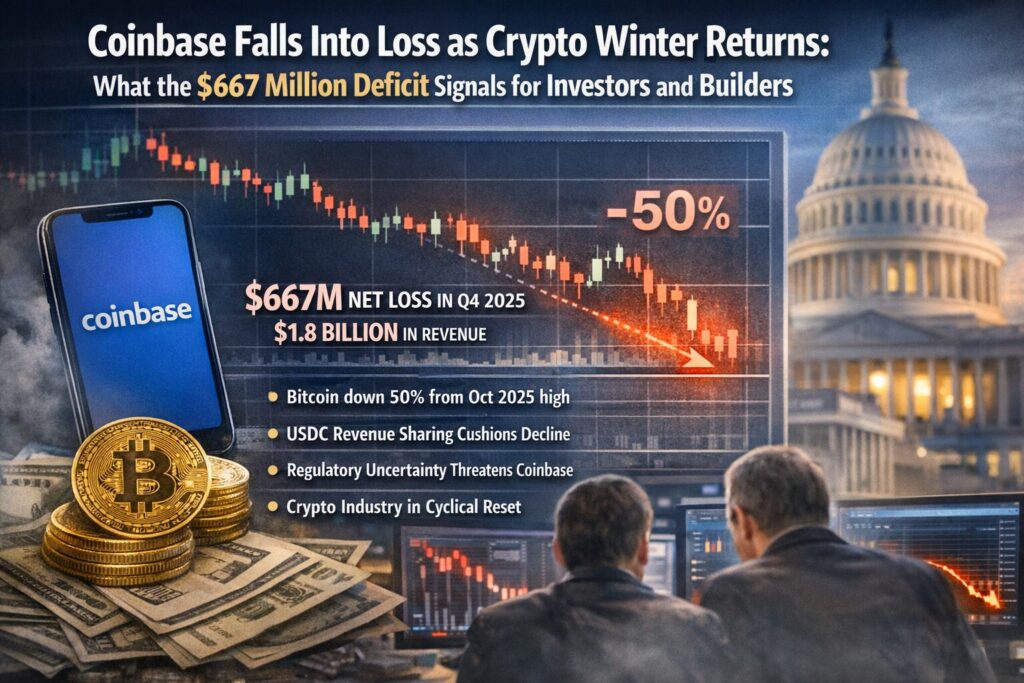
- Coinbase reported a $667 million net loss in Q4 2025 despite $1.8 billion in revenue.
- Bitcoin’s roughly 50% decline from its October 2025 high sharply reduced trading activity.
- Stablecoin revenue-sharing, particularly from USDC, helped cushion the downturn.
- Regulatory uncertainty in the United States threatens Coinbase’s stablecoin-linked income model.
- The broader crypto industry is restructuring but not collapsing, signaling a cyclical reset rather than systemic failure.
1. A Sudden Turn: From $1.3 Billion Profit to $667 Million Loss
Coinbase, one of the largest cryptocurrency exchanges in the United States, reported that its fourth-quarter 2025 revenue came in at $1.8 billion, representing a decline of more than 20% and falling short of market expectations. More strikingly, the company swung to a net loss of $667 million. In the same quarter the previous year, Coinbase had recorded a net profit of approximately $1.3 billion.
This dramatic reversal reflects the harsh realities of another crypto winter. Bitcoin, the bellwether asset of the digital asset market, fell roughly 50% from its October 2025 peak. As trading volumes declined, transaction fee income — historically Coinbase’s primary revenue engine — contracted sharply. At the same time, the company recorded valuation losses on its own crypto holdings, amplifying the impact on net income.
[Coinbase Net Income Comparison]
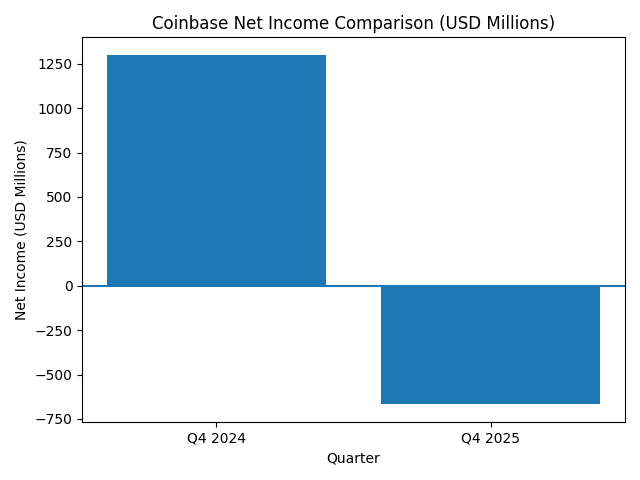
The chart clearly illustrates the dramatic shift from strong profitability to deep loss within a single year. For investors searching for new crypto opportunities, this volatility underscores both risk and asymmetric potential.
2. Revenue Resilience and Structural Diversification
Although revenue declined, $1.8 billion remains a substantial figure in absolute terms. Over the past several years, Coinbase has actively reduced its reliance on spot trading. The acquisition of Deribit, a crypto options exchange, marked an expansion into derivatives markets. The company also introduced stock trading services and prediction markets, attempting to build a more diversified financial platform.
One of the most important stabilizing factors has been Coinbase’s revenue-sharing model tied to USD Coin (USDC), issued by Circle. Under this model, Coinbase earns a share of interest generated from USDC reserves. During periods of depressed trading activity, stablecoin-related income has provided comparatively steady cash flow.
According to analysts, including those cited by Bloomberg, the stablecoin segment acted as a buffer during this downturn. In effect, USDC-linked income partially insulated Coinbase from the worst trading volatility.
[Revenue vs Market Expectation]
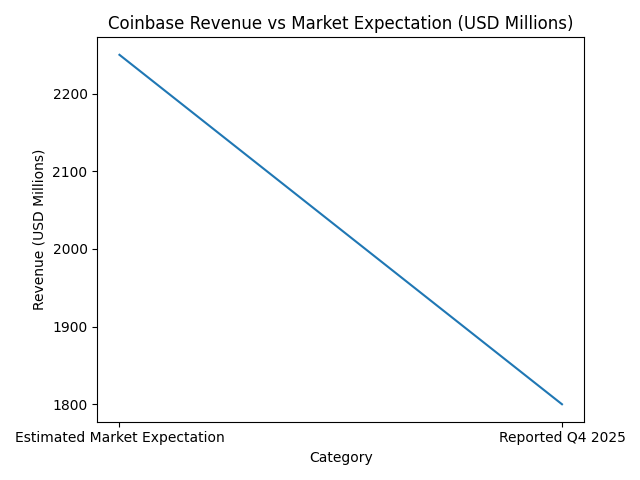
The revenue comparison illustrates how expectations were recalibrated downward, yet the company maintained significant scale. For builders interested in practical blockchain applications, stablecoins remain one of the most resilient business models in crypto.
3. Regulatory Clouds Over Stablecoin Rewards
However, even this stabilizing pillar is under threat. In the U.S. Senate, a market structure bill under deliberation includes provisions that may restrict exchanges from offering rewards linked to users’ stablecoin balances. Such limitations would directly impact Coinbase’s revenue-sharing model tied to USDC holdings.
Coinbase CEO Brian Armstrong reportedly withdrew prior support for the legislation in January, signaling growing concern within the company. Ongoing negotiations, potentially involving the White House, could materially reshape Coinbase’s income structure.
For readers seeking the next income stream in crypto, this regulatory dynamic is critical. Yield-bearing stablecoins have emerged as a hybrid between banking products and crypto-native assets. If reward mechanisms are curtailed, exchanges may need to pivot toward custody, infrastructure services, or tokenized real-world asset platforms.
4. Industry-Wide Impact Without Systemic Collapse
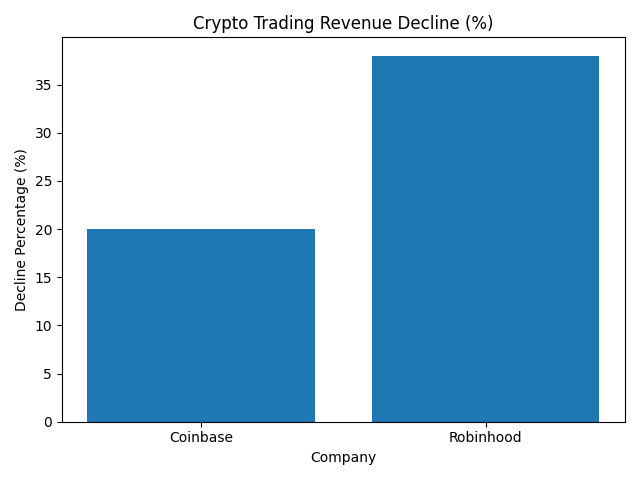
The crypto winter is not isolated to Coinbase. Gemini announced workforce reductions of up to 25% and scaled back overseas operations. Kraken saw the departure of its chief financial officer. Robinhood reported that its crypto trading revenue fell by 38%.
[Industry Revenue Decline Comparison]
Yet unlike the catastrophic collapses of Terra-Luna and FTX in 2022, the current downturn does not appear to involve large-scale insolvencies. Instead, companies are restructuring rapidly. Cost-cutting, product consolidation, and renewed focus on sustainable revenue streams characterize this phase.
This distinction is important. The 2022 crisis was systemic, involving cascading failures. The 2025–2026 winter appears cyclical — driven by price compression and reduced speculative demand rather than structural fraud or platform collapse.
5. What This Means for Investors Seeking the Next Asset
For investors hunting for new digital assets, the lesson is twofold. First, exchange-dependent tokens or revenue models tied purely to spot trading volumes are highly cyclical. Second, revenue models connected to infrastructure, custody, derivatives, and stablecoin settlement are comparatively durable.
Bitcoin’s 50% correction demonstrates that volatility remains intrinsic. However, institutional adoption trends — including ETF participation and tokenization initiatives — suggest that structural integration with traditional finance continues.
Builders and operators should consider the following emerging areas:
- Stablecoin settlement infrastructure.
- Tokenized treasury products.
- On-chain derivatives.
- Compliance-driven blockchain services.
- Institutional custody solutions.
Even in downturns, capital rotates rather than disappears. The crypto winter forces efficiency and exposes unsustainable models, but it also creates discounted entry points.
6. Practical Blockchain Utilization Beyond Speculation
From a practical perspective, the most resilient blockchain applications are not purely speculative. Stablecoins, remittance rails, cross-border settlement systems, and tokenized real-world assets provide utility independent of bull markets.
Coinbase’s pivot into diversified services reflects this reality. Exchanges that survive multiple cycles tend to evolve into broader financial infrastructure providers.
For entrepreneurs exploring new blockchain revenue streams, this period offers strategic advantages:
- Lower competition for developer talent.
- Reduced asset valuations for acquisitions.
- Regulatory clarity in progress.
- Institutional partnerships deepening despite price volatility.
7. Conclusion: Reset, Not Ruin
Coinbase’s $667 million loss in Q4 2025 marks a significant setback, but not an existential crisis. Revenue remains substantial at $1.8 billion. Stablecoin income continues to cushion volatility. Regulatory developments introduce uncertainty, yet also push the industry toward clearer frameworks.
The broader crypto market is undergoing restructuring rather than collapse. For disciplined investors and builders, this environment favors infrastructure plays over speculative momentum trades.
Crypto winters historically precede innovation waves. The companies that survive tend to be those that diversify revenue, manage risk conservatively, and build for utility rather than hype.
In that sense, Coinbase’s loss may not signal failure — but transition.
