
Main Points :
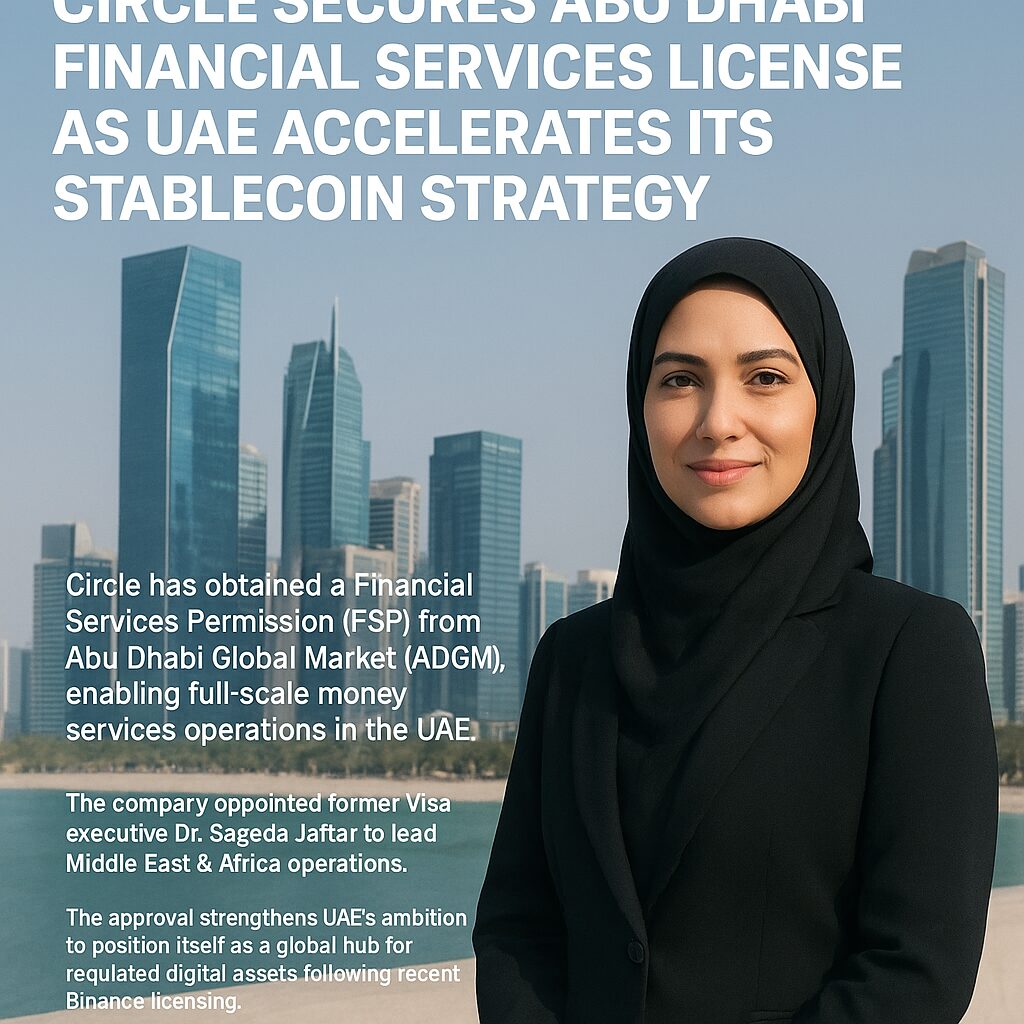
- Circle has obtained a Financial Services Permission (FSP) from Abu Dhabi Global Market (ADGM), enabling full-scale money services business operations in the UAE.
- The company appointed former Visa executive Dr. Saeeda Jaffar to lead Middle East & Africa operations.
- The approval strengthens UAE’s ambition to position itself as a global hub for regulated digital assets following recent Binance licensing.
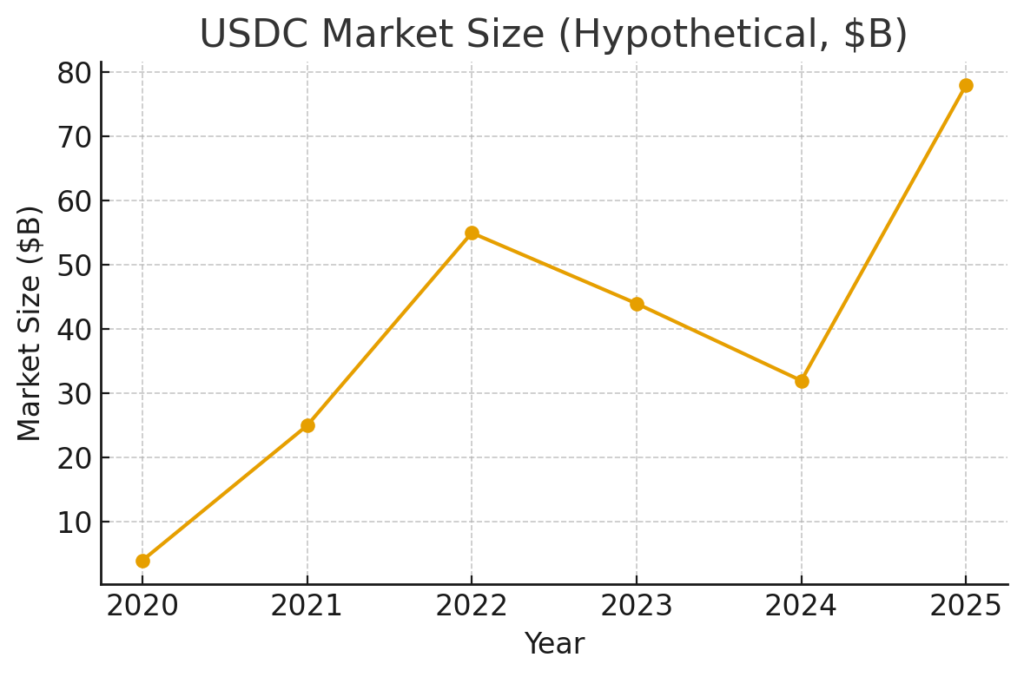
- USDC, a $78 billion stablecoin, is becoming increasingly integrated into global payment infrastructures, especially in regions with costly or limited access to traditional banking.
- Regulatory clarity in the UAE is accelerating institutional adoption of stablecoins for payments, remittances, settlement, and treasury operations.
Introduction: A New Phase for Regulated Stablecoins
Circle, the issuer of the $78 billion USD Coin (USDC) stablecoin, has secured a major regulatory milestone in the Middle East. On December 9, the Abu Dhabi Global Market (ADGM) granted the company a Financial Services Permission (FSP) license, enabling it to operate as a fully regulated money services provider in the United Arab Emirates (UAE). This development represents more than a local expansion—it signals the UAE’s commitment to becoming a global epicenter of regulated digital assets and stablecoin-based financial infrastructure.
The approval comes at a time when institutional crypto adoption is accelerating worldwide. As banks, remittance firms, and fintech companies explore blockchain-based payment rails, stablecoins such as USDC are emerging as critical assets connecting traditional finance with decentralized networks.
Below, this article expands on the news, contextualizes broader market developments, and analyzes the implications for investors, businesses, and the growing ecosystem of blockchain-based financial services.
1. Circle’s Entry into Abu Dhabi: What the New License Means
Circle’s newly obtained FSP license from ADGM’s Financial Services Regulatory Authority (FSRA) allows the company to conduct money services business operations, including issuance, custody, and payment services using USDC. It follows a provisional approval issued earlier in April, now converting into a fully authorized operational framework within the ADGM financial free zone.
This license grants Circle a legally recognized foundation to serve businesses across the UAE with stablecoin-based payment and settlement solutions. For example:
- Business payments and payroll via USDC
- Cross-border remittances at lower cost
- Institutional settlement between banks and fintechs
- Tokenized asset settlement within regulated environments
Circle’s FSP license also enhances the credibility of USDC in the region. Corporate treasuries and payment platforms that previously hesitated due to regulatory uncertainty can now integrate USDC with greater confidence.
2. Strategic Leadership: Appointment of Dr. Saeeda Jaffar
At the same time Circle announced its license, it revealed the appointment of Dr. Saeeda Jaffar as the Head of Middle East and Africa operations. Dr. Jaffar brings extensive experience from Visa, where she oversaw regional payment strategies and financial inclusion initiatives.
Her appointment signals Circle’s intention to establish institutional relationships with:
- Banks
- Payment processors
- Remittance operators
- Government-related technology initiatives
- Corporate treasury departments
This leadership move is strategically aligned with the UAE’s vision of positioning itself at the forefront of next-generation financial technology.
3. UAE’s Growing Influence as a Global Digital Asset Hub
The UAE has aggressively pursued a regulatory-first approach to digital assets. Circle’s approval came just one day after Binance secured a license from the same regulatory authority, highlighting a coordinated effort to onboard global players into a regulated environment.
In the broader context:
- Dubai’s Virtual Asset Regulatory Authority (VARA) and
- Abu Dhabi’s FSRA,
together form the region’s most comprehensive digital asset regulatory framework.
Their approach emphasizes:
- Clear licensing pathways
- Consumer protection
- Money laundering controls
- Market integrity standards
- Integration with banking infrastructure
This is in contrast with several Western jurisdictions, where regulatory uncertainty has caused companies to delay or scale back operations.
4. Stablecoins as the Backbone of Global Digital Finance
USDC is currently one of the largest stablecoins in the world, with a circulating supply of approximately $78 billion. Across the broader market, stablecoins represent a $300 billion asset class and continue to grow rapidly as institutional adoption increases.
Their appeal lies in characteristics such as:
- 1:1 U.S. dollar backing
- Real-time settlement
- Global compatibility
- Programmability for smart contracts
- Lower costs compared to SWIFT payments
In developing markets—where banking fees are high or infrastructure is lacking—the adoption of stablecoins for remittances and business payments is accelerating quickly.
The UAE, positioned as a global remittance hub, sees stablecoins as a tool to reduce friction and enhance financial connectivity.
5. Why the UAE Matters for Circle’s Global Strategy
Circle’s expansion into the UAE is part of a broader global strategy that includes:
- Expanding regulated issuance in the EU under MiCA
- Strengthening operations in Singapore and Japan
- Targeting regions with high remittance flows such as the Philippines and India
- Partnering with global payment institutions like Visa and MoneyGram
The UAE sits at a strategic intersection of these markets.
Key advantages of UAE operations
- Gateway to the Middle East, Africa, and South Asia (MEASA)
These regions collectively handle hundreds of billions of dollars in annual remittances. - Pro-business regulatory environment
The UAE actively collaborates with global fintech players. - Integration with major financial institutions
UAE banks are increasingly supportive of blockchain-based settlement. - Alignment with national digital transformation strategies
The UAE’s long-term agendas—such as the Abu Dhabi Economic Vision 2030—include digital finance as a core pillar.
6. Global Trends Reinforcing Circle’s Move
Several global developments reinforce the significance of Circle’s entry into Abu Dhabi:
A. Institutional Adoption Is Accelerating
Major financial entities—BlackRock, Fidelity, JPMorgan—are now exploring tokenized assets, programmable payments, and blockchain settlement layers.
USDC is a natural fit for these use cases.
B. Visa and Mastercard Expand Stablecoin Settlements
Visa’s pilot programs using USDC on Solana and Ethereum highlight growing real-world utility.
C. Governments Are Opening Up to Regulated Stablecoins
The UK, Japan, Singapore, and Hong Kong have all created frameworks for fiat-backed stablecoins.
D. De-dollarization Debates Increase Demand for Digital Dollars
Despite discussions about diversification away from the U.S. dollar, demand for digital dollars—including USDC—is rising in emerging markets.
E. Tokenization Markets Are Exploding
Analysts forecast that tokenized real-world assets (RWAs) could exceed $10 trillion by 2030. Stablecoins will be the settlement layer for these ecosystems.
7. Implications for Investors and Crypto Entrepreneurs
Circle’s licensing opens new opportunities:
A. Payment Platforms
Merchants and fintechs can adopt USDC for cross-border settlement and instant treasury operations.
B. Remittance Providers
The UAE is one of the world’s largest remittance corridors (>$100 billion annually).
USDC could reduce fees from $7 per transaction to less than $0.10.
C. Institutional Asset Managers
Regulated stablecoins enable participation in tokenized assets and on-chain money markets.
D. Web3 Builders and Startups
Stablecoins serve as the base layer for:
- NFT marketplaces
- Gaming economies
- Decentralized identity
- Tokenized loyalty systems
E. Corporate Treasuries
Companies can hold a portion of reserves in USDC for instant liquidity.
8. Risks and Regulatory Considerations
Despite rapid adoption, stablecoins face ongoing scrutiny:
- Reserve transparency
- Banking relationships
- Systemic risk management
- Cross-border AML controls
- Market fragmentation between jurisdictions
Circle’s regulated approach positions it to navigate these challenges better than many competitors.
Conclusion: A Pivotal Moment for Regulated Digital Finance
Circle’s acquisition of a Financial Services Permission license in Abu Dhabi represents more than regional expansion—it illustrates the emergence of a new global financial architecture where regulated stablecoins sit at the center of cross-border commerce.
The UAE’s proactive regulatory environment, combined with Circle’s institutional partnerships and growing stablecoin demand, suggests that the region may become a leading hub for the next decade of blockchain-enabled financial innovation.
For investors, entrepreneurs, and institutions seeking the next growth frontier in digital assets, the UAE’s stablecoin ecosystem is rapidly becoming one of the most strategically important markets in the world.
