
Main Takeaways :
- China has reaffirmed and significantly expanded its ban on cryptocurrencies, explicitly outlawing RWA tokenization and yuan-pegged stablecoins without state approval.
- The policy frames crypto not merely as a financial risk, but as a threat to monetary sovereignty, capital controls, and systemic stability.
- Overseas issuance and “regulatory arbitrage” by Chinese-linked entities are now directly targeted under a “same business, same risk, same rules” doctrine.
- The crackdown strengthens the strategic position of China’s Digital Yuan (e-CNY) while isolating private blockchain finance.
- For global investors and builders, China’s stance clarifies where innovation will be welcomed—and where it will be structurally impossible.
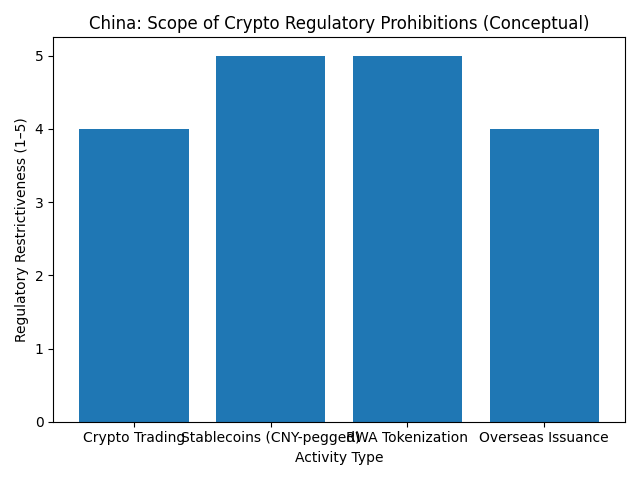
1. A Coordinated Regulatory Escalation, Not a Surprise Move
On February 6, the People’s Bank of China (PBoC), together with seven other major government bodies—including the National Development and Reform Commission, the Ministry of Public Security, the China Securities Regulatory Commission, and the State Administration of Foreign Exchange—released a joint notice expanding and clarifying China’s cryptocurrency regulations.
While China’s hostility toward cryptocurrencies is not new, this announcement represents a qualitative escalation. Rather than focusing only on trading or mining, regulators now directly address real-world asset (RWA) tokenization, stablecoins, and overseas issuance activities involving Chinese entities.
The statement explicitly links crypto-related activities to:
- Disruption of economic and financial order
- Threats to household wealth and asset safety
- Increased risks of fraud, capital flight, and illegal fundraising
This framing positions crypto not as an emerging technology needing oversight, but as a systemic financial hazard incompatible with China’s macro-control model.
2. Cryptocurrencies Are Not Money—And Never Will Be in China
The notice reiterates a core principle that has underpinned Chinese crypto policy for years:
cryptocurrencies do not have the legal status of fiat currency and must not circulate as money.
Bitcoin, Ethereum, and widely used stablecoins such as USDT are explicitly named. Activities deemed illegal financial operations include:
- Exchange between fiat currency and cryptocurrencies
- Crypto-to-crypto exchange services
- Acting as a central counterparty in crypto trading
- Information brokerage, order matching, or price-setting services
This effectively criminalizes not only exchanges, but also infrastructure providers, data intermediaries, and platforms offering “technical” support for crypto markets.
For builders, this matters: China is not merely banning speculative trading—it is closing the entire market stack.
3. A Clear and Explicit Ban on Yuan-Pegged Stablecoins
One of the most important clarifications in the new policy concerns yuan-denominated stablecoins.
The notice states that fiat-pegged stablecoins function as substitutes for certain monetary functions of legal tender. As such:
- No organization or individual may issue yuan-linked stablecoins domestically or overseas without explicit legal authorization.
- Chinese entities and individuals are prohibited from participating in or supporting offshore issuance of yuan-pegged stablecoins.
This is a direct response to global stablecoin growth, where dollar-pegged assets now settle trillions of dollars annually in on-chain transactions.
From Beijing’s perspective, a privately issued yuan stablecoin would:
- Undermine capital controls
- Enable cross-border fund flows outside state supervision
- Compete with the Digital Yuan (e-CNY)
The policy leaves little ambiguity: monetary tokenization is a state monopoly.
4. RWA Tokenization: From “Innovation” to Prohibited Activity
The notice provides one of China’s clearest official definitions of RWA tokenization to date:
the use of cryptography and distributed ledger technology to convert ownership or income rights of real assets into tradable tokens.
Unless explicitly approved and conducted on designated financial infrastructure, RWA tokenization is banned within China.
This is a critical divergence from global trends. In markets such as the US, EU, and Hong Kong, RWA tokenization is being explored for:
- Treasury bonds
- Real estate
- Private credit
- Commodities
China, however, views RWA tokenization as a backdoor form of securities issuance and shadow banking, capable of:
- Bypassing disclosure rules
- Creating leverage outside the regulated system
- Fueling speculative bubbles among retail investors
For entrepreneurs hoping to tokenize Chinese assets abroad, the door is now firmly closed.
5. Extraterritorial Reach: “Same Business, Same Risk, Same Rules”
Perhaps the most consequential aspect of the announcement is its extraterritorial scope.
The notice prohibits:
- Domestic entities and their overseas affiliates from issuing cryptocurrencies abroad without approval
- Overseas RWA tokenization based on Chinese domestic assets
Such activities will be supervised under the principle of “same business, same risk, same rules.”
In practice, this means:
- Regulatory arbitrage via offshore structures is no longer tolerated
- Chinese ownership or control triggers Chinese regulatory jurisdiction
- Multiple agencies—including SAFE and the CSRC—will coordinate enforcement
This sharply increases compliance risk for venture funds, founders, and service providers operating across borders.
6. Why Stablecoins Are Seen as a Systemic Threat
PBoC Governor Pan Gongsheng has repeatedly warned that stablecoins pose risks to global financial stability. In late 2025, he described them as:
“a threat to monetary sovereignty, especially in developing economies.”
Chinese regulators argue that stablecoins:
- Fail to meet robust KYC and AML standards
- Enable money laundering and cross-border fraud
- Facilitate illegal capital outflows
These concerns mirror debates in the US and Europe—but China’s response is categorical rather than incremental.
7. The Strategic Role of the Digital Yuan
Behind every restriction lies a strategic objective: the Digital Yuan (e-CNY).
China has invested heavily in building a state-controlled digital currency that:
- Preserves monetary sovereignty
- Enables programmable compliance
- Provides granular transaction visibility
Private stablecoins and RWA platforms represent direct competitors to this vision.
Reports indicate that even major technology firms, including Ant Group, were prevented from pursuing stablecoin issuance in Hong Kong due to these concerns.
In China’s framework, innovation is permitted only when the state retains full control.
8. Global Context: China Versus the Rest of the World
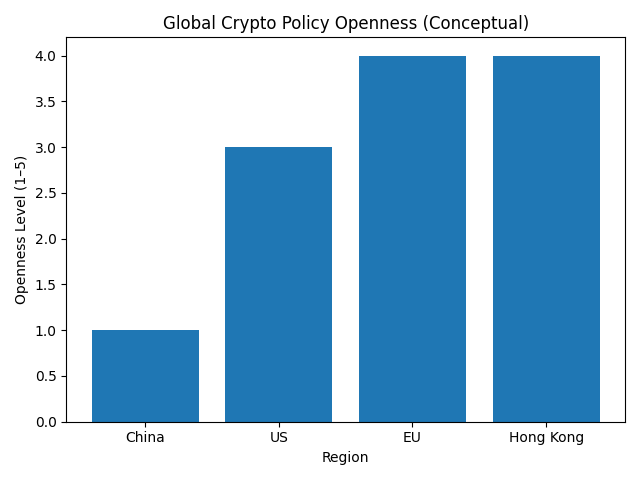
While China tightens restrictions, other jurisdictions are moving in the opposite direction.
- The US is debating market structure bills that may allow regulated stablecoin yield.
- The EU’s MiCA framework explicitly licenses crypto service providers.
- Hong Kong is positioning itself as a regulated crypto hub, including stablecoins and tokenized assets.
China’s approach is not conservative regulation—it is structural exclusion.
9. What This Means for Investors and Builders
For global readers seeking new crypto assets and revenue opportunities, the implications are clear:
- China will not be a market for open crypto innovation.
- Any China-linked exposure carries heightened regulatory risk.
- Opportunities lie in jurisdictions aligning compliance with innovation, not suppressing it.
At the same time, China’s clarity removes uncertainty. The rules are no longer ambiguous—they are definitive.
Conclusion: A Closed Door, But a Clear Signal
China’s expanded crypto ban is not about technology—it is about control.
By outlawing RWA tokenization, yuan-pegged stablecoins, and offshore issuance by Chinese entities, Beijing is drawing a hard boundary around its financial system.
For the global crypto ecosystem, this is not the end of innovation—but a reminder that blockchain finance and state power will not always coexist peacefully.
Builders and investors who understand this divide will be better positioned for the next cycle.
