

Main Points :
- The Commodity Futures Trading Commission (CFTC) has launched a pilot program allowing Bitcoin (BTC), Ethereum (ETH), and USD Coin (USDC) to be used as collateral in U.S. regulated derivatives markets.
- The pilot targets regulated futures-commission-merchants (FCMs) and imposes strict requirements — weekly disclosure of holdings, segregation of customer assets, and enhanced custody and reporting.
- The move includes new guidance for tokenized collateral — including real-world assets (like U.S. Treasuries) — and withdraws outdated restrictions in light of the newly enacted GENIUS Act.
- Industry leaders such as Coinbase, Circle, Crypto.com, and Ripple have publicly welcomed the decision, viewing it as a breakthrough for institutional involvement and mainstream adoption.
- For crypto investors and institutions, this may represent a fundamental shift — tokenized collateral could provide 24/7 liquidity, reduce settlement friction, and unlock greater capital efficiency.
Regulatory Breakthrough: What the CFTC Is Doing
On December 8, 2025, the CFTC — under the leadership of acting chair Caroline D. Pham — announced a landmark pilot program allowing certain digital assets to serve as collateral in regulated derivatives markets. The move encompasses BTC, ETH, and USDC, marking one of the most significant policy shifts for crypto since the passage of the GENIUS Act earlier in 2025.
For years, the use of cryptocurrencies as margin collateral in regulated U.S. markets was effectively off-limits. Now, the CFTC is offering a controlled sandbox — with strong oversight — that might set the tone for broader adoption.
In its press release, the CFTC highlighted that the pilot program “establishes clear guardrails to protect customer assets and provides enhanced CFTC monitoring and reporting.”
Importantly, the program also withdraws a 2020 staff advisory (which previously restricted digital assets as customer collateral) as obsolete in light of the GENIUS Act.
Moreover, the new guidance doesn’t stop at cryptocurrencies — it also covers tokenized real-world assets (e.g., U.S. Treasuries, money-market funds), potentially broadening the scope of “digital collateral” far beyond crypto.
How the Pilot Program Works: The Rules for Firms
The CFTC has designed the pilot with caution and phased rollout:
- Eligible participants: Only regulated futures-commission merchants (FCMs) that meet strict compliance and infrastructure standards.
- Accepted assets (initially): BTC, ETH, and USDC — other digital assets are not yet part of this first phase.
- Reporting requirements: Participating firms must submit weekly disclosures detailing the amounts and breakdown of digital assets held as customer collateral. Any material incident (e.g., custody problem, security breach) must be promptly reported.
- Custody and segregation: Digital collateral must be held in segregated, custody-compliant accounts — customer assets cannot be commingled with firm assets.
- Risk monitoring and safeguards: The pilot includes enhanced monitoring by the CFTC and explicit guardrails to mitigate operational, counterparty, and valuation risks.
The limited, carefully controlled nature of the pilot reflects an attempt to balance innovation with investor protection, recognizing both the promises and the risks of tokenized collateral.
Why This Matters — Potential Impact on Crypto & Finance
Institutional On-Ramp & Liquidity Boost
By permitting BTC, ETH, and USDC to be used as collateral, the CFTC is lowering barriers for institutional capital to flow into crypto markets. This could unlock substantial liquidity and pave the way for hedge funds, asset managers, and large financial institutions to deploy their crypto holdings more efficiently. Many analysts view this as a catalyst for institutional adoption.
Because tokenized collateral can settle 24/7 on-chain, it dramatically reduces friction compared to traditional collateral systems — enabling faster margin settlements, less downtime, and better capital efficiency.
Market Maturity & Regulatory Legitimacy
The pilot signals that U.S. regulators are ready to treat digital assets as more than speculative instruments. With formal oversight, custody standards, and disclosure rules, crypto — especially stablecoins and tokenized assets — may gain legitimacy in the eyes of traditional finance and regulators.
It also reflects a broader shift: the newly enacted GENIUS Act, combined with CFTC’s evolving posture, is pushing the U.S. toward a more structured, regulated digital-asset ecosystem.
Expanded Use Cases Beyond Trading
The implications go beyond derivatives trading. Tokenized real-world assets included in the guidance hint at a future where treasuries, money-market instruments, and other traditional financial instruments are “on-chain” — introducing potential for efficiency, composability, and global liquidity.
For crypto projects exploring yield strategies, collateralized lending, structured products, or DeFi/TradFi hybrids — this could open new design space, especially for “real-world-asset (RWA)” tokenization.
Industry Reaction — Support from Major Players
Leaders in the crypto industry responded positively:
- Coinbase’s Chief Legal Officer hailed the move as giving “regulatory certainty for the future,” calling the prior restrictions a “concrete ceiling on innovation.”
- Circle’s leadership argued that using regulated stablecoins like USDC across derivatives markets would lower costs, reduce settlement frictions, and support 24/7 global liquidity — strengthening the U.S. dollar’s role in the global financial system.
- Crypto.com and Ripple echoed support, noting that clear rules around custody, valuation, and operational risk make institutional participation realistic and safe.
This consensus from major entrants underscores how significant many consider this regulatory shift for the broader ecosystem.
Broader Trends: Where Crypto Regulation & Finance Are Heading
This pilot isn’t happening in a vacuum — it reflects a wider global trend in 2025 toward regulatory clarity, institutional adoption, and integration of crypto into traditional finance. Several factors contextualize this move:
- The GENIUS Act, passed earlier in 2025, provides a federal regulatory framework for stablecoins and tokenized assets, giving legal cover for initiatives like this.
- Globally, other jurisdictions are also grappling with stablecoin and tokenization regulation — for example, the European Union’s MiCAR regime, new stablecoin bills in Asia, and regulatory frameworks in jurisdictions like Singapore and the UAE.
- On the technology and market side, institutions have been increasingly experimenting with tokenization of real-world assets (RWA) — including treasuries, money-market funds, and even corporate debt. The CFTC’s guidance now opens the door for these tokenized RWAs to enter regulated trading venues.
In this sense, the pilot represents a convergence of legal, regulatory, technological, and market-structure trends — pushing toward a future where tokenized assets and traditional finance co-exist seamlessly.
What This Means for Crypto Investors, Builders, and Projects
For readers exploring new crypto opportunities — whether as investors, developers, or builders — this development changes the landscape in meaningful ways:
- Capital efficiency & leverage opportunities: If you hold BTC, ETH, or USDC, you may soon be able to use them as collateral in regulated derivatives markets — potentially unlocking additional leverage, liquidity, or yield without selling your core holdings.
- Real-World Asset tokenization becomes more viable: Projects focused on tokenizing real-world assets (e.g., treasuries, funds, real estate) may find a more receptive regulatory environment, enabling hybrid DeFi/TradFi products with real collateral backing.
- Institutional adoption horizon: With regulatory clarity, institutional capital may flow in more confidently — potentially driving up demand, liquidity, and infrastructure development (custody providers, compliant exchanges, derivatives platforms).
- Regulatory arbitrage diminishes: Since the pilot emphasizes U.S. markets under oversight, reliance on offshore, unregulated exchanges may decrease — improving security, transparency, and compliance for serious investors and institutions.
That said, the pilot is limited (only BTC, ETH, USDC; only certain FCMs; subject to strict reporting) — but it’s a first, critical step. For those looking for early adoption or positioning, now may be the moment to pay attention.
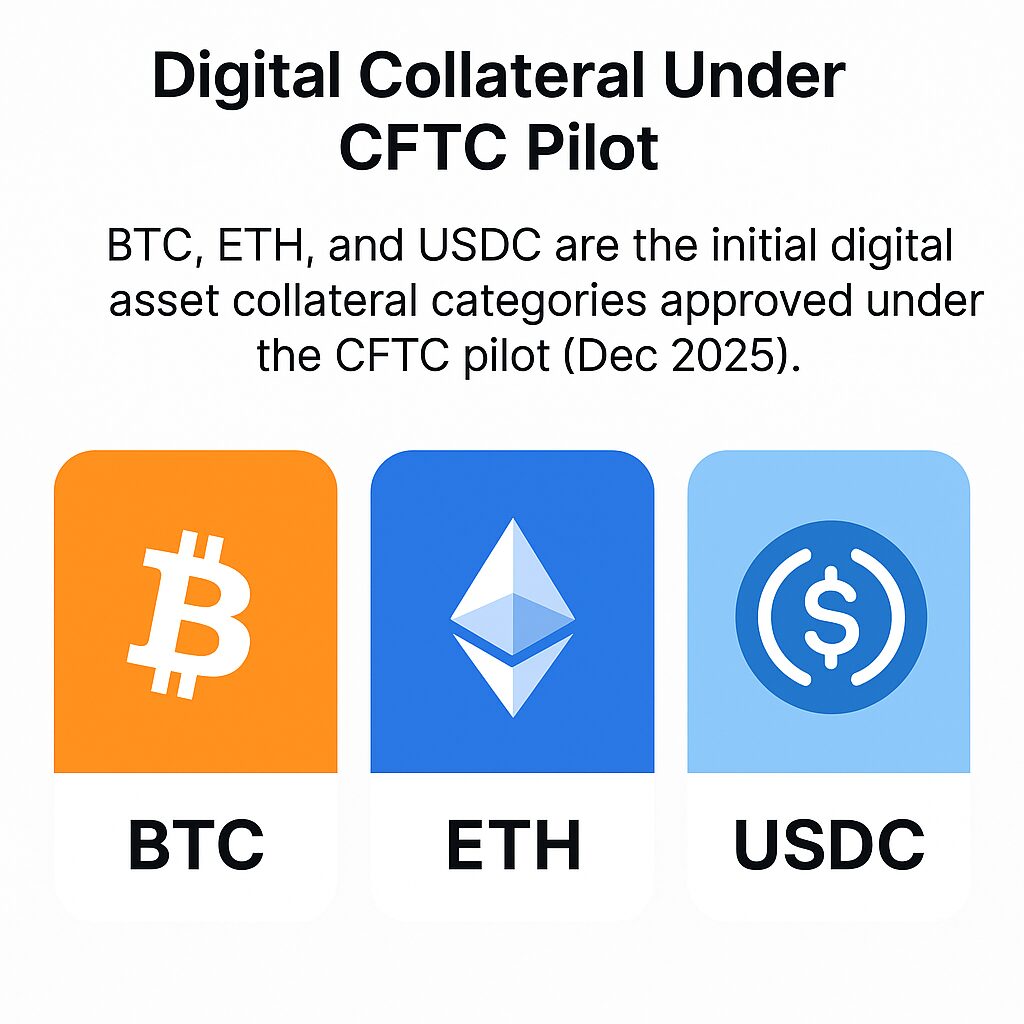
BTC, ETH, and USDC are the initial digital asset collateral categories approved under the CFTC pilot (Dec 2025).
Summation: A Turning Point for Crypto’s Institutional Integration
The launch of the CFTC’s digital-asset collateral pilot marks a historic turning point — one that may well redefine how crypto interacts with traditional finance. For years, crypto collateralization was largely confined to decentralized protocols or unregulated venues. Now, with formal regulatory approval under U.S. supervision, a new chapter may begin: one where digital assets — including stablecoins and tokenized real-world assets — become bona fide infrastructure in regulated derivatives markets.
For investors, builders, and institutions, this shift offers real opportunities: enhanced liquidity, capital efficiency, innovative tokenization, and a bridge between blockchain-native assets and traditional finance. As the pilot progresses, its results will likely determine how quickly crypto can transition from speculative fringe to core component of global financial plumbing.
