

Main Points :
- The Chair of the U.S. Commodity Futures Trading Commission (CFTC) stated that the crypto market structure bill, known as the CLARITY Act, is “near passage.”
- The bill would formally designate the CFTC as the primary regulator of spot markets for major digital assets such as Bitcoin and Ethereum.
- The Securities and Exchange Commission (SEC) would retain authority over digital assets classified as securities.
- Exchanges and brokers would have a 180-day registration window after enactment.
- Political disagreements over ethics provisions, public bailouts, and stablecoin yield restrictions have delayed Senate approval.
- The White House is pushing for a compromise before the end of February 2026.
- Regulatory clarity could significantly impact institutional capital flows, token issuance strategies, and blockchain-based financial innovation.
Introduction: Why This Moment Matters
The U.S. crypto industry may be standing at the edge of its most important regulatory turning point since the launch of Bitcoin. According to the Chair of the Commodity Futures Trading Commission (CFTC), the long-debated crypto market structure bill—formally referred to as the CLARITY Act—is “imminent.” If enacted, it would redefine regulatory authority between the CFTC and the Securities and Exchange Commission (SEC), potentially ending years of jurisdictional ambiguity.
For investors searching for new digital assets, yield opportunities, and practical blockchain use cases, regulatory clarity is not merely a compliance issue—it is a structural catalyst. Capital allocation, token design, exchange architecture, custody models, and even DeFi integrations depend heavily on how U.S. law categorizes and supervises digital assets.
Section 1: What the CLARITY Act Proposes
The CLARITY Act seeks to establish a durable and future-proof regulatory framework for digital assets. The CFTC Chair emphasized that regulation must not depend on administrative interpretation that can be reversed by the next regulator. Instead, the framework should be codified in law.
Under the proposed structure:
- The CFTC would supervise spot markets for major digital commodities such as Bitcoin and Ethereum.
- The SEC would retain authority over digital assets that qualify as securities.
- Joint rulemaking between the agencies would be required within 18 months of enactment.
- Exchanges and brokers would have a 180-day period to register under the new framework.
This division is significant. For years, crypto firms have operated in a gray zone, often unsure whether tokens would be classified as securities after launch. A statutory boundary between commodities and securities could unlock institutional participation.
Section 2: Legislative Timeline and Political Friction
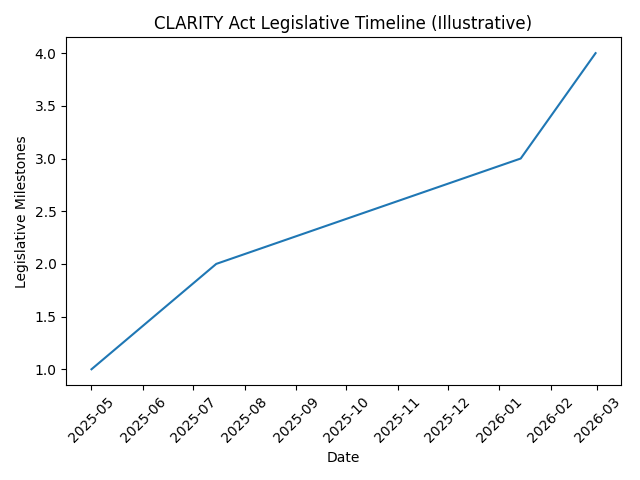
The bill was introduced in May 2025 and passed the House in July 2025. However, Senate deliberations stalled.
CLARITY Act Legislative Timeline
The delay stems from political and industry tensions:
- Democrats pushed for ethics provisions to prevent conflicts of interest related to presidential crypto holdings.
- Proposals were made to prohibit public bailouts for digital asset firms.
- Banking lobbyists sought amendments prohibiting stablecoins from offering yield.
- Industry groups, including major exchanges, temporarily withdrew support over certain amendments.
A committee vote scheduled for January 14, 2026, was postponed. The White House has since urged compromise before the end of February 2026.
Section 3: CFTC vs. SEC – The Regulatory Split
The central structural change is the formal delineation between the CFTC and the SEC.
Proposed Regulatory Oversight Distribution
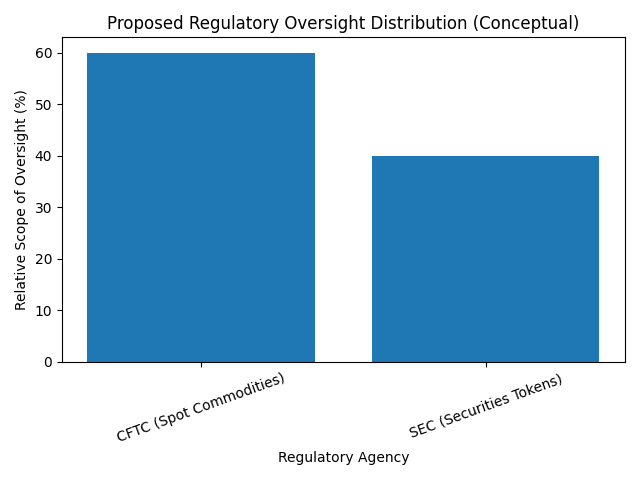
Under the CLARITY Act:
- CFTC: Spot markets for digital commodities.
- SEC: Securities tokens and investment contracts.
This split has major implications:
- Token issuers may design assets to qualify as commodities.
- Exchanges may reclassify listing standards.
- Institutional custodians may adjust compliance infrastructure.
- Derivatives markets could expand under clearer CFTC oversight.
For fintech operators and VASPs, especially those operating across jurisdictions, this clarity reduces regulatory arbitrage risk and supports scalable compliance architecture.
Section 4: Market Impact and Institutional Capital
Regulatory certainty historically precedes institutional capital inflows. Following the approval of Bitcoin spot ETFs in the United States, capital allocation accelerated significantly.
If the CLARITY Act passes:
- Institutional custody providers may expand services.
- Broker-dealers could integrate tokenized assets.
- Traditional exchanges may launch compliant digital commodity trading platforms.
- Tokenized real-world assets (RWAs) may scale under clearer classification rules.
Hypothetical Digital Asset Market Growth Under Regulatory Clarity
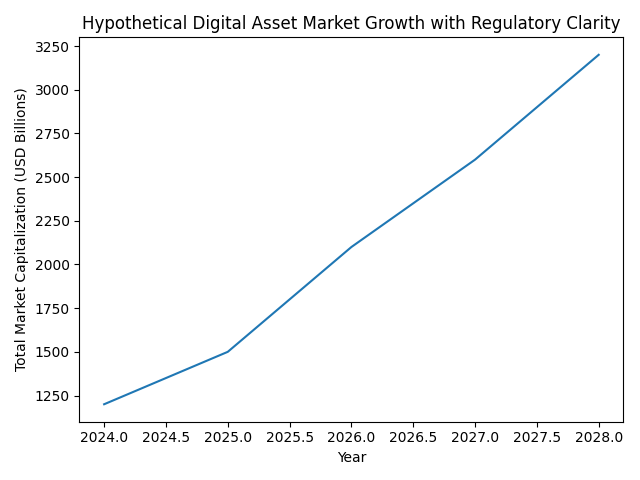
Although illustrative, the chart reflects a core principle: legal certainty reduces risk premiums. Reduced uncertainty lowers capital costs and increases long-term participation.
Section 5: Implications for Stablecoins and Yield Products
A major area of contention has been stablecoin yield. Banking interests have argued that allowing stablecoins to offer yield creates shadow banking risks.
If yield-bearing stablecoins are restricted:
- DeFi lending markets may migrate offshore.
- Tokenized treasury products could rise as alternatives.
- Exchanges may restructure staking and lending products.
For investors seeking yield in USD-denominated digital assets, the final language of the Act will be critical.
Section 6: Strategic Implications for Builders and Investors
For blockchain entrepreneurs and crypto investors, the passage of the CLARITY Act could signal:
- Clearer token launch strategies.
- Reduced enforcement uncertainty.
- Greater venture capital participation.
- Acceleration of tokenized asset infrastructure.
- Expanded CFTC-supervised derivatives products.
Projects that align with commodity classification standards may gain a structural advantage. Meanwhile, tokens structured as securities may face more traditional disclosure and compliance requirements.
Section 7: Global Competitive Context
The European Union has implemented MiCA. The UAE has established VARA. Hong Kong has expanded licensing for digital asset platforms. If the United States fails to act, capital may migrate permanently.
Passage of the CLARITY Act would signal that the U.S. intends to compete in digital finance rather than regulate it through enforcement alone.
Conclusion: A Structural Turning Point
The CFTC Chair’s statement that the CLARITY Act is “near passage” may mark the beginning of a new era. Regulatory clarity is not merely about compliance; it shapes capital formation, token economics, market architecture, and institutional confidence.
If enacted before the end of February 2026, the law could:
- Stabilize jurisdictional disputes.
- Encourage institutional adoption.
- Restructure exchange compliance frameworks.
- Influence global regulatory alignment.
For investors seeking the next digital asset opportunity, and for builders pursuing practical blockchain applications, this moment may define the next cycle of growth.
