
Main Points :
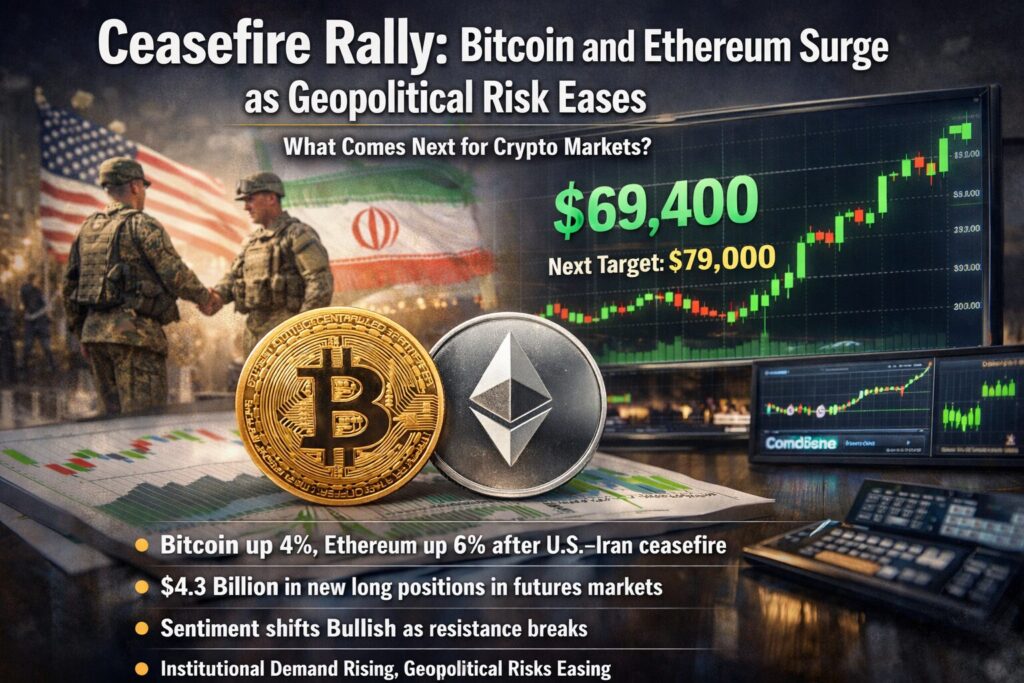
- Bitcoin surged ~4% and Ethereum ~6% following the U.S.–Iran ceasefire announcement
- Over $4.3 billion in new long positions entered perpetual futures markets
- Market sentiment flipped from multi-week bearish to short-term bullish
- Key resistance levels: $69,400 (breakout confirmed) → next target $79,000
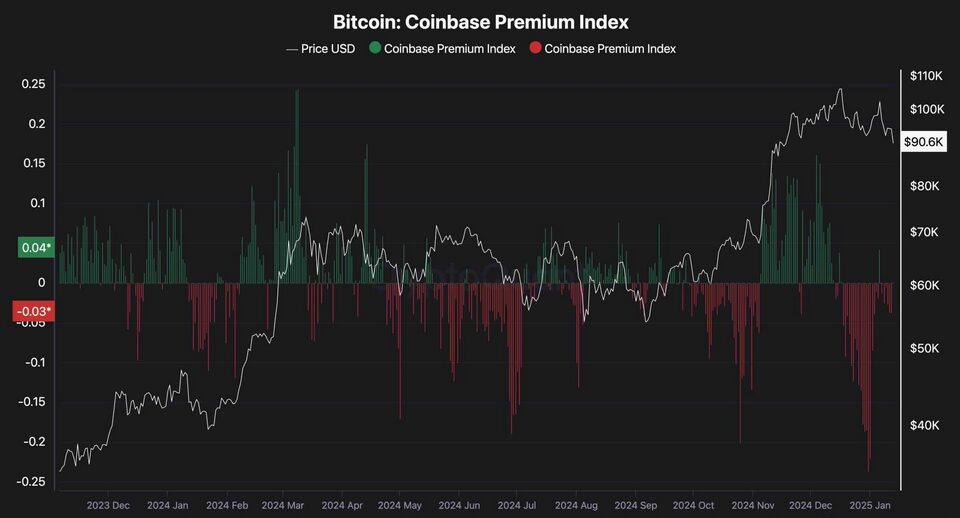
- Institutional demand signals (Coinbase Premium) turned positive again
- Macro stability and geopolitical easing are now core drivers of crypto momentum
1. A Geopolitical Shock Reversal: Why Crypto Reacted Instantly
The recent ceasefire agreement between the United States and Iran triggered a rapid and decisive shift across global financial markets, but nowhere was the reaction more immediate and pronounced than in cryptocurrency. Within just 24 hours of the announcement, Bitcoin rose approximately 4% while Ethereum surged nearly 6%, reversing a multi-week downtrend that had been driven by escalating geopolitical tensions.
For crypto markets, geopolitical instability typically introduces uncertainty, driving investors toward traditional safe-haven assets such as gold or U.S. Treasury bonds. However, the easing of tensions often has the opposite effect: it unlocks risk appetite. In this case, traders interpreted the ceasefire as a signal that broader macroeconomic conditions could stabilize, leading to renewed confidence in high-volatility, high-return assets like cryptocurrencies.
This reaction highlights a structural evolution in crypto markets. Bitcoin and Ethereum are no longer reacting solely to internal metrics such as hash rates or network activity—they are increasingly integrated into the global macro narrative. This aligns with recent trends where digital assets behave similarly to risk-on equities during periods of economic optimism.
2. The $4.3 Billion Signal: Futures Markets Confirm Bullish Conviction
Perhaps the most critical indicator of this rally was not the price increase itself, but the behavior of derivatives traders. Data shows that open interest in Bitcoin and Ethereum perpetual futures surged by approximately $2.1 billion and $2.2 billion respectively, totaling over $4.3 billion in new positions.
Importantly, this increase was not driven by short liquidations—a common catalyst for sudden price spikes—but by new long positions. This distinction matters significantly. It indicates that traders are not merely reacting to price movements but are actively positioning for continued upside.
Additional confirmation comes from the taker buy/sell ratio. In Bitcoin markets, this ratio climbed above 1.04, its highest level since March 21. A ratio above 1 indicates that market participants are aggressively buying at market price, rather than passively placing limit orders. Ethereum mirrored this pattern, reinforcing the notion of broad-based bullish sentiment.
Together, these metrics suggest that the rally is structurally supported by conviction, not just momentum.
3. Breaking the Downtrend: A Structural Shift in Market Psychology
For several weeks prior to the ceasefire, both Bitcoin and Ethereum had been trapped in a downward trajectory, influenced by geopolitical uncertainty and tightening global liquidity conditions. The recent rally marks a clear inflection point.
One of the most significant technical developments is Bitcoin’s move above $69,400, a level identified as the lower bound of traders’ realized price. This metric represents the average acquisition cost of recently moved coins and often acts as a psychological and technical resistance level.
Breaking above this level signals that a large portion of market participants are now in profit, which historically reduces selling pressure and enables further upward movement.
From a behavioral perspective, this transition is critical. Markets often move not just on fundamentals, but on collective psychology. The shift from fear to cautious optimism can create self-reinforcing cycles of buying activity.
4. The Next Barrier: Why $79,000 Matters
With $69,400 now acting as support, attention turns to the next major resistance level: approximately $79,000. This level corresponds to the midpoint of traders’ realized price bands and has historically functioned as a ceiling during bearish market phases.
Breaking through $79,000 would signal a more complete recovery of market structure and could open the path toward new all-time highs. However, this level is not just a technical barrier—it represents a psychological threshold where many investors who previously bought near the top may look to exit positions.
Therefore, the market’s behavior around this level will be crucial in determining whether the current rally evolves into a sustained bull trend or stalls into consolidation.
5. Institutional Demand Returns: The Coinbase Premium Turns Positive
Another key indicator supporting the bullish narrative is the return of the Coinbase Premium to positive territory. This metric measures the price difference between Coinbase (widely used by U.S. institutional investors) and other global exchanges.
A positive premium suggests that U.S.-based investors are buying more aggressively than their international counterparts. Over recent weeks, this premium had been negative, reflecting weak institutional demand. Its reversal signals renewed participation from large-scale investors.
This is particularly important because institutional flows often provide the liquidity and stability needed for sustained market growth. Retail-driven rallies can be volatile, but institutional involvement tends to anchor price movements.
6. Beyond the Ceasefire: Crypto’s Expanding Role in Global Finance
While the ceasefire acted as an immediate catalyst, broader developments are reinforcing crypto’s long-term relevance. Notably, Iran has explored the use of cryptocurrency for collecting transit fees in the Strait of Hormuz, potentially charging up to $2 million per supertanker.
This signals a growing acceptance of crypto not just as an investment asset, but as a tool for real-world economic activity—particularly in regions seeking alternatives to traditional financial systems.
Globally, similar trends are emerging:
- Increasing adoption of stablecoins in cross-border payments
- Expansion of institutional crypto products such as ETFs
- Integration of blockchain into supply chain and financial infrastructure
These developments suggest that crypto’s value proposition is evolving from speculative asset to foundational financial technology.
7. Risk Scenario: What Happens If Negotiations Fail?
Despite the current optimism, the market remains highly sensitive to geopolitical developments. Ongoing negotiations between the U.S. and Iran introduce a binary risk scenario.
If talks succeed, the current bullish momentum could strengthen, supported by continued macro stability and institutional inflows. However, if negotiations collapse, markets could quickly revert to a risk-off stance, triggering sell-offs across both crypto and traditional assets.
This underscores the importance of monitoring not just technical indicators, but also geopolitical news flows.
8. BTC/ETH Price Reaction and Resistance Levels
Conclusion: A Turning Point or a Temporary Relief Rally?
The recent surge in Bitcoin and Ethereum marks a pivotal moment for crypto markets. Driven by geopolitical easing, reinforced by derivatives market activity, and supported by institutional demand, the rally reflects a convergence of factors rarely aligned so clearly.
However, the sustainability of this momentum depends on external conditions—particularly geopolitical stability and macroeconomic trends. The $79,000 resistance level will serve as a critical test of market strength in the coming weeks.
For investors seeking new opportunities, this environment offers both promise and risk. The re-emergence of bullish sentiment suggests potential upside, but the underlying drivers remain fragile.
In this evolving landscape, success will depend on the ability to integrate macro awareness with on-chain and market data—a hallmark of the next generation of crypto investing.
