

Main Points :
- An estimated 40% of Canadian crypto users are not reporting taxes, exposing a massive compliance gap.
- The Canada Revenue Agency (CRA) has collected more than $75 million USD in audits but still faces “structural limitations.”
- CRA compelled Dapper Labs to disclose customer data—only the second case of forced disclosure in Canadian crypto history.
- FINTRAC has imposed record-high penalties, including a $130M USD fine on a Vancouver-registered entity.
- A new Canadian financial crime agency is planned by Spring 2026, marking a significant regulatory escalation.
- The growth in pandemic-era crypto usage and cross-border platforms has created unprecedented enforcement challenges.
- These shifts signal a new global direction: tax transparency and traceability will shape the next phase of crypto adoption.
Introduction: A New Era of Crypto Tax Enforcement in Canada
Over the past five years, cryptocurrency adoption in Canada has surged—from retail investors entering the market for the first time to sophisticated traders moving assets across multiple blockchain ecosystems. But alongside this growth, Canada now faces one of the largest tax compliance gaps in its history.
Newly revealed court documents show that the Canada Revenue Agency (CRA) believes up to 40% of crypto users may be failing to report taxable activity. Despite extensive audits and legal actions, the CRA openly acknowledges it lacks a reliable mechanism to identify all crypto participants or evaluate their tax obligations.
This article consolidates findings from the referenced Japanese report, integrates global regulatory trends, adds new insights from industry data, and outlines what investors, exchanges, and fintech operators need to understand about the shifting landscape of crypto governance.
1. The Scale of the Problem: 40% Estimated Non-Compliance
According to documents obtained by Canadian media, the CRA has determined through audit programs that the level of non-compliance in the crypto sector is significantly higher than in traditional financial products.
Earlier datasets had already indicated that:
- 15% of Canadian crypto users did not file taxes on time, or at all.
- 30% of those who filed were categorized as “high-risk” for non-compliance.
- 40% overall may be under-reporting or failing to report.
These figures establish a troubling pattern: tax ignorance or avoidance is not marginal, but widespread.
The following chart visualizes the estimated non-compliance breakdown:
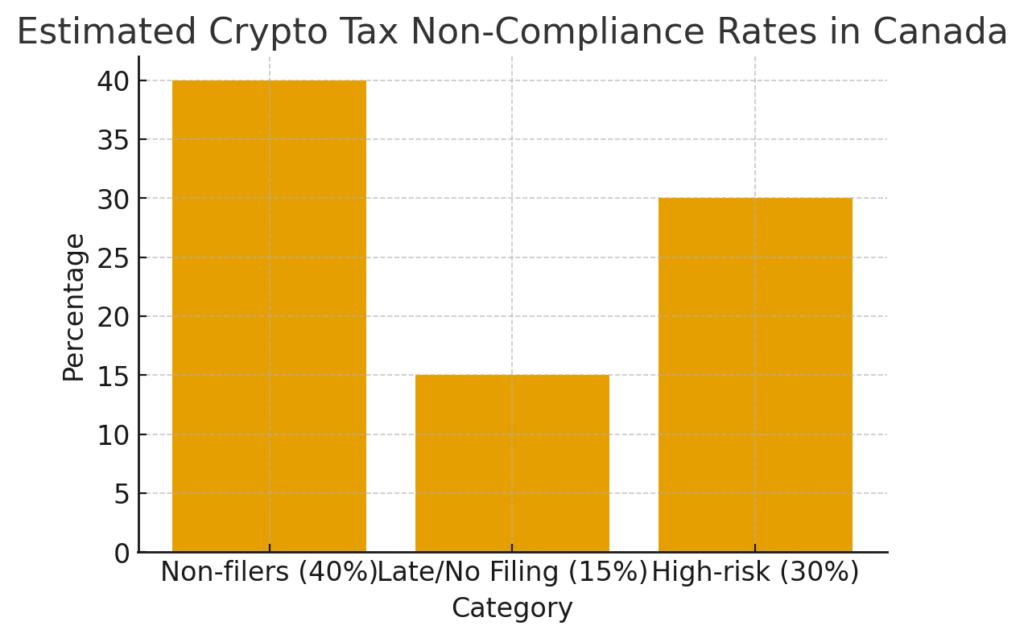
Such high estimates reveal the structural tension between decentralized financial systems and traditional tax infrastructures. Unlike banks, which issue T-slips and report balances, crypto platforms often exist outside Canadian jurisdiction, lack consistent reporting tools, or operate on-chain without any intermediaries.
2. CRA’s Enforcement Limitations: Why Crypto Remains Difficult to Monitor
In a sworn affidavit, the CRA’s head crypto auditor admitted that the agency has “no reliable method” to:
- Identify all Canadians operating in the crypto space
- Track wallets associated with taxpayers
- Assess compliance without voluntary disclosure or third-party data
This vulnerability is rooted in technological and regulatory constraints:
2.1. The Challenge of Pseudonymity
Public blockchains like Bitcoin, Ethereum, and Solana operate with pseudonymous addresses rather than personal identities.
2.2. Multi-Chain Complexity
Users now transact across dozens of networks—Layer-1 chains, Layer-2 rollups, sidechains, and app-specific chains.
2.3. Cross-Border Platforms
Accounts can be created easily on offshore exchanges in Seychelles, the Caribbean, or Eastern Europe.
2.4. Rapid Growth During COVID-19
The CRA notes crypto usage expanded dramatically during the pandemic, when millions began digital trading as traditional markets destabilized.
Even with improved blockchain analytics, tracing originators, beneficiaries, or swap-based capital gains remains deeply challenging.
3. The Dapper Labs Case: A Landmark Legal Precedent
One of the most significant developments was the CRA’s successful court order compelling Dapper Labs, the operator of NBA Top Shot and CryptoKitties, to hand over customer data.
Originally, the CRA demanded data on 18,000 users, eventually negotiating the number down to 2,500 through legal counsel.
This case is only the second time in Canadian history that a crypto company has been legally forced to disclose user information. The previous case involved Coinsquare, a Toronto-based exchange, in 2020.
Why the Dapper Case Matters
- It signals aggressive new enforcement toward NFT platforms, not just exchanges.
- It establishes legal precedent for compelling user data from blockchain companies operating in Canada.
- It creates expectations for future court orders targeting other large platforms.
Globally, similar actions are occurring:
- The U.S. IRS successfully compelled Coinbase (2017) and Kraken (2023) to disclose user records.
- Australia and the U.K. have begun synchronized tax data-sharing programs for crypto.
- The EU’s DAC8 framework will mandate full crypto tax reporting by 2026.
Canada is now aligning with this global shift.
4. FINTRAC’s Crackdown: Record-Breaking Fines Signal a New Phase
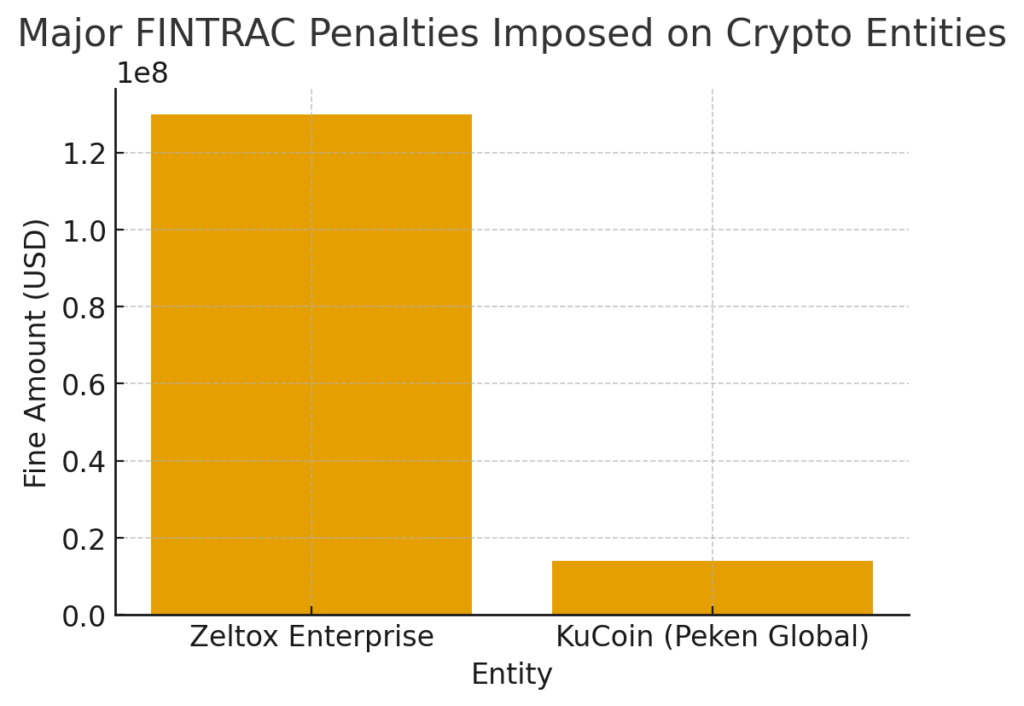
Canada’s anti-money laundering authority, FINTRAC, has imposed unusually severe penalties on crypto companies in 2024 and 2025.
4.1. The Canada-Registered Zeltox Enterprise Fine
FINTRAC issued a $130M USD fine to Zeltox Enterprise, which was allegedly operating from a Vancouver postal box, citing egregious non-compliance with AML and CFT laws.
This was the largest crypto-related compliance fine in Canadian history.
4.2. KuCoin (Peken Global) Fine
In another major action, FINTRAC fined the Seychelles-based exchange more than $14M USD for failing to register as a money services business providing cross-border remittance services.
These actions demonstrate a clear reality:
Canada is entering its strictest enforcement phase yet.
FINTRAC and CRA are closing the long-held belief in the industry that offshore entities can operate in Canada without regulatory consequences.
5. A New Canadian Financial Crime Agency Coming in 2026
Finance Minister François-Philippe Champagne announced the launch of a new federal financial crime agency scheduled for Spring 2026.
This agency will be:
- Canada’s first dedicated institution focused on advanced financial crime investigations
- Responsible for recovering illegal proceeds, including crypto-based assets
- Equipped with enhanced blockchain forensics capabilities
- Coordinated with CRA, FINTRAC, and international task forces
This suggests that by 2026–2027:
- Crypto tax enforcement will be faster
- Data collection will be more standardized
- Exchanges will face heavier scrutiny
- NFT and cross-border DeFi platforms may be monitored more aggressively
Canada is shifting from reactive audits to proactive digital enforcement.
6. Global Trends: Canada Is Not Alone
To contextualize Canada’s direction, it is clear other regulators worldwide are taking similar steps:
6.1. United States
- The IRS is deploying new digital asset reporting rules under the Infrastructure Investment and Jobs Act.
- Form 1099-DA will require exchanges to report customer transactions starting 2026.
6.2. European Union
- Under DAC8, all crypto asset service providers (CASPs) must share user transaction data among EU tax authorities by January 2026.
6.3. Asia-Pacific
- Japan already mandates strict reporting for crypto exchanges and is planning wallet-tracking procedures.
- South Korea will implement robust crypto taxation in 2025, including unrealized gains reporting.
- Australia integrates exchange data directly with the tax office, which has issued mass warning letters to crypto users.
The convergence is clear:
The world is moving toward standardized tax visibility for digital assets.
7. What This Means for Investors and New Crypto Projects
7.1. Investors Should Expect Full Traceability
Even if a platform does not provide tax slips today, future regulations may require:
- Automated cost basis calculation
- Wallet-to-exchange reconciliation
- Transaction-level reporting to tax authorities
7.2. Exchanges and VASPs Must Prepare for Higher Compliance Costs
Requirements will likely intensify:
- On-chain analytics integrations
- Automated sanctions screening
- Cross-border information exchange
- Stricter Travel Rule implementation
7.3. New Projects Must Build With “Compliance Compatibility”
For blockchain startups, “regulation-ready architecture” becomes a competitive advantage.
Even DeFi protocols increasingly adopt:
- KYC-enabled access tiers
- Wallet risk scoring integrations
- Token gating based on jurisdiction
7.4. Opportunities for Investors: The Rise of RegTech and Compliance Tokens
The tightening regulatory landscape is creating new business categories:
- Blockchain analytics companies
- Tax automation tools for DeFi
- Compliance-oriented stablecoins
- Tokenized identities and verifiable credentials
Investors exploring new crypto assets may find growth in projects that align with transparency, regulation, and institutional adoption.
Conclusion: The Future of Crypto Regulation in Canada and Beyond
Canada’s revelation that 40% of crypto users may be non-compliant marks a turning point. While blockchain technology provides borderless finance and privacy benefits, regulators worldwide are rapidly closing the reporting gap.
The CRA’s audits, FINTRAC’s historic penalties, and the coming 2026 financial crime agency indicate a decisive shift toward proactive, data-driven enforcement.
For investors, this means crypto is entering a mature era—less anonymous, more integrated with traditional finance, and increasingly shaped by regulatory infrastructure.
For builders and exchanges, compliance is no longer a bureaucratic necessity—it is a core architectural requirement and a marker of long-term viability.
As Canada adapts to the realities of digital finance, the convergence of transparency, innovation, and regulation will define the next decade of crypto adoption.
