
Main Points :
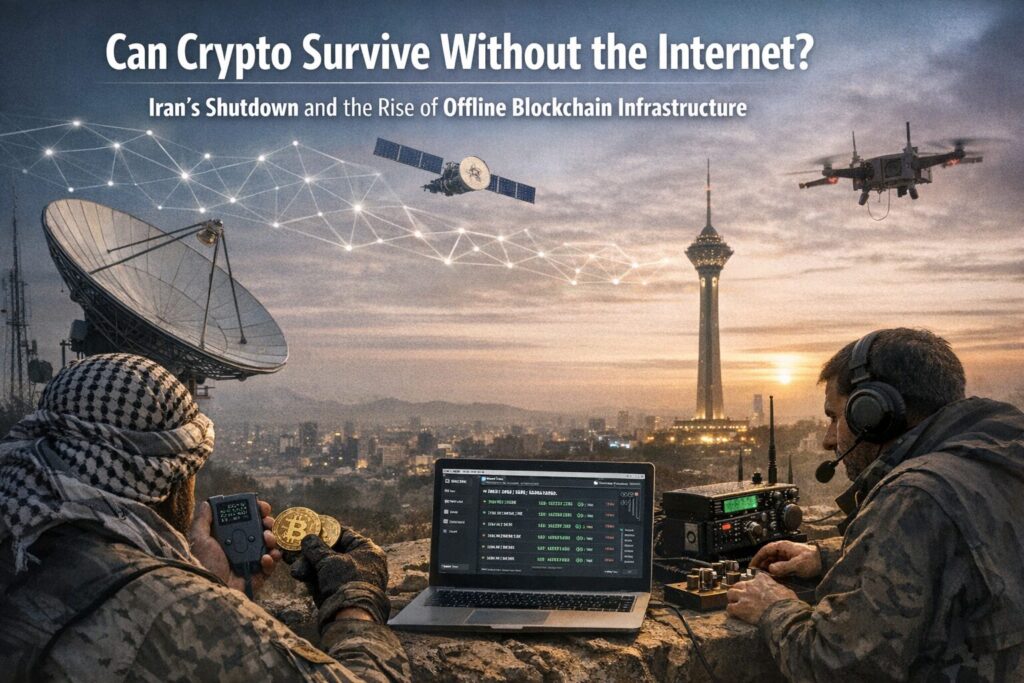
- Iran’s nationwide internet shutdown has raised urgent questions about whether cryptocurrency can function without traditional connectivity.
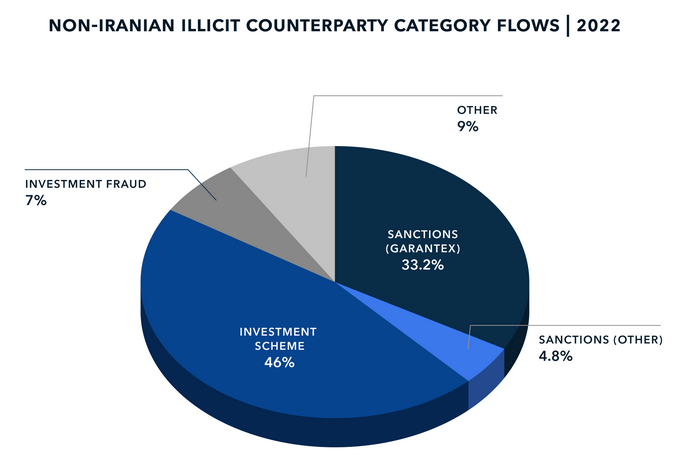
- Roughly 7 million Iranians are estimated to use crypto, with $3.7 billion in on-chain flows recorded between January and July 2025.
- Satellite internet, mesh networks, and radio-based blockchain transmission are emerging as realistic alternatives.
- Projects like Starlink, Blockstream Satellite, Bitchat, and experimental tools such as Darkwire show that “offline crypto” is no longer theoretical.
- These developments signal a broader shift: blockchain is evolving from a purely online financial system into a resilient parallel infrastructure.
1. Iran’s Internet Shutdown: A Stress Test for Crypto
In early 2026, the government of Iran imposed a nationwide internet shutdown as protests spread across the country amid worsening economic conditions. The move followed a sharp collapse of the Iranian rial, which hit a historic low against the U.S. dollar, intensifying public anger over inflation, unemployment, and capital controls.
For a population of approximately 92 million, the shutdown was not just a communications blackout—it was an economic choke point. According to Statista, an estimated 7 million Iranians are active cryptocurrency users. Blockchain analytics firm TRM Labs reported that between January and July 2025 alone, crypto flows linked to Iran totaled roughly $3.7 billion.
When the internet goes dark, the question becomes existential:
Can crypto still function when the network it depends on disappears?
2. Why Crypto Matters in Iran
Cryptocurrency adoption in Iran is not driven by speculation alone. It is deeply tied to survival and economic pragmatism.
International sanctions have restricted Iran’s access to the global banking system. Capital controls limit foreign currency purchases, while inflation steadily erodes purchasing power. Under these conditions, Bitcoin and stablecoins have become:
- A hedge against currency devaluation
- A cross-border settlement tool
- An informal remittance rail
Crypto in Iran is not an abstract investment class—it is a functional alternative financial system.
【Iran’s currency depreciation and estimated crypto adoption】
3. The Core Problem: Crypto Without Internet
At first glance, cryptocurrency appears inseparable from the internet. Wallets, nodes, exchanges, and explorers all rely on IP-based connectivity.
Without internet access:
- Transactions cannot be broadcast to the network
- Wallets cannot query balances or UTXOs
- Nodes cannot sync blocks
However, this assumption overlooks a critical distinction:
blockchain consensus requires data propagation—not necessarily the public internet.
4. Satellite Internet: Starlink as an Emergency Backdoor
One of the most discussed solutions during Iran’s blackout was Starlink, the satellite internet constellation operated by SpaceX.
Starlink uses low-Earth orbit satellites to deliver broadband connectivity directly to user terminals. During previous shutdowns, including in 2025, Iranian activists and technologists called on Elon Musk to enable Starlink access for civilians.
While unconfirmed reports suggested Musk acknowledged informal requests, the technical reality is clear:
Starlink can bypass terrestrial ISPs entirely.
From a crypto perspective, even limited satellite connectivity is sufficient. A single terminal in a neighborhood can:
- Broadcast signed transactions
- Sync blocks intermittently
- Act as a gateway for mesh or Bluetooth networks
This makes satellite internet a force multiplier for decentralized finance in censored environments.
5. Blockstream Satellite: Broadcasting Bitcoin Without the Web
A lesser-known but highly relevant solution comes from Bitcoin infrastructure firm Blockstream.
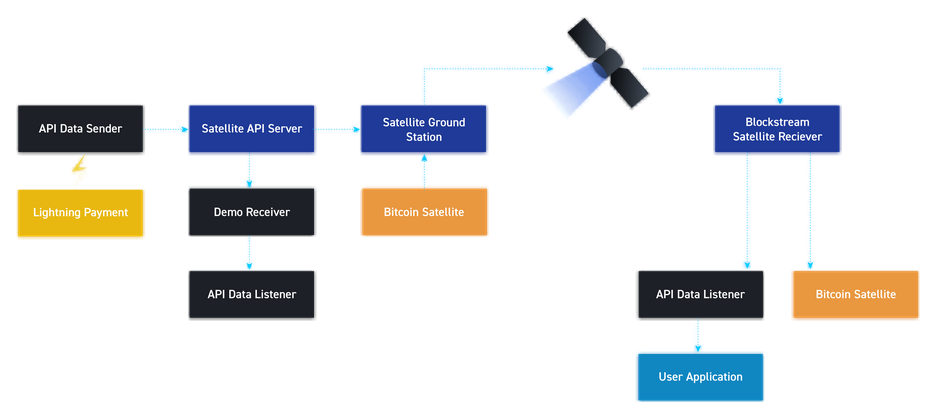
Blockstream operates a satellite network that continuously broadcasts the Bitcoin blockchain worldwide. Users only need:
- A small satellite dish
- A USB receiver
- Free-to-air satellite access
With this setup, users can receive Bitcoin block data without any internet connection. While transaction submission still requires an outbound link, creative solutions—such as SMS gateways or satellite uplinks—can close the loop.
This architecture reinforces Bitcoin’s original design philosophy:
global, censorship-resistant, and infrastructure-agnostic.
【Bitcoin satellite-based data flow】
6. Bluetooth Mesh Networks: The Rise of Bitchat
Another surprising development is Bitchat, a decentralized peer-to-peer messaging application associated with Twitter founder Jack Dorsey.
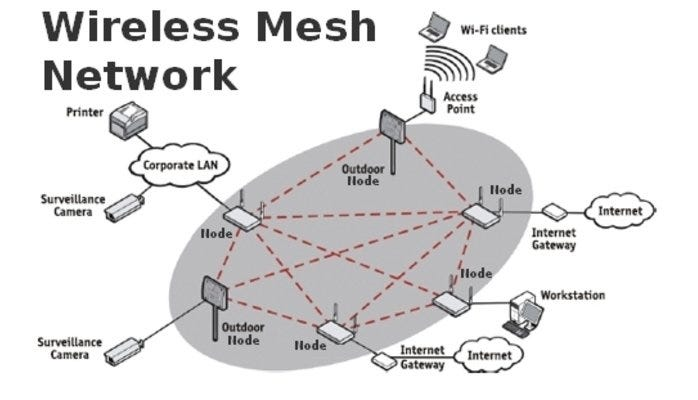
Bitchat uses Bluetooth mesh networking, allowing smartphones to relay messages directly between devices without internet or cellular service. Some users have demonstrated that raw Bitcoin transaction data can be transmitted across such meshes.
According to ChromeStats:
- Over 1.4 million downloads since launch
- Nearly 20,000 installs in the last 24 hours
- More than 460,000 installs in the past week
While final settlement still requires at least one node to connect online, this model enables:
- Local transaction propagation
- Offline signing and batching
- Community-level financial resilience
In effect, people become the network.
7. Experimental Tools: Darkwire and Long-Range Radio Meshes
Beyond commercial products, grassroots innovation is accelerating.
In May 2025, an anonymous developer known as Cyb3r17 released Darkwire, a system that uses long-range radio (LoRa-style) communication to propagate blockchain data across decentralized mesh networks.
Darkwire enables:
- Internet-free transaction relay
- Encrypted peer-to-peer messaging
- Eventual on-chain settlement once a gateway node reconnects
Although still under heavy redevelopment on GitHub, Darkwire illustrates a crucial trend:
crypto is moving into the physical layer of communications.
8. Cellular Without Internet: Machankura
Another notable example comes from Africa. In 2022, South African developer Kgothatso Ngako introduced Machankura, a tool that allows Bitcoin transactions using basic mobile phone networks—no internet required.
According to reporting by Forbes and the project’s official documentation, Machankura leverages:
- USSD and SMS
- Telecom signaling infrastructure
- Custodial and semi-custodial models
This approach is particularly relevant for regions where mobile coverage exists but data access is restricted or censored.
【Offline crypto communication methods】
9. What This Means for Investors and Builders
Iran’s internet shutdown is not an isolated incident. Similar disruptions have occurred in:
- Russia
- Myanmar
- Sudan
- Parts of Africa and South Asia
For crypto investors, this highlights a new evaluation metric:
Resilience under network failure
Projects that enable offline signing, delayed settlement, or alternative data propagation may become disproportionately valuable.
For builders, the implications are even clearer:
- Wallets must support offline-first UX
- Nodes must tolerate intermittent connectivity
- Infrastructure must assume hostile network conditions
This is no longer an edge case—it is a design requirement.
10. Conclusion: Crypto Beyond the Internet
The Iranian blackout demonstrates that cryptocurrency is entering a new evolutionary phase. What began as an internet-native financial experiment is becoming something more profound:
A parallel economic infrastructure capable of surviving censorship, sanctions, and shutdowns.
Satellite links, radio waves, Bluetooth meshes, and cellular signaling are transforming blockchain from a purely digital abstraction into a hybrid physical-digital network.
For those searching for the next wave of crypto innovation—not just new tokens, but new utility—the lesson is clear:
The future of blockchain is not faster trading.
It is unbreakable connectivity.
