

Key Takeaways :
- Bitcoin’s recent ~30% decline is historically consistent with a “bull-market correction,” not the start of a prolonged bear market.
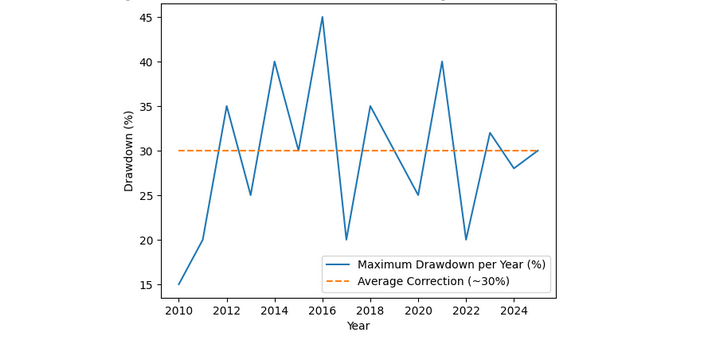
- Since 2010, Bitcoin has experienced roughly 50 drawdowns of 10% or more, with an average peak-to-trough decline of around 30%.
- Grayscale argues that the traditional “four-year halving cycle” model is no longer sufficient to explain current market dynamics.
- Institutional inflows via ETPs and corporate crypto treasuries are reshaping Bitcoin’s risk–return profile.
- Regulatory clarity and potential U.S. interest rate cuts could act as major tailwinds into 2026.
- The firm remains optimistic in the medium to long term, emphasizing that the greatest gains historically accrue to long-term holders.
1. Bitcoin’s Risk and Return Profile: Volatility as a Feature, Not a Flaw
In its latest crypto market report released in December 2025, U.S.-based digital asset manager Grayscale examined Bitcoin’s approximately 30% price decline since early October and concluded that the move falls squarely within the range of a historically “average correction.” According to the report, this downturn should not be interpreted as a sign of long-term market weakness, but rather as a typical fluctuation occurring within an ongoing bull market.
Grayscale’s analysis places Bitcoin’s volatility in a broader historical context. Over rolling three- to five-year periods, Bitcoin has delivered annualized returns ranging from approximately 35% to as high as 75%. At the same time, this performance has come with substantial volatility: on average, Bitcoin experiences three price drops per year exceeding 10%.
Since 2010, Bitcoin has undergone roughly 50 corrections of at least 10%, with the average drawdown from peak to trough amounting to about 30%. From this perspective, the current 32% decline since October appears statistically unremarkable.
[Historical Bitcoin drawdowns and average correction magnitude]
2. Two Types of Bitcoin Downturns: Cyclical Bear Markets vs. Bull-Market Corrections
Grayscale distinguishes between two structurally different types of Bitcoin price declines:
- Cyclical Bear Markets
These typically last two to three years, occur roughly once every four years, and involve prolonged periods of depressed prices and investor capitulation. - Bull-Market Corrections
These occur during broader uptrends, last approximately two to three months on average, and involve drawdowns of around 25%. During strong bull markets, such corrections can happen three to five times per year.
The recent decline, which reached approximately 32%, is more consistent with the second category. As such, Grayscale views it as a healthy reset rather than a structural breakdown. Based on this classification, the firm argues that Bitcoin could still reach a new all-time high in 2026.
This framework is especially relevant for investors focused on identifying entry points. Historically, many of Bitcoin’s strongest rallies began shortly after similar corrections flushed out excessive leverage.
3. Why Grayscale Rejects the Traditional Four-Year Cycle Theory
One of the most notable aspects of Grayscale’s report is its explicit rejection of the widely cited “four-year halving cycle” theory. This model suggests that Bitcoin prices rise for roughly three years following a halving event, only to decline sharply in the fourth year. According to Grayscale, this framework no longer accurately reflects today’s market reality.
The firm offers three primary reasons:
3.1 Absence of Parabolic Excess
Past cycle peaks were characterized by rapid, parabolic price increases followed by equally dramatic collapses. In the current cycle, no such explosive move has occurred. Price appreciation has been more measured, suggesting a structurally healthier market.
3.2 Structural Market Transformation
Bitcoin markets are no longer dominated by retail traders transacting solely through spot exchanges. Instead, capital inflows increasingly come from:
- Exchange-Traded Products (ETPs)
- Digital Asset Treasury (DAT) companies holding Bitcoin on balance sheets
This shift has introduced longer investment horizons and reduced reflexive speculative behavior.
3.3 Supportive Macro and Policy Environment
Grayscale highlights improving regulatory clarity and the potential for interest rate cuts as critical differences from prior cycles. A clearer regulatory framework reduces uncertainty premiums, while lower real interest rates tend to benefit scarce assets that compete with fiat currencies.
4. Signs of a Potential Market Bottom—and Remaining Risks
While Grayscale acknowledges early indicators that Bitcoin may be forming a bottom, it also cautions that demand remains subdued and capital inflows have yet to show sustained recovery. Additionally, the report notes that in late November, long-term holders—often referred to as “whales”—may have engaged in significant selling activity.
To confirm a durable market bottom, Grayscale recommends monitoring several key indicators:
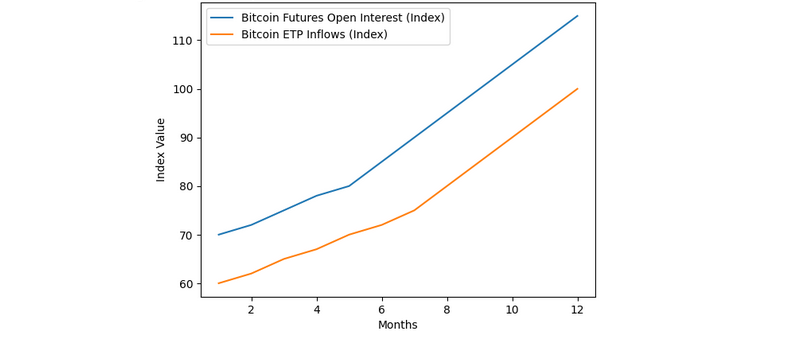
- Growth in Bitcoin futures open interest
- Renewed inflows into Bitcoin ETPs
- Stabilization of on-chain long-term holder supply
[Futures open interest and ETP inflows as bottom confirmation indicators]
5. Institutional Adoption and Regulatory Momentum in 2025
Grayscale identifies 2025 as a pivotal year for Bitcoin due to accelerating institutional participation driven by regulatory clarification. With clearer rules around custody, accounting, and compliance, large asset managers and corporations have begun allocating capital more confidently.
Although the aggregate market capitalization of cryptocurrencies has yet to fully reflect their long-term fundamentals, Grayscale believes that this divergence is temporary. Over time, valuations and fundamentals tend to converge, especially as institutional capital increases market depth and liquidity.
6. Macroeconomic Catalysts: Interest Rates, the Dollar, and Competing Assets
Looking toward late 2025 and into 2026, Grayscale highlights U.S. monetary policy as a key variable. The Federal Reserve’s decisions regarding rate cuts—and its forward guidance for 2026—could significantly influence Bitcoin’s trajectory.
All else equal, declining real interest rates tend to weaken the U.S. dollar. This environment historically benefits assets that compete with fiat currencies, including gold and certain cryptocurrencies. Bitcoin, often framed as “digital gold,” stands to gain from such dynamics.
7. Legislative Developments: Digital Asset Market Clarity Act
Another bullish factor cited by Grayscale is ongoing bipartisan efforts in the U.S. Congress to advance digital asset market clarity legislation. Should these initiatives succeed, they could:
- Lower compliance uncertainty
- Encourage additional institutional entry
- Support higher long-term valuations across the crypto market
Such legislative progress would further differentiate the current environment from previous cycles, where regulatory ambiguity frequently triggered sharp sell-offs.
8. Long-Term Perspective: Why HODL Still Matters
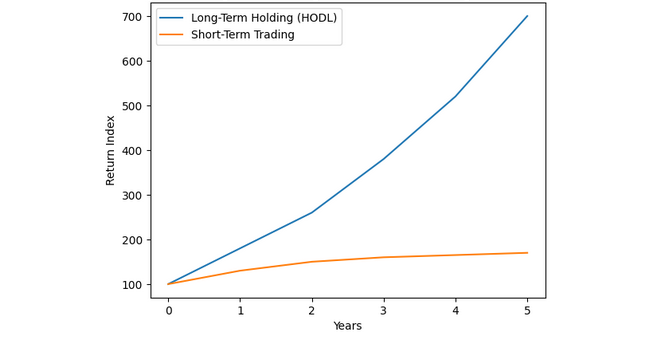
Despite near-term volatility, Grayscale reiterates a familiar but data-supported conclusion: the largest gains in Bitcoin’s history have accrued to investors who held through multiple cycles. While short-term optimism exists, the firm emphasizes that disciplined long-term holding remains the most effective strategy for capturing Bitcoin’s asymmetric upside.
[Long-term holding vs. short-term trading performance]
Conclusion: A Changing Bitcoin Market, But a Familiar Opportunity
Grayscale’s latest outlook suggests that while Bitcoin’s market structure is evolving, its core investment thesis remains intact. Volatility continues to be a defining characteristic, but not a fatal flaw. Instead, it is the mechanism through which long-term value is transferred from short-term speculators to patient holders.
If regulatory clarity, institutional adoption, and favorable macro conditions continue to align, Bitcoin reaching a new all-time high in 2026 is not only possible, but historically consistent with its past behavior. For investors seeking new digital assets, future income sources, and practical blockchain exposure, Bitcoin remains a central—and increasingly institutionalized—pillar of the crypto ecosystem.
