
Main Points :
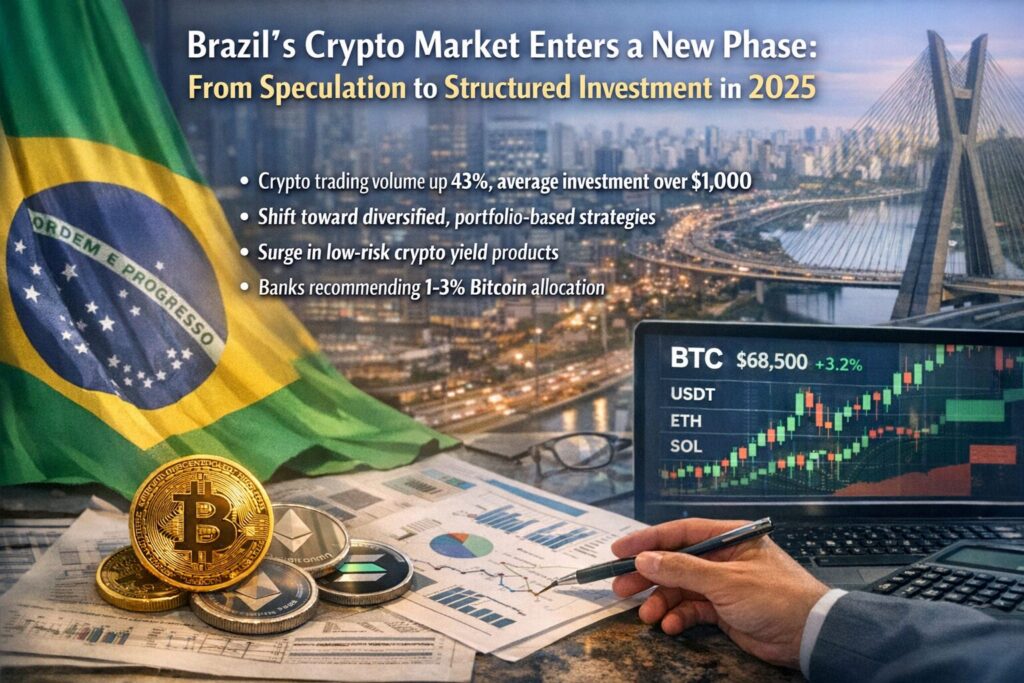
- Brazil’s cryptocurrency market expanded sharply in 2025, with total trading volume up 43% year-on-year and average individual investment exceeding $1,000.
- Investor behavior is shifting from short-term speculation toward portfolio-based, structured allocation, including diversification across multiple digital assets.
- Bitcoin remains the most traded asset, followed by USD-pegged stablecoins, Ether, and Solana, while stablecoins increasingly serve as a low-volatility gateway.
- Low-risk crypto yield products recorded triple-digit growth, signaling demand for predictable returns within the digital asset ecosystem.
- Traditional financial institutions in Brazil are now explicitly recommending Bitcoin allocations (1–3%), reflecting deeper institutional acceptance.
Introduction: A Structural Shift in Brazil’s Crypto Economy
Brazil’s cryptocurrency market is undergoing a decisive transformation. What was once dominated by speculative retail trading is now evolving into a more mature investment environment characterized by portfolio construction, risk segmentation, and yield-oriented products. According to a 2025 investor report released by Mercado Bitcoin, Latin America’s largest digital asset exchange, crypto activity in Brazil surged across nearly every metric.
The report, titled “Raio-X do Investidor em Ativos Digitais 2025”, draws on proprietary transaction data and reveals not only higher volumes but also a notable change in investor intent. Average investment per user now exceeds $1,000, total transaction volume is up 43% year-on-year, and diversification is becoming mainstream rather than exceptional.
This article synthesizes the findings of that report, incorporates broader market trends, and examines what Brazil’s experience reveals about the next phase of global crypto adoption—particularly for readers seeking new digital assets, alternative income streams, and practical blockchain use cases.
Trading Volume and Capital Commitment: The Numbers Behind the Expansion
The most striking headline figure is the 43% year-on-year increase in total crypto trading volume across Mercado Bitcoin’s platform in 2025. This growth occurred despite continued global macroeconomic uncertainty, suggesting that crypto participation in Brazil is becoming structurally embedded rather than opportunistic.
Equally important is the rise in average investment per individual, which reached approximately $1,000 (converted from around BRL 5,700). This figure is meaningful in a Brazilian context, where disposable income levels vary significantly by region and demographic. It indicates not just more users, but users committing larger portions of capital.
Rather than frequent micro-trades, the data suggests fewer but more deliberate allocation decisions. This aligns with global patterns observed in other emerging markets, where crypto increasingly functions as a parallel investment layer, complementing traditional financial products rather than replacing them outright.
From Single Bets to Portfolio Design: Diversification Takes Hold
One of the most revealing insights from the report is that 18% of investors now allocate funds across multiple cryptocurrencies. While still a minority, this marks a clear shift away from the earlier “single-asset” mindset—most commonly all-in Bitcoin or meme-driven tokens.
Diversification implies a higher level of financial literacy and a longer-term perspective. Investors are beginning to differentiate between:
- Store-of-value assets (Bitcoin),
- Smart contract platforms (Ether),
- High-throughput networks (Solana),
- And stablecoins for liquidity management.
This evolution mirrors traditional portfolio theory, now being applied within a digital asset framework. In practical terms, Brazil’s retail crypto investors are beginning to behave more like global allocators than speculative traders.
Asset Breakdown: Bitcoin, Stablecoins, and Layer-1 Competition
Bitcoin’s Continued Dominance
Bitcoin remains the most traded cryptocurrency in Brazil by volume. Its role is no longer limited to price appreciation; it is increasingly treated as a macro hedge and a non-sovereign store of value.
Despite significant price volatility throughout 2025, Bitcoin’s liquidity, global recognition, and decentralized nature continue to make it the anchor asset for Brazilian investors.
Stablecoins as the Entry Point
USD-pegged stablecoins—particularly USDt—ranked second in trading volume. Transactions involving stablecoins nearly tripled year-on-year, reflecting demand for lower volatility amid inflation concerns and currency fluctuations.
Stablecoins are increasingly used as:
- On/off ramps between fiat and crypto,
- Temporary parking assets during market uncertainty,
- And settlement tools for crypto-native yield products.
Ether and Solana: Functional Assets Gain Ground
Ethereum and Solana followed closely in trading activity. Their popularity reflects interest not just in price movement, but in ecosystem participation—staking, decentralized finance (DeFi), NFTs, and tokenized assets.
For Brazilian investors, these platforms represent exposure to infrastructure rather than pure speculation, aligning with the broader shift toward utility-driven blockchain adoption.
The Rise of Low-Risk Crypto Yield Products
One of the fastest-growing segments in Brazil’s crypto market is low-risk yield generation. Products locally referred to as “Renda Fixa Digital (RFD)”—digital fixed-income instruments—saw investment volume grow by 108% in 2025.
Mercado Bitcoin reported distributing approximately $325 million to investors through such products during the year. These offerings typically involve structured exposure to blockchain-based yields, often backed by overcollateralized mechanisms or conservative lending strategies.
This trend highlights a crucial point: many new crypto users are not seeking extreme returns, but predictable income streams comparable to bonds or term deposits—delivered through blockchain rails.
Demographic and Regional Expansion
Younger Investors Enter the Market
Investors aged 24 and under increased by 56% year-on-year, signaling growing interest among younger demographics. However, growth was not limited to youth; demand increased across all age brackets, including high-net-worth individuals and institutional participants.
This broad-based participation suggests that crypto in Brazil is no longer a niche or generational phenomenon—it is becoming financially mainstream.
Geographic Concentration and Diffusion
Trading activity remains concentrated in Brazil’s Southeast and South, particularly São Paulo and Rio de Janeiro. These regions benefit from higher income levels, stronger financial infrastructure, and proximity to fintech hubs.
At the same time, participation in the Central-West and Northeast regions is rising, indicating diffusion beyond traditional economic centers. Improved mobile access and localized education efforts are likely contributing factors.
Traditional Finance Responds: Bitcoin Allocation Goes Mainstream
In a development that would have seemed unlikely just a few years ago, Itaú Asset Management—one of Brazil’s most influential asset managers—has publicly recommended that investors allocate 1% to 3% of their portfolios to Bitcoin.
According to strategist Renato Eid, the rationale includes:
- Rising geopolitical risk,
- Shifting global monetary policy,
- And persistent currency instability.
Bitcoin, despite its volatility, is framed as an asset with distinct return characteristics and diversification benefits. This endorsement signals a critical inflection point: crypto is no longer merely tolerated by traditional finance in Brazil—it is actively incorporated into asset allocation frameworks.
Implications for Global Crypto Adoption
Brazil’s experience offers a preview of what crypto adoption may look like in other emerging and middle-income economies. Key lessons include:
- Adoption deepens when crypto offers both growth and income,
- Stablecoins act as critical bridges during macro uncertainty,
- And institutional endorsement accelerates normalization.
For blockchain builders and investors alike, Brazil demonstrates that real adoption is less about hype and more about financial relevance.
Conclusion: Brazil as a Bellwether for the Next Crypto Cycle
The Brazilian crypto market in 2025 is no longer defined by speculative excess. Instead, it reflects a maturing ecosystem where investors think in terms of portfolios, risk-adjusted returns, and long-term utility.
With rising capital commitment, diversified asset allocation, expanding yield products, and growing institutional support, Brazil has emerged as one of the most instructive case studies in global crypto evolution.
For those searching for new digital assets, alternative income streams, and practical blockchain applications, Brazil’s trajectory suggests that the next phase of crypto growth will be driven not by novelty, but by integration into everyday financial decision-making.
