Brazil’s House of Representatives has introduced Bill PL 4501/2024 to create a Strategic Sovereign Bitcoin Reserve (RESBit) aiming to acquire up to 1 million BTC over five years.
The plan would allow Bitcoin payments for taxes, income tax exemptions on digital asset capital gains, and legally guarantee self‑custody and free transfer rights for citizens.
Management of the reserve is to be shared between Brazil’s Central Bank and the Ministry of Finance, with tight security measures including cold wallets and blockchain/AI monitoring.
Bitcoin could also serve as collateral for Brazil’s CBDC “Drex”, aligning digital currency policy with sovereign asset strategy.
The bill has implications for global reserve asset norms, potentially influencing how other nations approach Bitcoin in sovereign finance. Recent trends show similar discussions in countries including Germany, France, Japan, and the U.S. (proposed reserve legislation).
Introduction: A Strategic Shift in Sovereign Finance
In an unprecedented move that could reshape national sovereign finance, Brazil’s Chamber of Deputies has revived and expanded a legislative proposal aimed at embedding Bitcoin (BTC) into the country’s official reserve framework. Under Bill PL 4501/2024, Brazil plans to establish a Strategic Sovereign Bitcoin Reserve, known as RESBit, with a goal of holding up to 1,000,000 Bitcoin within five years.
This proposal places Brazil at the forefront of a growing global conversation about integrating digital assets into national asset strategies—a conversation that extends beyond speculative interest and into fiscal policy, currency stability, and technological governance.
The Details of the Bill: Structure and Objectives
1. The Reserve Target: Why 1 Million BTC?
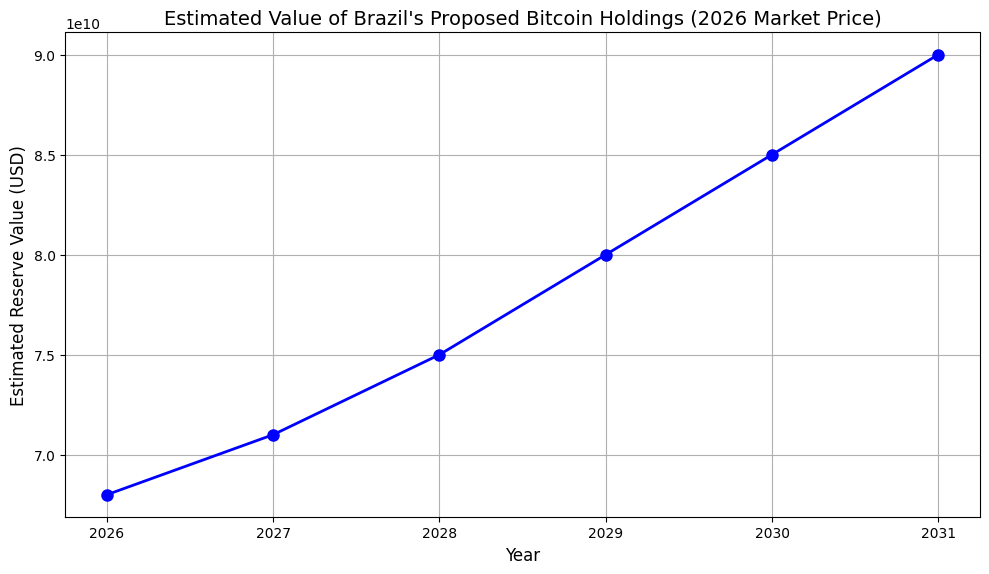
The core of PL 4501/2024 is straightforward yet historic: over a five‑year timeframe, Brazil would accumulate up to 1,000,000 BTC as a sovereign reserve asset. Based on Bitcoin’s prevailing market price (hovering above $68,000—$69,000 at the time of writing), this reserve would represent a staggering $68 billion + allocation.
“Estimated Value of Brazil’s Proposed Bitcoin Holdings (2026 Market Price)”
showing Bitcoin price vs hypothetical reserve value over a timeline from 2026–2031.
The strategy involves gradual purchases over the five‑year period to minimize market disruption. This is a notable divergence from one‑off acquisitions or sudden treasury allocations seen in past national digital asset strategies.
2. Legal Rights and Tax Policy Innovation
The bill further includes provisions that go beyond accumulation. Key reforms proposed include:
Allowing Bitcoin to be used to pay federal taxes, making BTC a recognized legal medium within Brazil’s fiscal system.
Exemption of capital gains tax on digital asset gains, a dramatic shift from traditional tax treatment.
Legal safeguards guaranteeing self‑custody rights and freedom of transfer for digital asset holders, strengthening property rights at the citizen level.
These innovations are designed not only to facilitate broader adoption of Bitcoin within Brazil but also to signal a legal environment favorable to digital asset investments and blockchain participation.
3. Custody, Oversight, and National Security
Under the legislative text, the reserve is to be jointly overseen by Brazil’s Central Bank (Banco Central do Brasil) and the Ministry of Finance. Strategic design elements include:
Use of high‑security cold wallets with advanced blockchain and AI‑driven monitoring systems.
Semi‑annual reporting to Congress on reserve status, custody practices, and any transactions.
Such frameworks aim to balance transparency with national security, reducing risks associated with custody mismanagement or opaque reporting.
4. Bitcoin as Collateral for CBDC Drex
A particularly forward‑looking aspect of the bill is its proposal to allow Bitcoin to serve as collateral for Brazil’s central bank digital currency (CBDC) called “Drex”. This aligns sovereign Bitcoin reserves with digital currency infrastructure, creating a dual purpose: reserve asset and monetary support mechanism.
If enacted, this will represent a rare instance where Bitcoin is legally integrated into the foundational monetary architecture of a sovereign digital currency.
Political Context and Global Significance
Brazil’s move comes amid growing global momentum around national crypto reserve discussions. While one small group of countries has already moved into formal national crypto reserves—such as the United States’ strategic Bitcoin reserve and digital asset stockpile—others like Japan, Poland, and Pakistan remain at debate stages.
In this context:
Brazil’s proposed reserve is one of the largest and most structurally ambitious, aiming for a reserve scale that outruns many national holdings.
It stands out for its integration of legal rights protections and fiscal uses of Bitcoin, not merely asset acquisition.
The proposal could serve as a blueprint for other G20 nations if it gains traction in legislative committees and eventually becomes law.
This is not merely financial innovation—it’s a shift in how sovereign economies conceptualize digital assets as strategic tools, not just speculative instruments.
Challenges, Debate, and Opposition
Despite broad interest, the bill faces legislative hurdles. It must still pass multiple committees in Brazil’s House of Deputies, be approved by the Senate, and signed by the President before becoming law.
Critics argue that:
Bitcoin’s inherent price volatility makes it a risky reserve asset.
The scale of acquisition—1 million BTC, representing a significant portion of global supply—raises liquidity and market impact concerns.
Central bank regulation currently does not recognize BTC as a reserve asset, creating legal and regulatory friction.
These debates are playing out in hearings and committee reviews and will shape whether Brazil’s proposal advances.
Conclusion: A Strategic Turning Point
Brazil’s innovative proposal for a Strategic Sovereign Bitcoin Reserve is a bold experiment at the intersection of monetary policy, digital finance, and national strategy. By aiming to acquire up to 1 million BTC, reform tax law, protect digital rights, integrate Bitcoin with CBDC collateral frameworks, and establish robust governance, Brazil could set a new precedent for how sovereign states interact with digital assets.
Whether this bill becomes law remains uncertain, but its very existence underscores a transformative moment: Bitcoin is no longer purely market speculation—it is being legislated into the core of national financial planning.
About Us and Media
Blockchain and cryptocurrency media covering and exposing the practical application development on the blockchain industry and undiscovered coins.
Click edit button to change this text. Lorem ipsum dolor sit amet, consectetur adipiscing elit
Manage Consent
To provide the best experiences, we use technologies like cookies to store and/or access device information. Consenting to these technologies will allow us to process data such as browsing behavior or unique IDs on this site. Not consenting or withdrawing consent, may adversely affect certain features and functions.
Functional Always active
The technical storage or access is strictly necessary for the legitimate purpose of enabling the use of a specific service explicitly requested by the subscriber or user, or for the sole purpose of carrying out the transmission of a communication over an electronic communications network.
Preferences
The technical storage or access is necessary for the legitimate purpose of storing preferences that are not requested by the subscriber or user.
Statistics
The technical storage or access that is used exclusively for statistical purposes.The technical storage or access that is used exclusively for anonymous statistical purposes. Without a subpoena, voluntary compliance on the part of your Internet Service Provider, or additional records from a third party, information stored or retrieved for this purpose alone cannot usually be used to identify you.
Marketing
The technical storage or access is required to create user profiles to send advertising, or to track the user on a website or across several websites for similar marketing purposes.