

Main Points :
- Bitmine Immersion Technologies has surpassed 4 million ETH, representing over 3.3% of Ethereum’s total supply, positioning itself as the world’s largest Ethereum treasury holder.
- The company’s “Alchemy of 5%” strategy—aiming to hold 5% of ETH’s total supply—marks an unprecedented corporate treasury experiment.
- Beyond passive holding, Bitmine plans to launch a Made-in-America Validator Network (MAVAN), signaling deeper participation in Ethereum’s staking economy.
- Strong backing from major institutional investors highlights growing confidence in ETH-centric balance sheet strategies.
- Bitmine’s rise reflects a broader trend: corporations are no longer merely holding crypto—they are becoming structural participants in blockchain networks.
Introduction: From Bitcoin Treasuries to Ethereum Treasuries
Over the past several years, the idea of a “crypto treasury company” has evolved rapidly. What began with Bitcoin-focused balance sheet strategies—most famously championed by companies like Strategy—has now expanded into a broader exploration of digital assets as long-term strategic reserves.
In December 2025, Bitmine Immersion Technologies announced a milestone that may redefine this trend: total holdings of more than 4.06 million ETH, alongside Bitcoin, cash, and high-risk venture investments, bringing total assets to approximately $13.2 billion.
This is not simply a large number. It represents a new level of ambition—one where a single publicly visible corporate entity seeks to control a meaningful percentage of a major blockchain’s monetary base. For Ethereum, whose economic model is increasingly intertwined with staking, validation, and decentralized finance, this raises fundamental questions about governance, yield generation, and the future role of corporations in decentralized ecosystems.
Bitmine’s Current Holdings and Financial Structure
According to the company’s December 22 disclosure, Bitmine’s asset composition as of December 21 is as follows:
- Ethereum (ETH): 4,066,062 ETH
- Bitcoin (BTC): 193 BTC
- Equity investment: $32 million in Eightco Holdings
- Cash: $1.0 billion
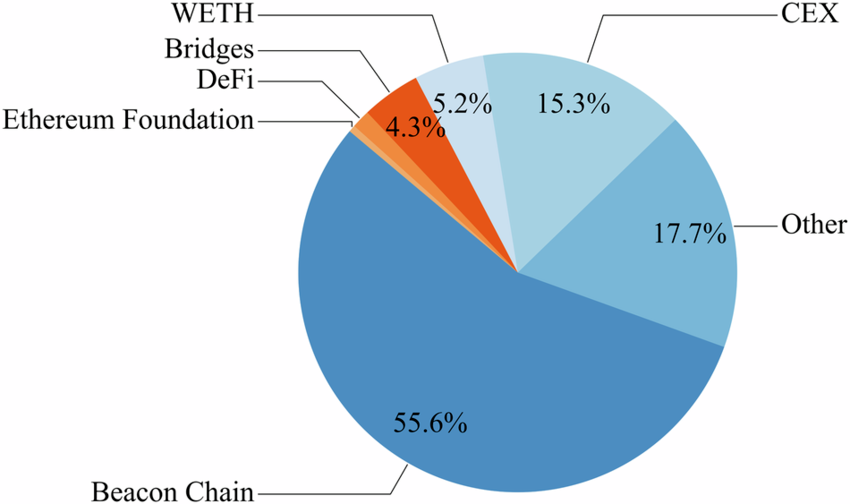
At current market valuations, Ethereum alone accounts for the overwhelming majority of Bitmine’s balance sheet. With total ETH supply hovering around 120 million coins, Bitmine’s holdings represent approximately 3.37% of all ETH in existence.
Ethereum total supply vs. Bitmine’s holdings (conceptual visualization).
This concentration places Bitmine in a category of its own. While other firms hold ETH as part of diversified treasuries, no other company has publicly pursued accumulation on this scale.
The “Alchemy of 5%”: A Corporate Monetary Experiment
Bitmine refers to its long-term vision as the “Alchemy of 5%”—a strategy to accumulate 5% of Ethereum’s total supply. While the phrase carries a marketing flourish, the underlying goal is clear: achieve critical mass in a scarce digital asset that underpins a global financial and computational network.
Why 5% Matters
In traditional finance, owning 5% of an asset class—especially one with governance or yield implications—confers significant strategic leverage. In Ethereum’s case, such a share could translate into:
- Substantial staking yield once deployed through validators
- Influence over network security participation (though not protocol governance in a direct sense)
- A powerful signaling effect to markets regarding ETH’s role as a productive reserve asset
Thomas Lee, Chairman of Bitmine and co-founder of Fundstrat, emphasized the pace of accumulation:
“In just five and a half months, Bitmine surpassed 4 million ETH. This is a critical milestone as we move rapidly toward our 5% Alchemy goal.”
From Holding to Participating: The MAVAN Validator Network
Perhaps the most strategically important development is Bitmine’s plan to launch the Made-in-America Validator Network (MAVAN) in early 2026.
What Is MAVAN?
MAVAN is envisioned as a proprietary Ethereum staking infrastructure designed to:
- Validate transactions on Ethereum’s proof-of-stake network
- Generate staking rewards from Bitmine’s ETH holdings
- Emphasize U.S.-based, compliant infrastructure
This marks a shift from passive treasury management to active protocol participation.
Ethereum proof-of-stake flow and the role of validators.
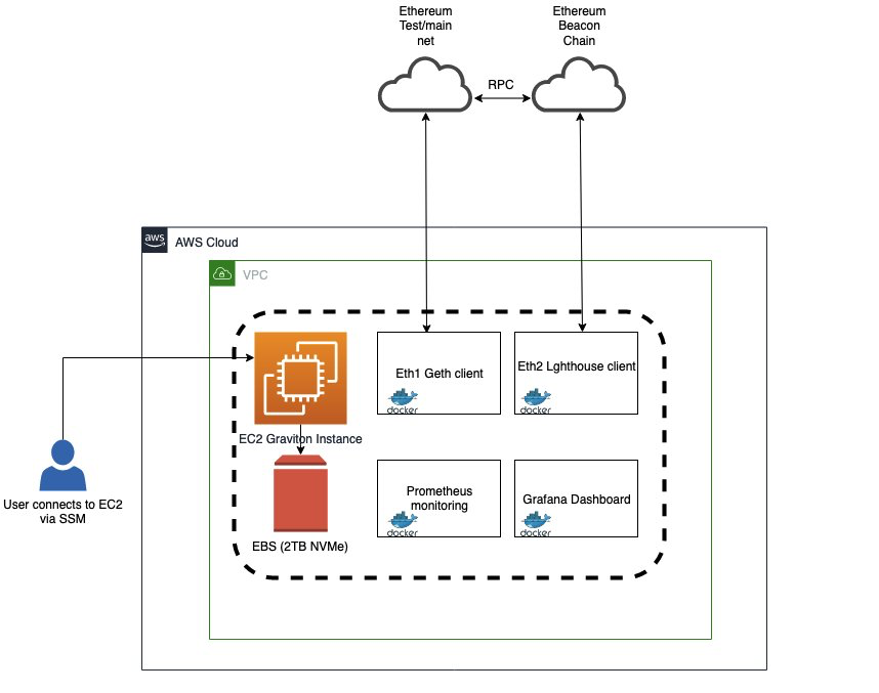
For Ethereum, where staking yield has become a foundational economic incentive, MAVAN could transform Bitmine’s ETH from a dormant asset into a recurring revenue engine—blurring the line between treasury management and infrastructure operation.
Market Impact and Liquidity: A Stock That Trades Like a Mega-Cap
Bitmine’s growing prominence is not limited to its crypto holdings. The company’s stock has seen an explosive rise in trading activity.
As of December 19, Bitmine’s five-day average daily trading volume reached $1.7 billion, ranking it 66th among approximately 5,700 U.S.-listed equities. This places it alongside established giants such as Wells Fargo and Chevron in terms of liquidity.
This phenomenon underscores a crucial shift: equity markets are increasingly treating crypto-native treasury companies as liquid proxies for digital asset exposure.
Institutional Backers: Who Is Betting on Bitmine?
Bitmine’s strategy has attracted a formidable roster of supporters, including:
- ARK Invest (Cathie Wood)
- Founders Fund
- Pantera Capital
- Galaxy Digital
- Kraken
- Digital Currency Group (DCG)
- Bill Miller III and Thomas Lee as individual investors
Such backing suggests that Bitmine’s approach is not viewed as speculative excess alone, but as a calculated bet on Ethereum’s long-term centrality in global finance and computation.
Broader Context: Ethereum’s Role in the Next Crypto Cycle
Bitmine’s rise coincides with broader structural trends:
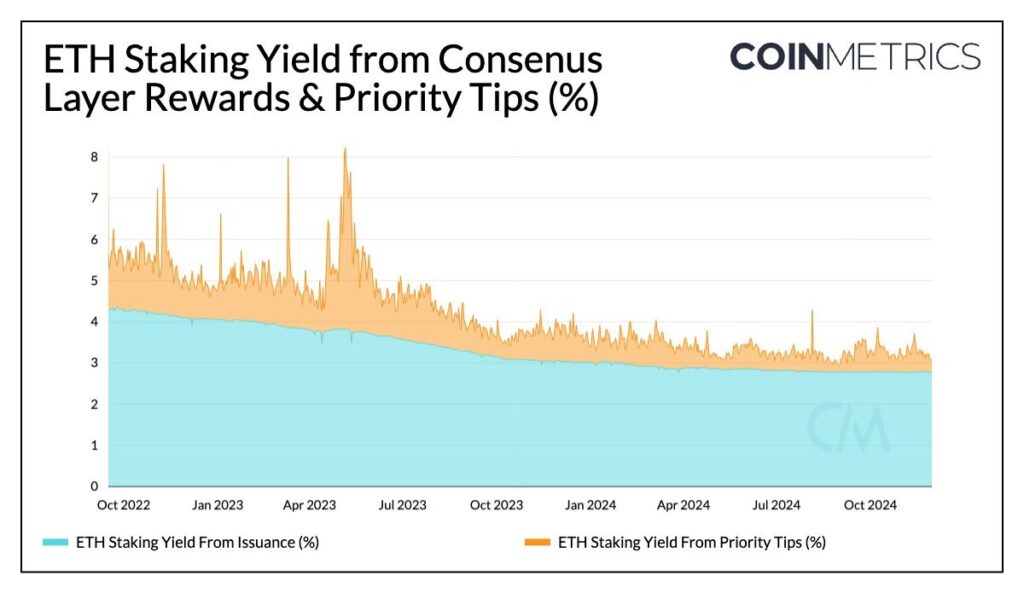
- Ethereum as Yield-Bearing Capital
Unlike Bitcoin, ETH can generate native yield through staking, making it attractive for balance sheets seeking income, not just appreciation. - Tokenized Finance and Real-World Assets
Ethereum remains the dominant platform for tokenization experiments involving bonds, funds, and stablecoins. - Corporate Demand for On-Chain Infrastructure
As enterprises explore blockchain settlement and custody, ETH increasingly functions as both “fuel” and “collateral.”
Historical Ethereum staking yields (illustrative).
Risks and Open Questions
Despite its ambition, Bitmine’s strategy raises legitimate concerns:
- Market Risk: Concentrated exposure to ETH price volatility
- Protocol Risk: Changes in Ethereum’s economics or staking rules
- Perception Risk: Centralization concerns if large holders dominate validation
These risks underscore that Bitmine’s experiment is not merely financial—it is systemic.
Conclusion: A Glimpse into Crypto-Native Corporate Finance
Bitmine Immersion Technologies’ accumulation of over 4 million ETH is more than a headline-grabbing statistic. It represents a new model of corporate finance, where balance sheets are built not just around cash and bonds, but around programmable, yield-generating digital assets.
Whether the “Alchemy of 5%” ultimately succeeds or falters, its implications will ripple far beyond Bitmine itself. For investors, developers, and policymakers alike, this moment signals that Ethereum is no longer just a platform—it is becoming infrastructure worthy of sovereign-scale strategies.
