
Main Points :
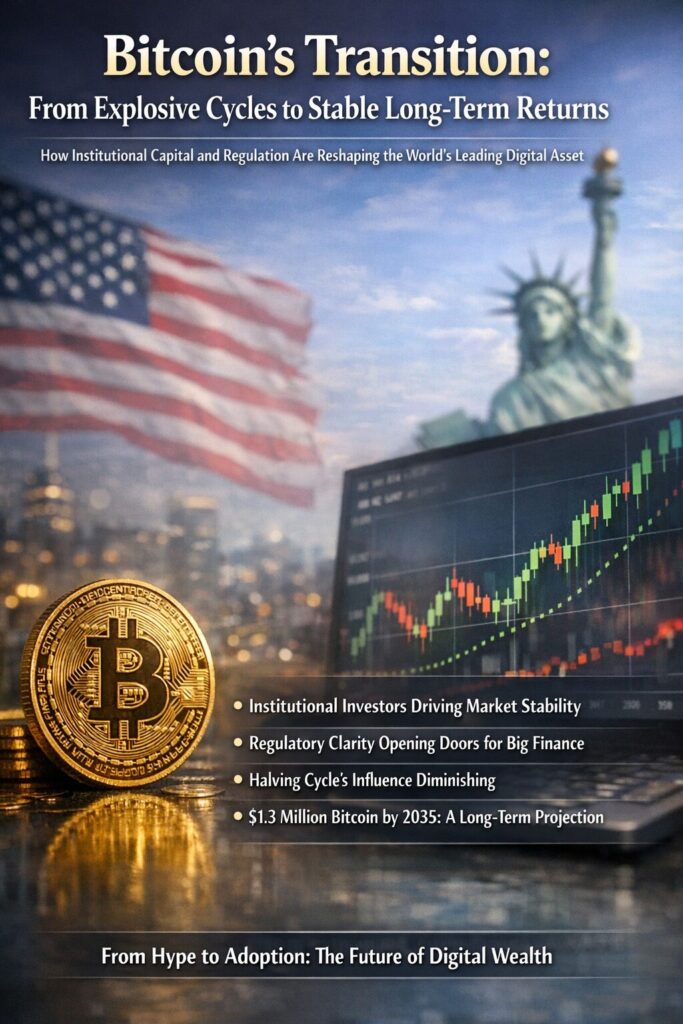
- Bitcoin is entering a new structural phase, shifting from extreme boom-and-bust cycles to more stable, long-term returns.
- Institutional investors, rather than retail speculation, are becoming the primary drivers of price formation.
- The traditional four-year halving cycle is losing its explanatory power as capital inflows, regulation, and financial infrastructure mature.
- Clearer regulation in the United States is acting as a green light for large financial institutions.
- Long-term projections—such as a $1.3 million Bitcoin price by 2035—are increasingly framed around adoption and capital allocation, not hype.
Introduction
Bitcoin has spent much of its existence defined by dramatic cycles: euphoric rallies followed by brutal drawdowns, often tied to its four-year halving schedule. For investors, this volatility was both its greatest attraction and its most daunting risk.
However, according to Bitwise Chief Investment Officer Matt Hougan, that era is gradually coming to an end. In late December 2025, Hougan explained in a CNBC interview that Bitcoin is entering a new phase—one characterized not by explosive short-term gains, but by steadier, more predictable long-term returns.
This article expands on that view, integrates recent market developments, and explores what this transition means for readers interested in new crypto assets, sustainable income opportunities, and practical blockchain adoption.
Bitwise CIO’s Long-Term Bitcoin Growth Scenario
Hougan’s thesis is simple but profound: Bitcoin is no longer a niche speculative instrument—it is becoming a core macro asset.
He argues that growing participation from pension funds, asset managers, banks, and publicly listed companies is naturally reducing volatility. Unlike retail traders, institutions tend to allocate capital systematically, rebalance portfolios during drawdowns, and hold assets for years rather than weeks.
Hougan has publicly stated a long-term price target of $1,300,000 per Bitcoin by 2035, a figure that may sound aggressive but is rooted in traditional asset-allocation math. If Bitcoin captures even a modest share of global stores of value—gold, sovereign bonds, and offshore wealth—the valuation becomes plausible.
Importantly, Hougan emphasized that the road to such levels will likely be gradual, not parabolic. The expectation for 2026 and beyond is continued appreciation, but through compound growth, not speculative spikes.
Institutional Investors Are Changing Bitcoin’s Market DNA
Moving Beyond the Four-Year Cycle
Historically, Bitcoin’s halving events—occurring roughly every four years—created predictable patterns: supply shock, rapid price increase, retail frenzy, and eventual collapse.
Hougan argues this framework is losing relevance. While halvings still matter fundamentally, they are no longer the dominant force. Instead, Bitcoin’s price is increasingly shaped by:
- ETF inflows and outflows
- Corporate treasury allocations
- Regulatory clarity
- Integration into traditional financial products
In other words, Bitcoin is starting to behave less like a startup stock and more like a maturing asset class.
A New Price Formation Mechanism
Institutional capital behaves differently from retail money. Large funds often employ strategies that automatically buy during market weakness, providing structural support during corrections.
Hougan cited the post-October 2025 pullback—after Bitcoin reached new highs—as an example. Despite a correction, the drawdown remained shallow compared to past cycles. There was no panic cascade, no 70% collapse—just controlled consolidation.
This reflects a market where long-term conviction outweighs short-term fear.
Regulation: From Headwind to Catalyst
Declining Regulatory Uncertainty
For years, regulatory ambiguity—especially in the United States—kept major institutions on the sidelines. That is now changing.
Clearer frameworks for custody, ETFs, and compliance have reduced perceived legal risk. Hougan described regulatory clarity as a “go signal” for institutional capital.
He also warned that without continued legislative progress, Bitcoin’s upside could be capped. Regulation, paradoxically, is no longer the enemy of decentralization—it is becoming a prerequisite for scale.
Banks and Wall Street Enter the Arena
Major financial institutions are already positioning themselves. Reports indicate that JPMorgan is exploring expanded Bitcoin trading services for institutional clients.
Meanwhile, Michael Saylor, chairman of Strategy, has forecast that by 2026, multiple large U.S. banks will:
- Hold Bitcoin on their balance sheets
- Offer Bitcoin custody services
- Use Bitcoin as collateral for lending
If realized, this would mark a historic shift: Bitcoin evolving from an outsider asset into financial infrastructure.
Market Context: Bitcoin at Around $88,000
At the time of writing, Bitcoin trades near $88,000. While this level would have been considered euphoric just a few years ago, the current market mood is notably calm.
Hougan interprets this stability as evidence that Bitcoin is transitioning toward a “stable return” profile—still volatile compared to bonds or equities, but far less chaotic than its early years.
For investors seeking long-term exposure rather than speculative windfalls, this evolution may actually expand Bitcoin’s appeal, not reduce it.
What This Means for Investors and Builders
For Investors
- Bitcoin is increasingly suited to long-term portfolio allocation, not just tactical trading.
- Volatility may decline, but risk-adjusted returns could improve.
- The focus shifts from timing cycles to understanding capital flows and regulation.
For Blockchain Practitioners
- Institutional adoption accelerates demand for custody, compliance, analytics, and infrastructure.
- Stablecoin integration, settlement layers, and regulated on-ramps become critical.
- Bitcoin’s role as pristine collateral opens new financial use cases.
Conclusion: A Maturing Monetary Network
Bitcoin’s story is no longer just about rebellion or rapid enrichment. As highlighted by Bitwise CIO Matt Hougan, it is becoming something more subtle—and arguably more powerful: a durable, globally recognized monetary asset.
The transition from explosive cycles to stable returns does not signal the end of opportunity. Instead, it marks the beginning of a phase where Bitcoin integrates more deeply into the global financial system, attracting capital that values resilience over hype.
For those searching for new crypto assets, sustainable returns, and practical blockchain applications, understanding this shift is essential. Bitcoin’s next decade may not be its loudest—but it could be its most consequential.
