
Main Points :
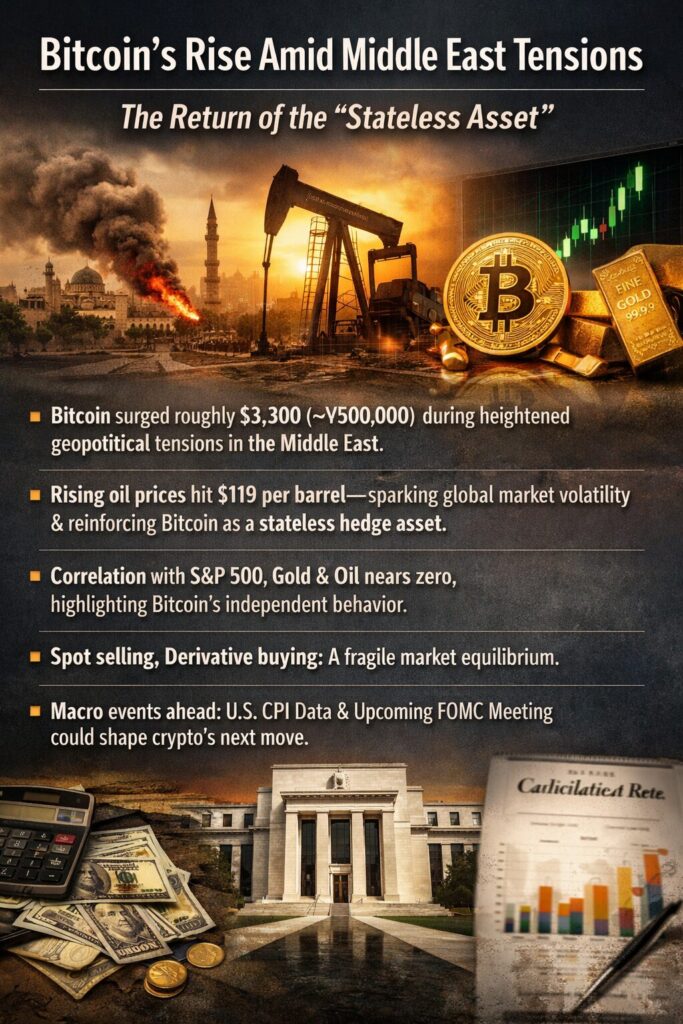
- Bitcoin surged roughly $3,300 (≈¥500,000) during heightened geopolitical tensions in the Middle East.
- Rising oil prices—briefly touching $119 per barrel—triggered global market volatility but also reinforced Bitcoin’s narrative as a stateless hedge asset.
- Correlation with traditional assets such as the S&P 500, gold, and oil has recently approached zero, highlighting Bitcoin’s independent behavior.
- Market structure currently shows spot selling but derivative buying, creating a fragile equilibrium.
- Macro events—including U.S. CPI data and the upcoming FOMC meeting—could determine the next direction of the crypto market.
Introduction: Bitcoin’s Safe-Haven Narrative Reappears
In early March 2026, Bitcoin once again demonstrated a trait that has fascinated economists, investors, and technologists for more than a decade: its potential role as a stateless financial asset. As geopolitical tensions escalated in the Middle East and oil prices surged, global financial markets experienced a wave of volatility. Yet Bitcoin showed surprising resilience, rising approximately $3,300 within a short period.
This movement came as the price of WTI crude oil briefly climbed to $119 per barrel, the highest level in nearly four years, triggering panic across traditional markets. In the midst of this uncertainty, capital flowed into Bitcoin, reinforcing the long-standing thesis that decentralized digital assets can act as a hedge against geopolitical instability and centralized financial systems.
The concept of Bitcoin as a “stateless asset”—an asset not issued or controlled by any government—has gained renewed attention. Historically, investors have relied on gold or government bonds during times of crisis. However, Bitcoin’s digital nature and decentralized infrastructure are increasingly positioning it as a modern alternative store of value.
This article examines the market dynamics behind Bitcoin’s recent price surge, the macroeconomic and geopolitical factors influencing crypto markets, and the broader implications for investors seeking new opportunities in blockchain-based assets.
Middle East Geopolitics and Bitcoin’s Surge
The immediate catalyst for Bitcoin’s price increase was the escalation of geopolitical risk in the Middle East. Reports emerged that Mojtaba Khamenei, known for his anti-Western stance, had become Iran’s new Supreme Leader. This development raised concerns about regional instability and potential military escalation.
Financial markets quickly reacted. Oil prices soared, global equities declined, and investors began searching for assets less exposed to geopolitical shocks. Bitcoin benefited from this shift in sentiment.
Unlike fiat currencies or national securities, Bitcoin operates on a decentralized network maintained by miners and nodes across the globe. No government can freeze it, confiscate it easily, or manipulate its supply. These characteristics make it particularly attractive during times when trust in state-based financial systems weakens.
Historically, Bitcoin has reacted differently to geopolitical crises compared with traditional safe havens. While gold often rises gradually during uncertainty, Bitcoin tends to experience rapid inflows of speculative capital, producing sharper price movements.
In this recent episode, the narrative of Bitcoin as a neutral global asset—accessible to anyone with an internet connection—appears to have resonated strongly with investors.
Oil Prices and the Energy Paradox in Bitcoin Mining
While geopolitical tensions pushed Bitcoin higher, the same forces introduced a potential downside risk.
Rising oil prices typically translate into higher electricity costs, which directly impact Bitcoin mining operations. Mining requires substantial computational power, and electricity is the largest operational expense for miners.
If energy prices remain elevated, several consequences could emerge:
- Reduced mining profitability, especially for smaller operators.
- Increased concentration of mining power among large industrial players with cheaper energy sources.
- Potential selling pressure from miners who need to liquidate Bitcoin to cover operating costs.
However, the relationship between energy prices and Bitcoin is complex. Some analysts argue that higher energy costs could actually strengthen Bitcoin’s long-term security. As inefficient miners exit the market, the network becomes dominated by operators with optimized infrastructure and renewable energy strategies.
Moreover, Bitcoin mining has increasingly shifted toward renewable and stranded energy sources, including hydroelectric power, geothermal energy, and natural gas flaring. This transition may reduce the network’s vulnerability to fluctuations in fossil fuel markets.
Bitcoin’s Decoupling from Traditional Assets
One of the most intriguing developments in recent months has been Bitcoin’s declining correlation with traditional financial assets.
Recent data suggests that the two-month correlation coefficients are approximately:
| Asset | Correlation with Bitcoin |
|---|---|
| S&P 500 | -0.09 |
| Gold | -0.25 |
| Oil | -0.24 |
These values indicate that Bitcoin is currently behaving largely independently of traditional markets.
This decoupling is significant for institutional investors. Portfolio managers often seek assets with low correlation to diversify risk. If Bitcoin continues to demonstrate independence from equities, commodities, and bonds, it could become increasingly attractive as a portfolio diversification instrument.
However, correlations in financial markets are notoriously unstable. During major market crashes—such as the 2020 pandemic shock—Bitcoin temporarily moved in tandem with equities. The current low correlation may therefore represent a temporary market phase rather than a permanent structural shift.
Market Structure: Spot Selling vs. Derivative Buying
Beyond macroeconomic factors, internal market dynamics also reveal a complex picture.
Recent order flow analysis shows:
- Spot markets: Slightly dominated by selling pressure.
- Derivative markets: Stronger buying activity.
This divergence creates what traders call a structural imbalance.
When derivatives traders—especially those using leverage—become overly optimistic while spot holders sell, markets can become vulnerable to sudden downward movements. Liquidations in leveraged positions may accelerate volatility.
Another key indicator is the Put-Call Ratio (PCR) in the options market. Recently, the PCR has been rising due to an increase in put options. This suggests that many investors are hedging against potential downside risk.
In practical terms, the market currently exhibits a mixed sentiment environment:
- Long-term optimism about Bitcoin’s narrative.
- Short-term caution among professional traders.
Trump’s Statement and Market Stabilization
Adding another layer to the situation, U.S. President Donald Trump reportedly stated that the conflict in the Middle East was “almost over.” This statement helped calm financial markets, reducing the immediate geopolitical premium embedded in asset prices.
As a result, Bitcoin’s upward momentum slowed and the market entered a period of consolidation.
This pattern highlights an important aspect of Bitcoin’s behavior: while it can benefit from geopolitical uncertainty, it can also lose momentum once tensions ease.
For traders and investors, this means that geopolitical narratives should be viewed as short-term catalysts rather than long-term drivers.
Macro Catalysts: CPI, Industrial Production, and the FOMC
Looking ahead, several macroeconomic events could shape the direction of the cryptocurrency market:
- March 11 – U.S. Consumer Price Index (CPI)
- March 12 – U.S. Industrial Production Index
- March 19 – Federal Open Market Committee (FOMC) meeting
Inflation data remains particularly important. If CPI shows persistent inflation, the Federal Reserve may maintain or increase monetary tightening. Higher interest rates typically reduce liquidity in financial markets, which can weigh on speculative assets such as cryptocurrencies.
Conversely, signs of slowing inflation could trigger renewed risk appetite, potentially benefiting Bitcoin and other digital assets.
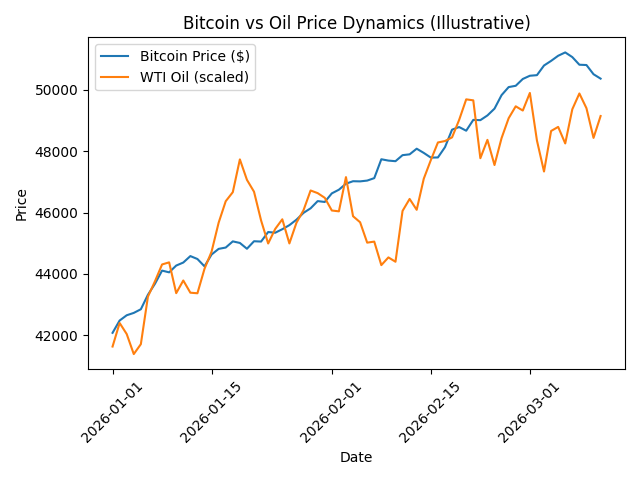
Chart Illustration: Bitcoin vs Oil Price Dynamics
Graph concept:
- X-axis: Date (Jan–Mar 2026)
- Left Y-axis: Bitcoin Price ($)
- Right Y-axis: WTI Oil Price ($)
Purpose: illustrate divergence between oil spikes and Bitcoin price trends.
Diagram: Crypto Market Structure (Spot vs Derivatives)
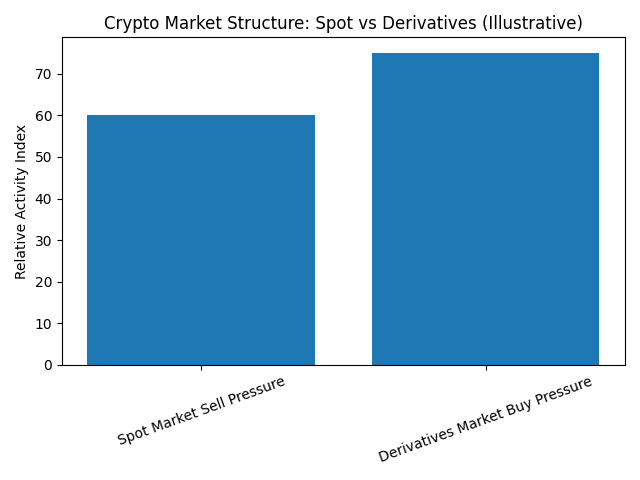
Diagram concept:
- Spot Market → Selling pressure
- Derivatives Market → Leveraged buying
- Convergence risk → Liquidation cascade
Purpose: show how imbalanced liquidity structures can create volatility.
Broader Implications for Crypto Investors
For investors seeking new opportunities in digital assets, several strategic insights emerge from the current market environment.
First, Bitcoin’s stateless narrative continues to gain traction during periods of geopolitical stress. This strengthens its position as a hedge asset within the digital economy.
Second, the decoupling from traditional markets—if sustained—could enhance Bitcoin’s role in diversified portfolios.
Third, derivative market activity indicates that professional traders remain heavily involved in shaping short-term price dynamics.
Finally, macroeconomic events continue to influence crypto markets, reminding investors that digital assets are increasingly integrated into the global financial system.
Conclusion: Bitcoin’s Identity as a Global Neutral Asset
Bitcoin’s recent price movement highlights a defining feature of the cryptocurrency revolution: the emergence of a financial asset independent of national governments and traditional institutions.
As geopolitical tensions, energy markets, and macroeconomic policies interact, Bitcoin’s role in the global financial system continues to evolve. For some investors, it represents a speculative instrument. For others, it is becoming a core component of a new decentralized financial architecture.
Whether Bitcoin ultimately becomes the digital equivalent of gold or remains a volatile technological asset remains uncertain. Yet one trend is clear: during moments of global uncertainty, the idea of a borderless, censorship-resistant asset becomes increasingly compelling.
For investors searching for the next wave of blockchain-driven financial innovation, Bitcoin’s response to geopolitical shocks may offer a glimpse into the future of money itself.
