
Key Points :
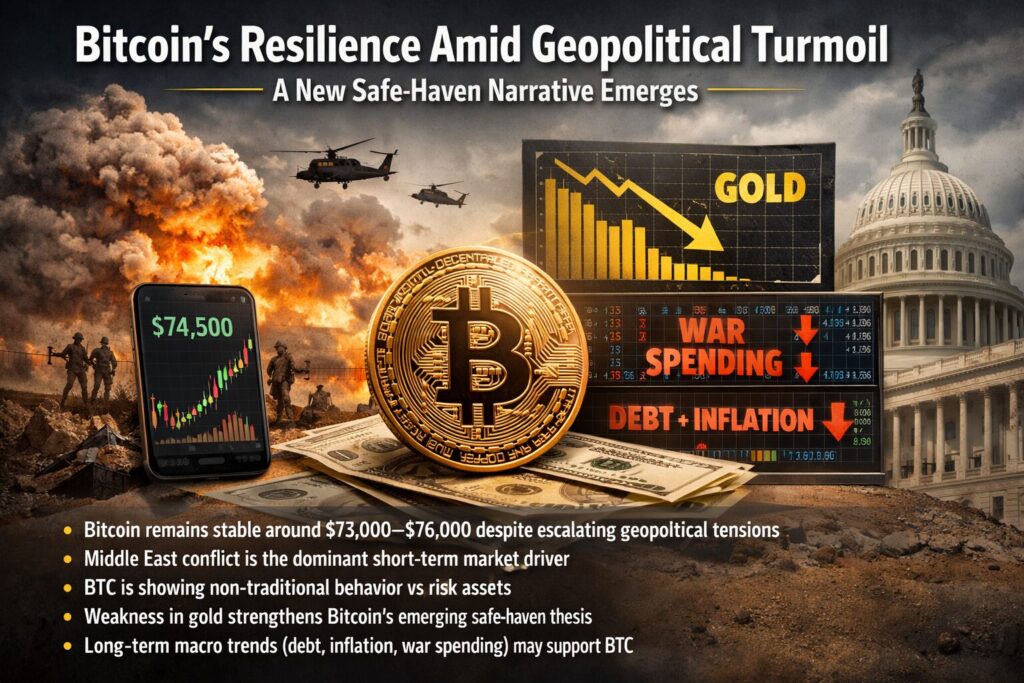
- Bitcoin remains stable around $73,000–$76,000 despite escalating geopolitical tensions
- Middle East conflict is the dominant short-term market driver
- BTC is showing non-traditional behavior vs risk assets
- Weakness in gold strengthens Bitcoin’s emerging safe-haven thesis
- Long-term macro trends (debt, inflation, war spending) may support BTC
1. Market Overview: Bitcoin Holds Ground Under Pressure
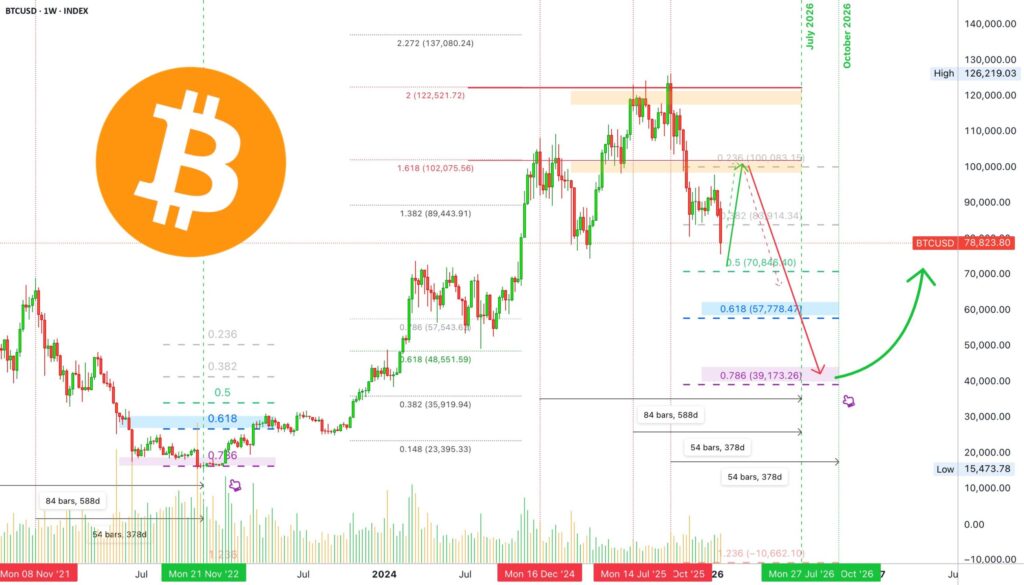
Bitcoin has demonstrated notable resilience this week, trading within a relatively tight range between approximately $72,000 and $76,000, despite escalating geopolitical tensions in the Middle East.
The market opened the week near $71,000, before briefly rallying toward $76,000 following a temporary easing of geopolitical risks. This came after statements suggesting a delay in military escalation. However, optimism proved short-lived as conflicting narratives emerged, reigniting uncertainty.
Despite these developments, Bitcoin has not experienced the sharp drawdowns typically associated with risk-off environments. Instead, it has maintained a stable consolidation pattern, indicating strong underlying support.
2. Geopolitical Dynamics: The Dominant Market Driver
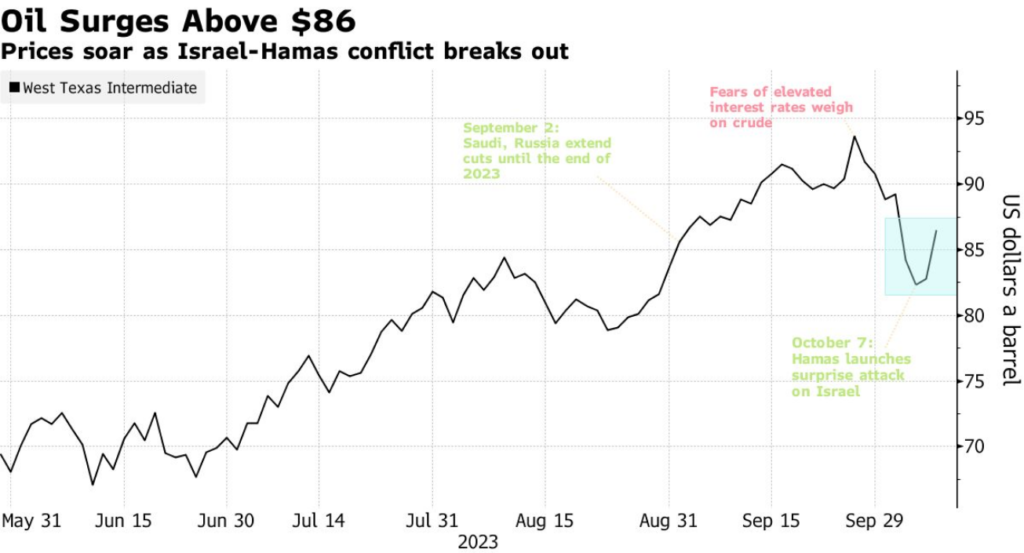
The primary driver of market sentiment remains the evolving geopolitical situation involving the United States and Iran.
While U.S. officials suggest progress toward de-escalation, Iranian authorities have publicly denied such developments. This divergence has introduced significant uncertainty, which continues to weigh on global markets.
Several key risk factors are shaping the current environment:
- Increased military mobilization on both sides
- Rising probability of escalation into ground conflict
- Energy market instability, particularly oil price fluctuations
- Potential diplomatic intervention (e.g., third-party mediation)
These dynamics are influencing not only traditional markets like equities and bonds but also digital assets such as Bitcoin.
3. Bitcoin vs Traditional Risk Assets: A Structural Shift
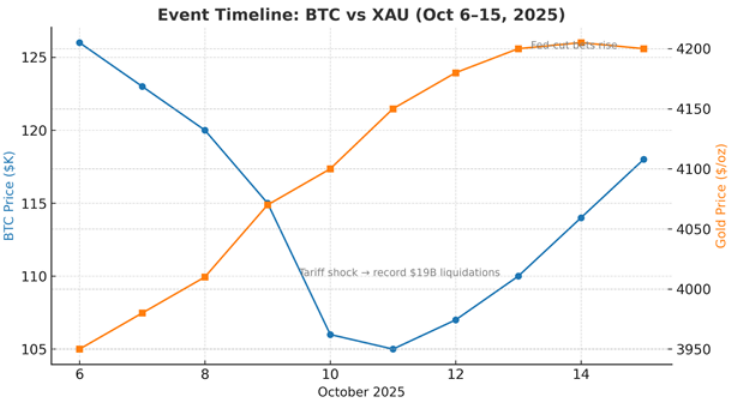
A key observation from recent market behavior is Bitcoin’s divergence from traditional risk assets.
While the Nasdaq index has entered a corrective phase, Bitcoin has not followed suit. This decoupling suggests a structural shift in how the market perceives BTC.
Historically, Bitcoin has behaved like a high-beta risk asset, moving in tandem with equities. However, recent price action indicates a transition toward a hybrid role:
- Part risk asset
- Part macro hedge
- Part alternative store of value
This evolving identity is critical for investors evaluating Bitcoin’s role in diversified portfolios.
4. The Gold Comparison: Why Bitcoin Is Gaining Ground
One of the most intriguing aspects of the current market environment is the relative underperformance of gold.
Traditionally, gold has been the primary safe-haven asset during periods of geopolitical instability. However, in this cycle, gold has not exhibited the expected strength.
Several factors may explain this shift:
- Rising interest rates reduce gold’s attractiveness (no yield)
- Liquidity preference shifts toward more flexible assets
- Increased institutional familiarity with Bitcoin
As a result, Bitcoin is increasingly being considered as an alternative safe haven, particularly among younger institutional investors and macro funds.
5. On-Chain and Structural Support Factors
Beyond price action, underlying blockchain data suggests that selling pressure may have already been absorbed earlier in the year.
Key supportive factors include:
- Stabilization in active addresses and transaction volume
- Reduced speculative leverage compared to previous cycles
- Accumulation by long-term holders
These factors indicate that the market may have already undergone a significant deleveraging phase, creating a stronger base for future price movements.
6. Macro Backdrop: War, Debt, and Monetary Pressure
The broader macroeconomic environment is becoming increasingly supportive of Bitcoin’s narrative.
Key themes include:
- Expanding fiscal deficits driven by war spending
- Persistent inflationary pressures due to energy costs
- Rising global interest rates and sovereign debt concerns
In such an environment, traditional fiat systems face structural challenges, enhancing the appeal of decentralized assets like Bitcoin.
Bitcoin’s fixed supply and decentralized nature position it uniquely as a hedge against monetary debasement.
7. Scenario Analysis: Short-Term vs Long-Term Outlook
Short-Term Outlook
Bitcoin’s direction will largely depend on geopolitical developments:
- De-escalation scenario → Risk-on rally, BTC may test higher resistance levels (~$78,000+)
- Escalation scenario → Risk-off sentiment, but BTC downside may remain limited
Long-Term Outlook
Even in the case of prolonged conflict, Bitcoin may benefit from:
- Capital flight from unstable regions
- Growing distrust in traditional financial systems
- Increased adoption as a neutral, borderless asset
8. Conclusion: A Turning Point for Bitcoin’s Identity
Bitcoin’s behavior in the current geopolitical environment marks a potential turning point in its evolution.
Rather than acting purely as a speculative asset, Bitcoin is beginning to exhibit characteristics of a macro hedge and, potentially, a safe-haven asset.
While uncertainties remain—particularly regarding geopolitical developments—the underlying strength in Bitcoin’s price action suggests a shift in market perception.
If this trend continues, Bitcoin could solidify its position not just as a digital asset, but as a foundational component of the global financial system.
