
Main Points :
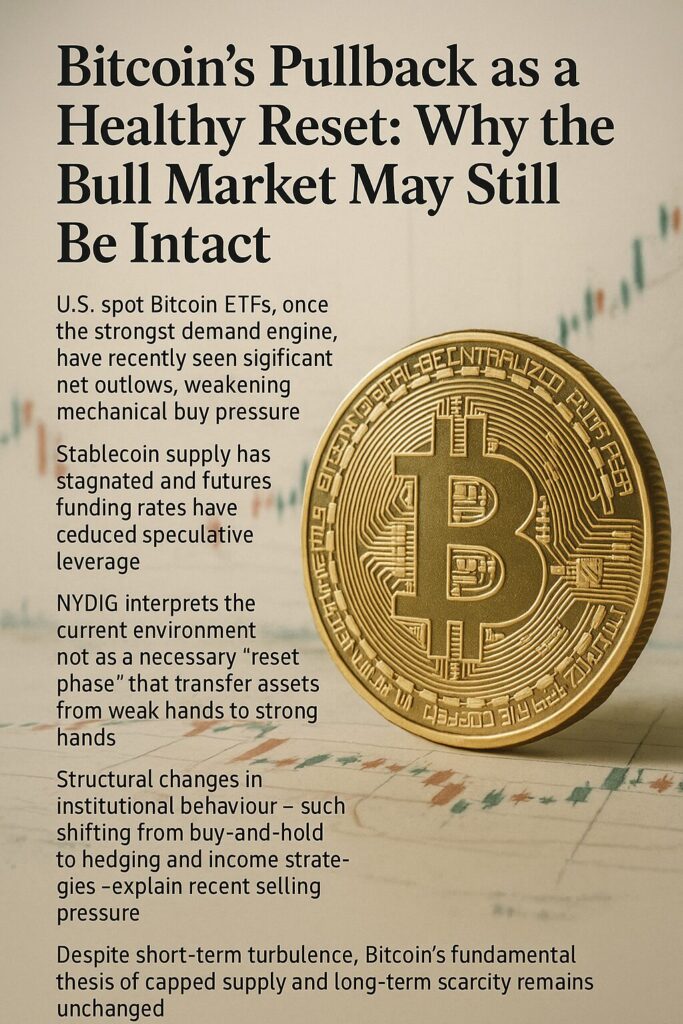
- U.S. spot Bitcoin ETFs, once the strongest demand engine, have recently seen significant net outflows, weakening mechanical buy pressure.
- Stablecoin supply has stagnated and futures funding rates have cooled, signaling reduced speculative leverage.
- NYDIG interprets the current environment not as the end of the bull market but as a necessary “reset phase” that transfers assets from weak hands to strong hands.
- Structural changes in institutional behavior—such as shifting from buy-and-hold to hedging and income strategies—explain recent selling pressure.
- Despite short-term turbulence, Bitcoin’s fundamental thesis of capped supply and long-term scarcity remains unchanged.
Introduction: A Market That Looks Weak but Isn’t Finished
Bitcoin’s recent decline has raised concerns among investors who have grown accustomed to the near-relentless rally that characterized much of 2024 and early 2025. According to NYDIG’s latest market report, the upward momentum driven by robust demand channels—such as spot ETFs, expanding stablecoin liquidity, and aggressive futures positioning—has started to cool.
ETF net outflows have intensified, futures funding rates have fallen, and the once-dominant inflow engine has notably weakened. At first glance, these developments could be interpreted as signs of a deteriorating bull market. However, NYDIG argues that the opposite is true: what the market is experiencing is not a breakdown, but a reset, clearing excess froth before the next expansionary phase.
Such reset periods are not only normal but also indispensable in sustained bull markets. They purge speculative extremes, recalibrate leverage, and shift supply from short-term, momentum-driven traders to committed long-term holders. To understand where the Bitcoin market may be heading next, we must examine the three critical pillars of current conditions: ETF flows, stablecoin supply behavior, and derivatives market dynamics.
1: Spot Bitcoin ETF Outflows—A Structural Change, Not a Collapse
Spot Bitcoin ETFs in the U.S., launched in early 2024, fundamentally reshaped Bitcoin demand. Their automatic, rules-based buying transformed retail and institutional behavior, contributing to Bitcoin’s surge past earlier resistance zones.
But November 2025 witnessed the first major reversal: substantial net outflows, even from previously steady buyers such as BlackRock’s ETF products. This shift weakened the mechanical bid that had provided consistent support for Bitcoin throughout the year.
Why did ETF demand weaken?
NYDIG points to a key structural development:
The increase in ETF options position limits has enabled institutions to transition from straightforward buy-and-hold accumulation to more complex strategies aimed at risk hedging and income generation.
This is not a bearish signal; rather, it reflects the natural evolution of Bitcoin from a speculative asset to a fully financialized macro instrument. When new strategies become available, capital reallocates accordingly, leading to temporary selling pressure.
Section 2: The Slowdown in Stablecoin Expansion
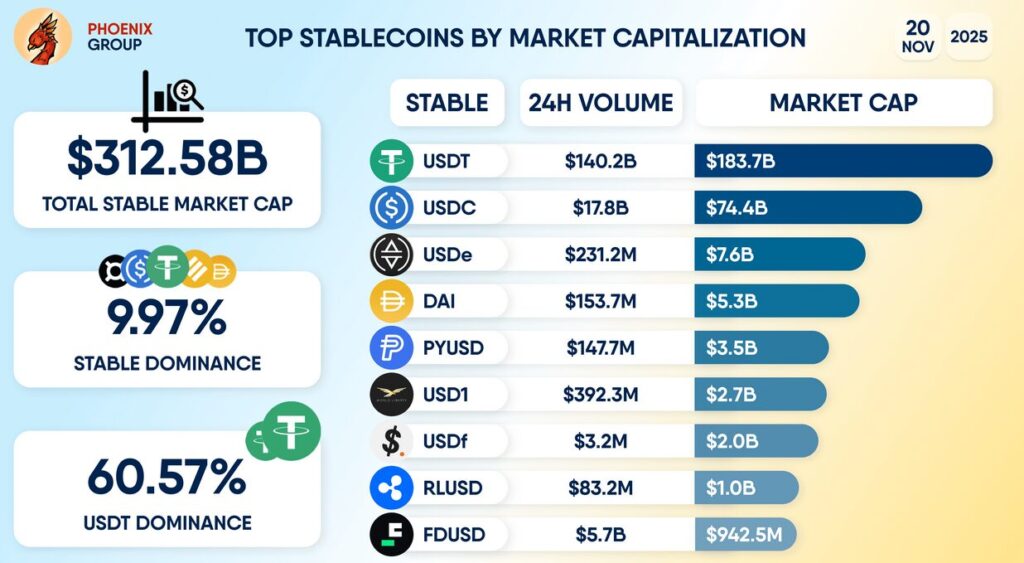
Stablecoins serve as the “liquidity rails” of the crypto market. When stablecoin supply expands, new purchasing power typically flows into risk assets like Bitcoin. Conversely, stagnation or contraction reflects liquidity tightening.
In recent months, leading stablecoins such as USDT and USDC have shown flat or declining supply growth. This coincides with U.S. regulatory tightening and uneven global liquidity conditions.
The stagnation of stablecoin issuance indicates that marginal buyers—especially retail and offshore leveraged participants—have become more cautious. But history shows that stablecoin slowdowns often occur in the middle of bull cycles, not the end, as markets pause to digest gains.
Section 3: Derivatives Market Cooling—Lower Funding Rates and Reduced Leverage
One of the strongest signs that the market is undergoing a healthy reset is found in the derivatives market. NYDIG highlights that futures funding rates have declined, indicating that the number of traders willing to take on leveraged long positions has decreased.
Overly bullish funding rates often precede short-term corrections, while reduced or neutral rates create a more sustainable environment for long-term appreciation.
Leverage washouts precede strong rallies
Lower funding rates suggest that speculative traders, who often exacerbate volatility, have temporarily exited. This reduces the risk of cascading liquidations and allows long-term investors to accumulate Bitcoin at more attractive valuations.
Section 4: Market Psychology—From Easy Mode to Selective Mode
NYDIG describes the past year as “easy mode,” where almost every investor enjoyed gains thanks to strong macro tailwinds, ETF demand, and growing institutional adoption. But markets eventually shift into selective mode, requiring patience, conviction, and disciplined strategy.
During such periods:
- Long-term holders often increase their share of total supply.
- New entrants have an opportunity to accumulate coins transferred from short-term speculators.
- The market resets expectations and builds a more stable foundation for future growth.
This is consistent with Bitcoin’s historical behavior across prior cycles. Every major bull run—2013, 2017, 2021—experienced multi-month cooling phases that looked like bearish reversals but ultimately served as springboards.
Section 5: Why the Bull Market Structure Remains Intact
Despite the cooling demand engine, several structural indicators remain bullish:
1. Bitcoin’s supply remains capped at 21 million
Scarcity is Bitcoin’s defining economic proposition. No downturn changes its immutable supply schedule.
2. Long-term holder supply is at or near all-time highs
Coins held for 155+ days are historically the least likely to be sold during volatility.
3. Institutional integration continues to deepen
Even with temporary ETF outflows, the broader integration of Bitcoin into global financial infrastructure is accelerating.
4. Regulatory clarity is improving
The U.S., EU, UK, Singapore, and parts of Asia now have clearer frameworks for Bitcoin financial products, enabling conservative institutions to participate without regulatory ambiguity.
Taken together, these factors suggest that the current correction is normal within the context of a maturing asset class—not a structural top.
Section 6: What Comes Next? Scenario Outlook After the Reset
NYDIG emphasizes that Bitcoin cycles often shift from euphoria to consolidation before resuming upward trajectories. Following the flush of excessive leverage and speculative sentiment, several outcomes become more likely:
Short-Term Outlook (1–3 months)
- Lower volatility with price discovery around major support levels
- Continued ETF rebalancing as institutions refine strategies
- Gradual reinflation of stablecoin liquidity
Medium-Term Outlook (3–12 months)
- Renewed ETF inflows once new fiscal calendars start
- Expansion of Bitcoin custody products globally
- Increased adoption in payment channels and treasury strategies
Long-Term Outlook (12–36 months)
- Bitcoin continues transitioning toward a macro reserve asset
- Scarcity effects intensify as post-halving supply remains constrained
- BTC could attract a broader set of sovereign, pension, and insurance portfolios
NYDIG concludes that the market is undergoing a healthy re-accumulation phase, not a terminal decline.
Conclusion: A Cooling Market That Remains Fundamentally Strong
Bitcoin’s recent decline may unsettle some investors, but the data indicates a healthy reset rather than a breakdown. ETF outflows, stablecoin stagnation, and cooling derivatives leverage are signs that speculative excess is being flushed out.
NYDIG’s analysis affirms that long-term structural conditions remain intact: institutional participation is maturing, supply is fixed, and the macro narrative for Bitcoin as a scarce digital asset continues to strengthen.
For investors seeking new crypto assets, income opportunities, or practical blockchain implementation, the current phase offers clarity: the bull market is not over—it is evolving. Accumulation, research, and strategic positioning may prove far more valuable now than during the earlier euphoria.
