

Main Points :
- Bitcoin’s role as a store of value is expanding as global economic and geopolitical risks increase.
- The total store-of-value market is growing rapidly, not remaining static.
- Institutional investors, corporations, and sovereign wealth funds are accelerating adoption.
- Bitcoin does not need to replace gold entirely to reach $1 million.
- Structural factors such as ETF inflows, reduced volatility, and digital financial infrastructure are supporting long-term growth.
Introduction: From $4,000 to a Potential $1 Million
For years, the idea that Bitcoin could reach $1 million per coin was widely dismissed as unrealistic speculation. Even experienced financial advisors and professional investors often viewed such predictions as extreme scenarios far removed from traditional valuation models.
However, the rapid development of the cryptocurrency ecosystem over the past decade has fundamentally changed that perspective.
Matt Hougan, Chief Investment Officer of the digital asset management firm Bitwise, recently revisited this question in a market memo titled “How Bitcoin Could Reach $1 Million.” In it, Hougan argues that the common assumption underlying skepticism—namely that Bitcoin would need to replace gold entirely to achieve such a valuation—is flawed.
Instead, he suggests that Bitcoin’s potential lies in the expansion of the global store-of-value market itself, combined with increasing institutional adoption.
At the time of writing, Bitcoin trades around $70,000, with a market capitalization near $1.4 trillion. By contrast, the global gold market is estimated to be worth approximately $36 trillion.
While these figures initially make a $1 million Bitcoin seem implausible, a deeper examination of macroeconomic trends reveals a different possibility.
The Store-of-Value Thesis: Bitcoin as Digital Gold
Matt Hougan frames Bitcoin primarily as a store of value, similar to gold.
A store of value is an asset that investors use to preserve wealth outside traditional fiat currency systems or banking infrastructure. Historically, gold has served this function for thousands of years, acting as a hedge against inflation, currency debasement, and geopolitical instability.
Bitcoin shares several characteristics with gold that make it suitable for this role:
- Scarcity: Bitcoin has a fixed maximum supply of 21 million coins.
- Decentralization: It operates outside government control.
- Durability and portability: Bitcoin can be stored digitally and transferred globally within minutes.
- Transparency: The blockchain ledger publicly records all transactions.
These features have led many investors to describe Bitcoin as “digital gold.”
From this perspective, Bitcoin’s price can be estimated using a simple formula:
Bitcoin Price = (Total Store-of-Value Market × Bitcoin Market Share) ÷ Total BTC Supply
Using current numbers:
- Store-of-value market (gold + Bitcoin) ≈ $38 trillion
- Bitcoin share ≈ less than 4%
Under this static model, Bitcoin would need to capture over 50% of the market to reach $1 million.
That assumption appears extremely unrealistic.
But according to Hougan, the model itself is flawed.
The Overlooked Factor: The Store-of-Value Market Is Growing
A critical mistake many analysts make is assuming that the store-of-value market is fixed in size.
In reality, it has been expanding for decades.
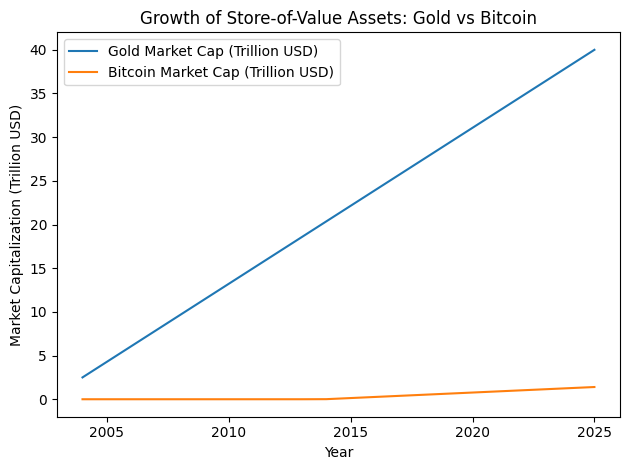
One of the clearest examples is the growth of the gold market after the launch of gold ETFs in 2004. Since then, gold has become significantly easier for institutional investors to access.
Below is an illustration of the expansion in the global store-of-value market.
[Store of Value Market Growth]
Download:
sandbox:/mnt/data/bitcoin_store_of_value_growth.png
From 2004 to today:
- Gold’s market capitalization grew from roughly $2.5 trillion to nearly $40 trillion.
- This represents an average annual growth rate of approximately 13%.
Several macroeconomic forces contributed to this expansion:
- Rising government debt worldwide
- Quantitative easing and monetary stimulus
- Inflation concerns
- Geopolitical instability
These forces increase demand for assets that preserve value outside fiat currency systems.
Bitcoin is increasingly becoming one of those assets.
A Realistic Scenario: Bitcoin Reaches $1 Million Without Dominating Gold
If the store-of-value market continues expanding at a similar pace, its size could reach approximately $121 trillion within ten years.
Under that scenario:
- If Bitcoin captures 17% of the market,
- And the total supply remains capped at 21 million BTC,
the resulting price per Bitcoin would approach $1 million.
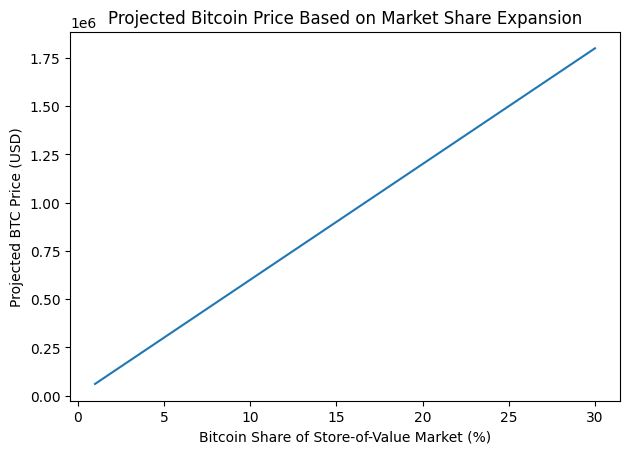
This means Bitcoin does not need to replace gold entirely.
Instead, it only needs to become a meaningful share of a much larger market.
While increasing market share from 4% to 17% is still challenging, it is far more realistic than capturing 50% or more.
Institutional Adoption: ETFs, Corporations, and Sovereign Funds
Several major developments over the past few years have strengthened the case for Bitcoin adoption.
1. Bitcoin ETFs
The approval of spot Bitcoin ETFs in the United States marked a major turning point for institutional investment.

These ETFs allow traditional investors—including pension funds, family offices, and wealth managers—to gain exposure to Bitcoin without directly managing digital wallets or private keys.
Within months of launch, Bitcoin ETFs attracted tens of billions of dollars in inflows, signaling strong institutional demand.
2. Corporate Treasury Allocation
Major companies have also begun allocating portions of their treasury reserves to Bitcoin.
While early adopters like MicroStrategy pioneered this strategy, other corporations have increasingly considered Bitcoin as an alternative reserve asset.
This trend reflects growing concern over currency debasement and inflation risk.
3. Sovereign Wealth Funds
Perhaps the most significant development is the potential involvement of sovereign wealth funds.
These government-owned investment funds manage trillions of dollars in capital. Even a small allocation to Bitcoin could dramatically increase demand.
Some analysts estimate that if sovereign funds allocated 1–3% of their portfolios to Bitcoin, the market could experience substantial price appreciation.
Reduced Volatility and Increasing Market Maturity
Another key factor supporting Bitcoin’s long-term growth is the gradual decline in volatility.
In Bitcoin’s early years, extreme price swings made it difficult for institutional investors to treat it as a serious asset class.
However, several structural changes have improved market stability:
- Growth of derivatives markets (futures and options)
- Increased liquidity from institutional trading desks
- Better custody infrastructure
- Regulatory clarity in major jurisdictions
As volatility decreases, Bitcoin becomes easier to integrate into traditional portfolios.
For many institutional investors, volatility reduction is a critical prerequisite for large-scale adoption.
Macro Trends Supporting Bitcoin’s Growth
Beyond institutional adoption, broader macroeconomic trends may also strengthen Bitcoin’s role as a store of value.
Rising Government Debt
Global government debt has reached historic highs.
As debt expands, governments often rely on monetary policy tools—such as currency expansion—to manage obligations. This can erode the purchasing power of fiat currencies over time.
Bitcoin, with its fixed supply, offers a potential hedge.
Geopolitical Fragmentation
The international financial system is becoming increasingly fragmented due to geopolitical tensions.
Sanctions, capital controls, and currency restrictions have highlighted the risks of relying solely on centralized financial infrastructure.
Bitcoin’s decentralized architecture provides an alternative system that is resistant to political interference.
Digital Financial Infrastructure
The development of Layer-2 technologies, institutional custody solutions, and blockchain-based financial services is also making Bitcoin more practical for global finance.
These innovations strengthen the long-term utility of the network.
Risks and Uncertainties
Despite its strong growth potential, Bitcoin still faces several risks.
- Store-of-value demand could stagnate if macroeconomic conditions stabilize.
- Gold prices could decline, reducing the size of the broader market.
- Bitcoin may fail to capture additional market share due to regulatory or technological challenges.
However, Hougan argues that many current models may actually underestimate Bitcoin’s potential, particularly if new financial use cases emerge.
Conclusion: Bitcoin’s Path Toward a Seven-Figure Future
The idea of Bitcoin reaching $1 million once seemed implausible.
But when viewed through the lens of a rapidly expanding global store-of-value market, the scenario becomes far more realistic.
Bitcoin does not need to eliminate gold or dominate global finance. Instead, it must simply capture a meaningful share of a growing market while benefiting from structural trends such as:
- Institutional adoption
- Financial innovation
- Macroeconomic instability
- Increasing demand for decentralized assets
If these forces continue developing over the next decade, Bitcoin could evolve from a niche digital asset into one of the world’s most important financial instruments.
And in that future, a $1 million Bitcoin may no longer sound extraordinary—it may simply reflect the next stage of monetary evolution.
