
Main Points :
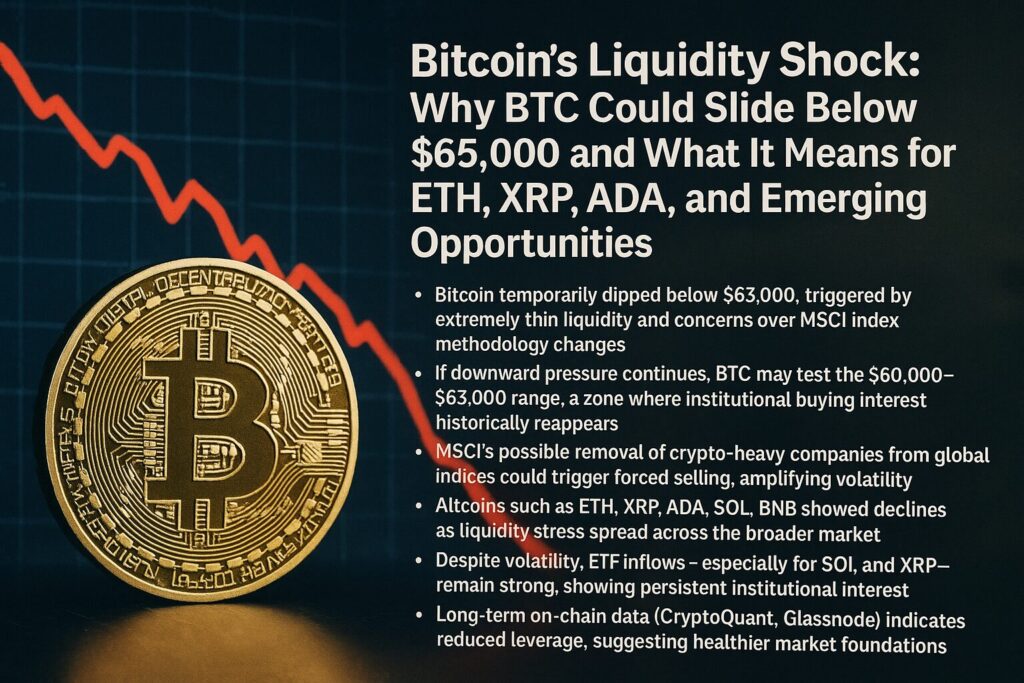
- Bitcoin temporarily dipped below $83,000, triggered by extremely thin liquidity and concerns over MSCI index methodology changes.
- If downward pressure continues, BTC may test the $60,000–$65,000 range, a zone where institutional buying interest historically reappears.
- MSCI’s possible removal of crypto-heavy companies from global indices could trigger forced selling, amplifying volatility.
- Altcoins such as ETH, XRP, ADA, SOL, BNB showed declines as liquidity stress spread across the broader market.
- Despite volatility, ETF inflows—especially for SOL and XRP—remain strong, showing persistent institutional interest.
- Long-term on-chain data (CryptoQuant, Glassnode) indicates reduced leverage, suggesting healthier market foundations.
- For investors seeking new crypto assets, revenue opportunities, and practical blockchain utility, the current environment presents early-stage openings.
Bitcoin’s December Volatility: Liquidity, Index Risk, and Market Fragility
1. Introduction: A Market Exposed to Liquidity Stress
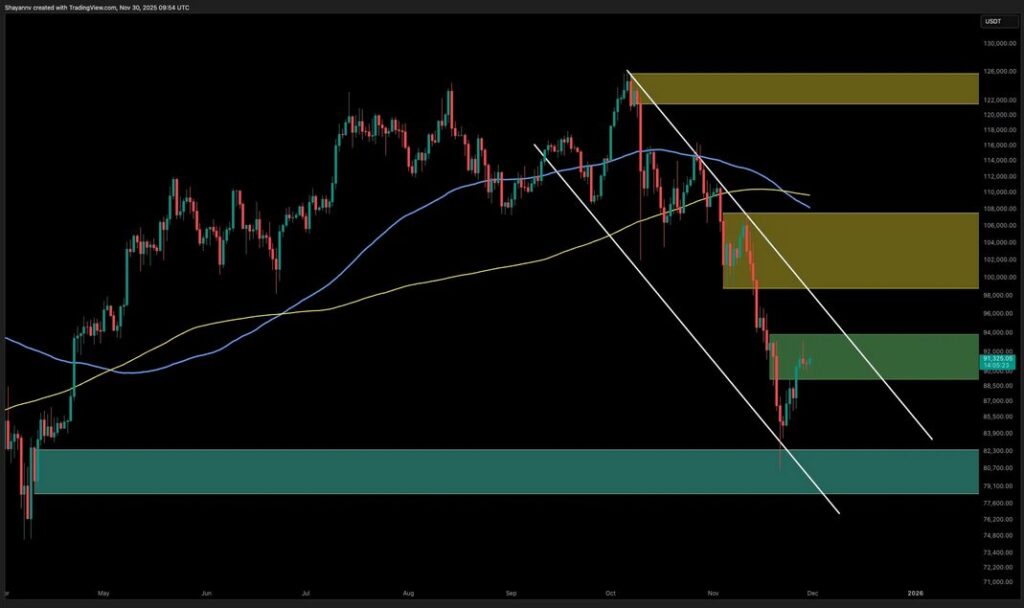
In early December, Bitcoin encountered one of the most dramatic intraday swings since mid-2024. Prices briefly slipped under $83,000, driven not by macroeconomic shocks but by severe structural fragility within the crypto market.
Liquidity thinned rapidly over the weekend, coinciding with fears about upcoming MSCI index computation changes, igniting a market-wide cascade.
During Asian trading hours on December 2, BTC rebounded slightly above $85,000, but major altcoins—ETH, XRP, ADA, SOL, and BNB—declined by up to 2%.
Analysts highlighted a key issue: even mild stress pushes today’s crypto markets into exaggerated moves, due to diminished market depth and thinner orderbooks.
VALR CEO Farzam Ehsani explained that BTC’s slide below $90,000 was “a collision between fragile market structure and exceptionally low liquidity,” noting that orderbooks lacked the resiliency required to absorb rapid selling flows.
2. MSCI’s Potential Reclassification: A Hidden Systemic Threat
One of the biggest catalysts behind investor anxiety is MSCI’s ongoing evaluation of whether companies holding large amounts of crypto on their balance sheets should be excluded from global equity indices.
The companies under scrutiny—including Strategy, Marathon, Riot, Metaplanet, and American Bitcoin—collectively hold more than $137 billion in digital assets.
This represents almost 5% of all existing Bitcoin.
If MSCI proceeds with reclassification, index funds would be forced to sell these equities automatically. For a market as liquidity-sensitive as crypto-linked stocks, such forced repositioning could trigger abrupt flows out of BTC itself.
Ehsani emphasized that “any rule change mechanically triggers asset-holding recalculation,” potentially leading to forced selling and substantial capital migration.
Investors are already positioning defensively, expecting short-term imbalances if reclassification is approved.
3. November’s Weak Performance Sets a Bearish Tone for December
BTC already closed November with a 17.5% monthly decline, marking its worst performance in nearly three years. With December starting off weak, the market is now debating whether BTC will revisit deeper support zones.
On a technical level, if BTC remains below the $80,500 zone, traders anticipate a potential slide toward $64,000, a key Fibonacci and liquidity support area frequently cited by institutional analysts.
Should the decline extend further, BTC may test the broader $60,000–$65,000 accumulation zone, where large institutional buyers—including competitors to Strategy—tend to scale in aggressively.
This creates a paradox:
Short-term bearish momentum may unlock long-term institutional buying opportunities.
4. ETF Flows Show Resilience: SOL and XRP Lead Institutional Interest
Even amid the downturn, several U.S.-listed crypto ETFs continue to experience positive inflows.
- Solana spot ETF: five consecutive weeks of inflows, adding more than $600 million since late October.
- XRP spot ETF: cumulative inflows now exceed $666 million.
These flows demonstrate that major institutions are not retreating from digital assets; instead, they are reallocating across chains with strong utility narratives.

5. On-Chain Signals: Market Leverage Is Decreasing
Although volatility remains elevated, data from CryptoQuant and Glassnode reveals positive underlying trends:
- Leverage is actively flushing out from derivatives markets.
- Long-term holder supply remains near historical highs.
- Exchange reserves remain moderate, reducing liquidation contagion risk.
These indicators suggest that while external risks (index rules, macro shocks) may weigh heavily, the structural health of the BTC market is more stable than surface-level volatility suggests.
6. What This Means for ETH, XRP, ADA, SOL — and New Opportunities
Liquidity shocks rarely remain isolated to Bitcoin. Thin orderbooks, automated liquidations, and synchronized sentiment spill over instantly to the rest of the market.
ETH
- Sensitive to BTC dominance movements
- At risk of testing lower support zones if BTC continues downward
- Long-term thesis remains strong as ETH staking participation increases
XRP
- ETF inflows support medium-term price stability
- Regulatory clarity (U.S., APAC) continues improving
- A downturn could offer entry opportunities for institutional-scale buyers
ADA & SOL
- Both remain liquidity-sensitive
- SOL’s ETF momentum helps reduce downside risk
- ADA remains more vulnerable but attracts long-term ecosystem builders
Emerging Opportunities for Investors Seeking New Crypto Assets
This environment may favor:
- Layer-2 scaling tokens with real adoption
- Cross-chain liquidity protocols gaining traction
- Practical blockchain enterprise tools used by financial institutions
- Yield-generating assets decoupled from BTC volatility
- Tokens associated with decentralized data networks and AI infrastructure
Given your target audience—seeking new assets and revenue opportunities—the current downturn may represent an early accumulation window in fundamentally strong sectors.
7. Conclusion
Bitcoin’s recent dip below $83,000 highlights a deeper concern: the fragility of liquidity across crypto markets.
The MSCI classification issue adds a layer of structural risk that could accelerate flows in and out of crypto-heavy companies, with ripple effects across BTC, ETH, XRP, ADA, and the broader market.
Yet, institutional behavior—especially ETF inflows—demonstrates that long-term conviction remains intact.
For investors exploring new cryptocurrencies, practical blockchain applications, and emerging revenue models, this environment offers both risks and early asymmetric opportunities.
The coming weeks will determine whether BTC revisits the $60,000–$65,000 institutional zone, an area that historically precedes renewed accumulation phases.
Regardless of short-term volatility, fundamentals and adoption trends continue strengthening—suggesting that long-term participation remains one of the most compelling strategies in today’s digital asset landscape.
