

Main Points :
- Institutional investors now control about 14% of Bitcoin’s total supply.
- Spot Bitcoin ETFs hold roughly $92 billion worth of BTC, with $2.1 billion net inflows in the last three weeks.
- Institutional ownership is shifting the market from retail speculation to long-term capital allocation.
- Strategy (formerly MicroStrategy) has accumulated over 761,000 BTC, positioning itself as a “Bitcoin central bank.”
- Long-term holders now control around 60% of circulating Bitcoin, contributing to market stability.
- Major analysts forecast Bitcoin reaching around $150,000 by the end of 2026, with some even projecting a $1 million long-term price scenario.
1. The Structural Shift: Bitcoin Is Becoming an Institutional Asset
Over the past decade, Bitcoin has evolved from a niche digital experiment into one of the most widely discussed macro assets in global finance. A recent report by U.S. investment bank Bernstein argues that this transformation has now entered a decisive stage. According to the firm’s analysts, Bitcoin is rapidly building what they describe as “the most resilient capital base in its history.”
This shift is driven primarily by two powerful forces: the emergence of spot Bitcoin exchange-traded funds (ETFs) and the growing trend of corporate treasury allocations into Bitcoin.
In the early years of Bitcoin, the market was dominated by retail investors and short-term speculation. Price volatility was extreme, and large drawdowns often followed periods of hype. However, the introduction of regulated financial vehicles—especially spot ETFs in the United States—has fundamentally changed how institutional investors gain exposure to Bitcoin.
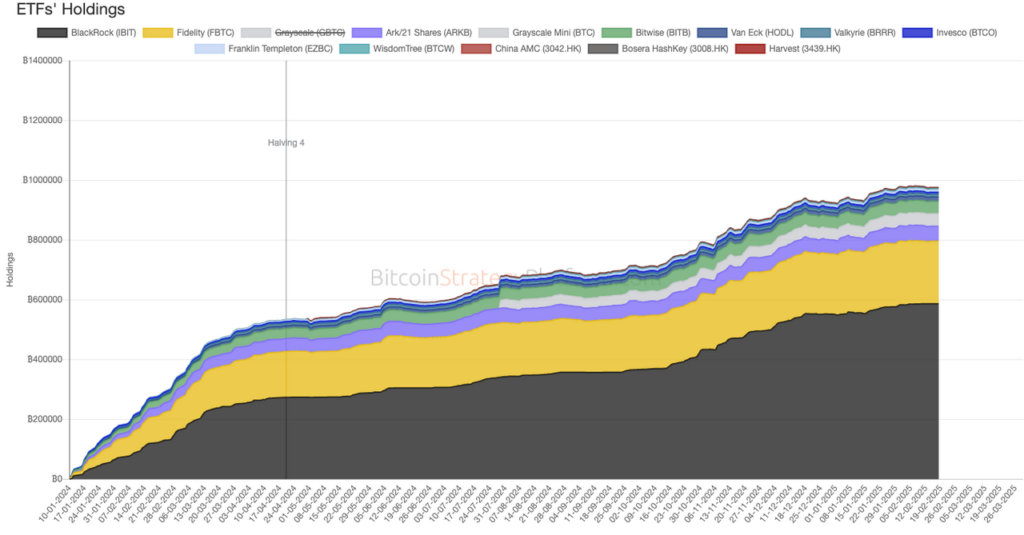
Today, spot Bitcoin ETFs collectively hold approximately $92 billion worth of BTC, representing about 6.1% of the total Bitcoin supply. Over the past three weeks alone, these funds recorded net inflows of approximately $2.1 billion, signaling renewed institutional interest despite market volatility earlier in the year.
This institutional capital is fundamentally different from speculative retail flows. Pension funds, asset managers, and family offices typically adopt long-term portfolio strategies, meaning that the Bitcoin they acquire is less likely to return quickly to the market.
As a result, Bernstein estimates that ETF holdings, corporate treasury holdings, and government reserves combined now account for roughly 14% of Bitcoin’s total supply.
This represents a dramatic structural shift in the Bitcoin ecosystem.
Institutional Ownership Share of Bitcoin Supply
2. Bitcoin Outperforming Traditional Assets
The institutionalization of Bitcoin is also reflected in its market performance relative to traditional assets.
Over the past week alone, Bitcoin rose roughly 7%, while Ethereum surged approximately 16%, outperforming major benchmarks including gold, silver, and leading global stock indices.
Historically, Bitcoin was often viewed as a high-risk speculative asset that moved independently from traditional markets. But increasingly, it is being discussed alongside macro hedges such as gold.
Several factors are driving this perception:
- Growing institutional adoption
- Increasing scarcity due to long-term holding behavior
- Rising geopolitical uncertainty
In times of geopolitical stress, investors typically look for assets that are portable, censorship-resistant, and independent of counterparty risk. Bitcoin’s digital nature allows it to be transferred globally without relying on traditional financial intermediaries.
Bernstein analyst Gautam Chhugani noted that in the event of severe geopolitical disruption—such as physical conflicts in major economic regions—Bitcoin’s unique attributes as a portable, non-sovereign digital asset could become even more apparent.
This narrative increasingly positions Bitcoin as a “digital reserve asset.”
3. Strategy: The “Central Bank of Bitcoin”
Perhaps the most striking observation in Bernstein’s report is the characterization of Strategy as the “lender of last resort” for Bitcoin markets.
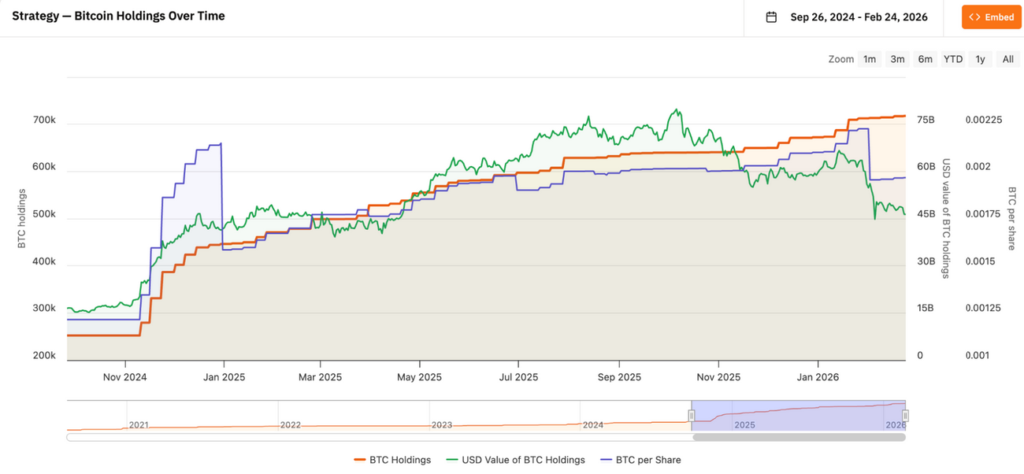
Strategy—formerly known as MicroStrategy—has spent several years aggressively accumulating Bitcoin as part of its corporate treasury strategy. As of March 2026, the company holds approximately:
761,068 BTC
This makes Strategy by far the largest corporate holder of Bitcoin in the world.
The company acquired 66,231 BTC in 2026 alone, purchasing the coins at an average price of around $85,000.
To finance these acquisitions, Strategy has introduced a novel capital strategy involving STRC preferred shares, which offer an 11.5% annual dividend. Through at-the-market (ATM) issuance of these shares, the company raises capital that is then deployed to purchase additional Bitcoin.
The STRC instrument itself has grown rapidly, with weekly trading volumes exceeding $2 billion.
This model effectively transforms Strategy into something resembling a Bitcoin monetary authority. During market downturns, the company’s continued buying activity acts as a structural demand floor, reinforcing investor confidence that significant institutional buyers remain active.
For institutional investors evaluating the Bitcoin market, this dynamic provides an additional layer of psychological support.
Strategy’s Bitcoin Accumulation Growth
4. The Rise of Long-Term Holders
Another important structural change in the Bitcoin market is the rapid growth of long-term holders (LTHs).
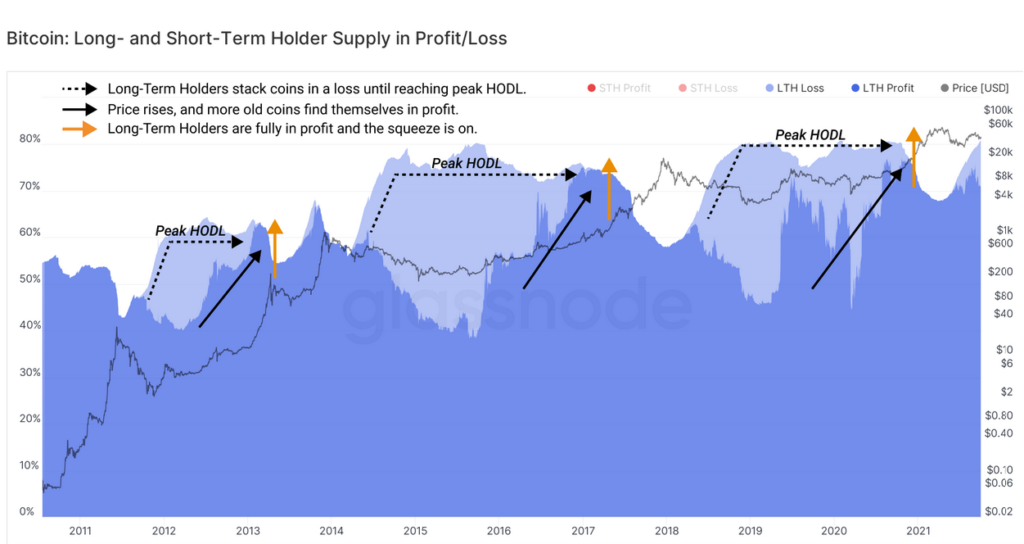
Blockchain analytics now indicate that approximately 60% of circulating Bitcoin has not moved for more than one year.
This metric suggests that a large portion of Bitcoin supply is effectively removed from active trading markets.
When long-term holding behavior increases, several market effects occur:
- Reduced speculative selling pressure
- Lower circulating liquidity
- Stronger price support during market corrections
For example, during recent market volatility, Bitcoin ETFs experienced surprisingly small outflows. According to Bitwise CIO Matt Hougan, even during a period where cryptocurrency prices fell by roughly 50%, net ETF outflows remained below $1 billion.
This behavior contrasts sharply with traditional speculative markets, where large price declines typically trigger rapid investor capitulation.
Instead, many institutional investors appear to be demonstrating what crypto traders call “diamond hands”—a willingness to hold through volatility.
Long-Term Bitcoin Supply vs Circulating Liquidity
5. Is the Four-Year Cycle Ending?
For many years, Bitcoin’s price movements were commonly explained by the four-year halving cycle, in which mining rewards are reduced and supply growth slows.
However, Bernstein argues that this narrative may now be losing relevance.
In a report published in December 2025, the firm described the traditional “four-year cycle theory” and fears of Bitcoin competing with gold as “the weakest bearish arguments in Bitcoin’s history.”
The reason is simple: the structure of the Bitcoin market has changed.
When Bitcoin was primarily held by retail traders, market sentiment could swing dramatically. Speculative cycles were driven by hype, leverage, and panic selling.
But as institutional ownership grows, Bitcoin begins to behave more like a strategic asset allocation rather than a speculative trade.
Large institutional investors typically accumulate assets gradually and hold them for extended periods. This dampens volatility and reduces the probability of extreme cyclical crashes.
6. The Road to $150,000—and Beyond
Bernstein maintains its $150,000 Bitcoin price target for the end of 2026.
While that forecast may appear aggressive compared to historical price levels, the firm believes the underlying fundamentals support further appreciation.
Several long-term catalysts remain in play:
ETF adoption expansion
Institutional allocations into Bitcoin ETFs are still in early stages. Many pension funds and sovereign wealth funds have yet to establish meaningful exposure.
Corporate treasury adoption
More corporations may follow Strategy’s example by allocating a portion of their balance sheets to Bitcoin as an inflation hedge.
Global macro uncertainty
Rising geopolitical tensions and monetary instability could increase demand for non-sovereign assets.
Some analysts take an even more optimistic view. Bitwise CIO Matt Hougan has suggested that Bitcoin could ultimately reach $1 million per coin over the long term if it captures a meaningful share of global reserve assets.
Conclusion: Bitcoin’s Capital Base Is Becoming Stronger Than Ever
The Bitcoin market is undergoing a profound structural transformation.
Institutional capital—through ETFs, corporate treasuries, and long-term investment strategies—is replacing the speculative retail dominance that once defined the ecosystem.
With 14% of supply already held by institutions, 60% locked in long-term storage, and companies like Strategy acting as major accumulation engines, Bitcoin’s market structure is evolving into something far more stable and resilient.
For investors searching for new digital assets, revenue opportunities, and real-world blockchain applications, this shift carries important implications.
Bitcoin may no longer be simply a volatile speculative asset.
Instead, it is gradually emerging as a global digital reserve asset supported by institutional capital, corporate balance sheets, and long-term conviction.
If Bernstein’s analysis proves correct, the coming decade could see Bitcoin transition from a disruptive technology experiment into a foundational pillar of the global financial system.
