
Key Points :
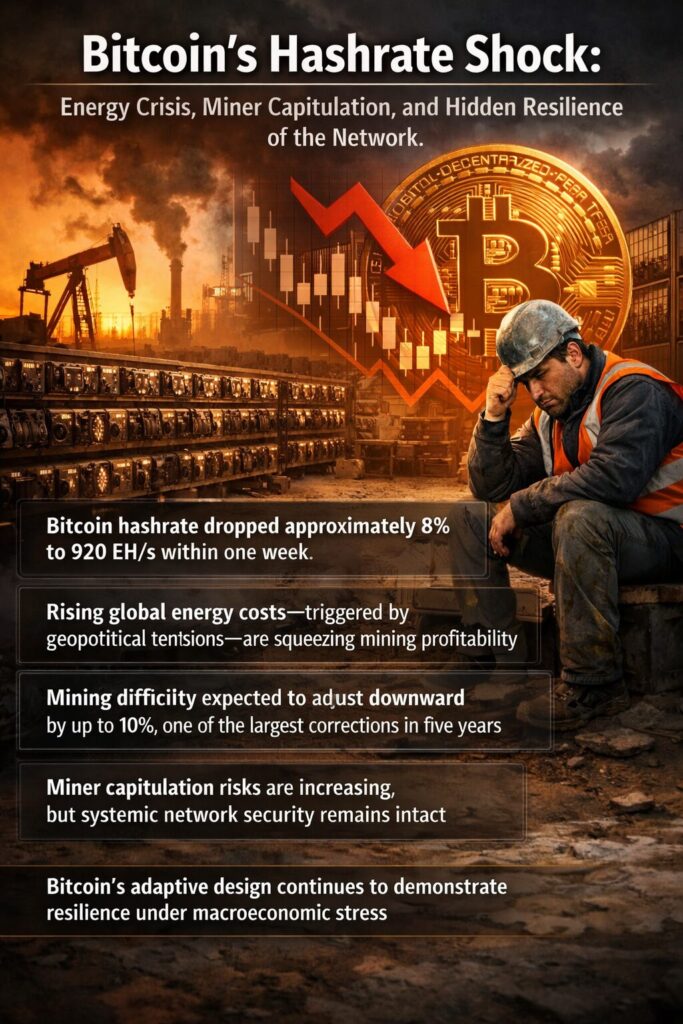
- Bitcoin hashrate dropped approximately 8% to 920 EH/s within one week
- Rising global energy costs—triggered by geopolitical tensions—are squeezing mining profitability
- Mining difficulty is expected to adjust downward by up to 10%, one of the largest corrections in five years
- Miner capitulation risks are increasing, but systemic network security remains intact
- Bitcoin’s adaptive design continues to demonstrate resilience under macroeconomic stress
1. A Sudden Drop: What an 8% Hashrate Decline Really Means
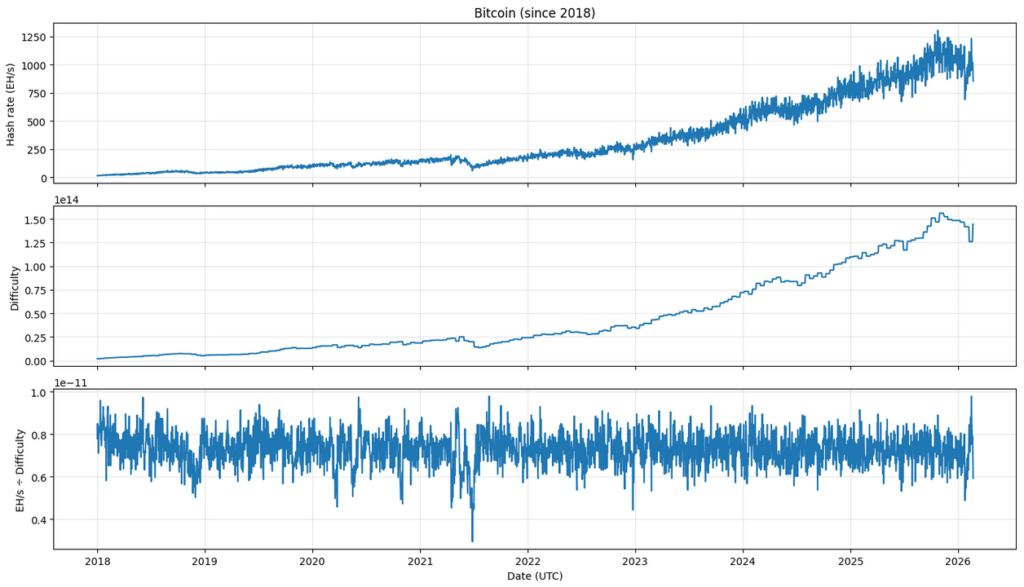
The Bitcoin network recently experienced a sharp decline in its total computational power, with hashrate falling by approximately 8% within a single week to around 920 EH/s. At first glance, this may appear alarming, especially for investors who associate hashrate with network security and long-term viability.
However, understanding the mechanics behind hashrate reveals a more nuanced picture. Hashrate is not merely a measure of security—it is also a direct reflection of miner participation, which in turn is highly sensitive to operational costs. When mining becomes less profitable, weaker or less efficient miners temporarily shut down their operations.
This decline, therefore, is not necessarily a sign of structural weakness. Instead, it represents a dynamic rebalancing process within the mining ecosystem.
Bitcoin Hashrate Trend (Recent Decline Visualization)
2. The Energy Shock: Geopolitics Meets Mining Economics
The primary driver behind this hashrate drop is not technological—it is geopolitical.
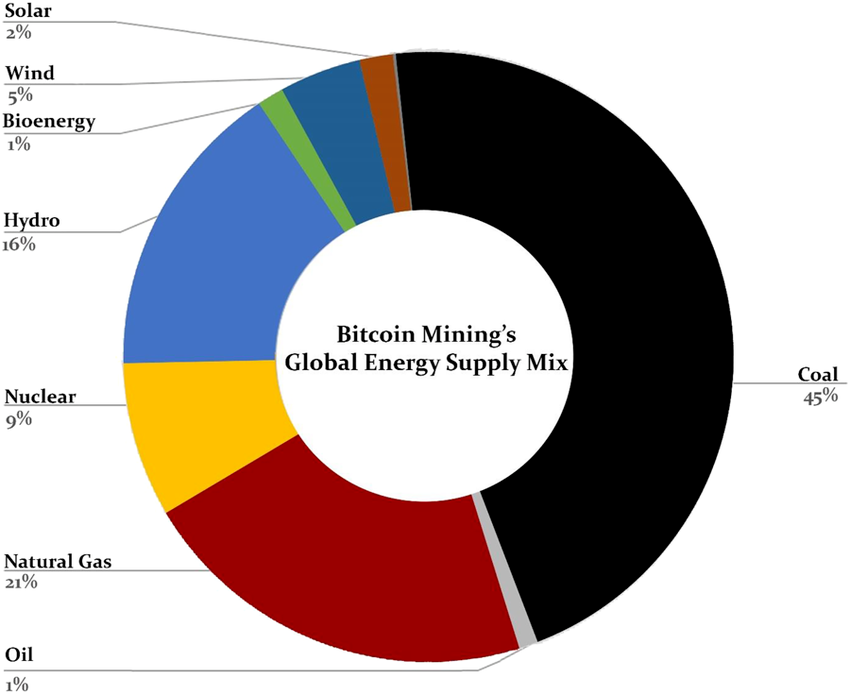
The recent escalation of tensions involving Iran has led to a surge in global oil prices. While Bitcoin mining often relies on diverse energy sources such as natural gas, hydroelectric power, and renewables, the global energy market remains interconnected. When oil prices rise, electricity costs follow in many regions.
Federal Reserve Chair Jerome Powell acknowledged that rising energy prices have contributed to an upward revision in inflation forecasts—from 2.4% to 2.7% for 2026. This macroeconomic pressure cascades directly into mining operations.
Even if only 8–10% of miners are located in oil-dependent regions, the marginal cost increase can have an outsized impact. Mining is a highly competitive industry where profitability margins are often razor-thin. A small increase in energy costs can force less efficient operators offline.
3. Mining Difficulty Adjustment: Bitcoin’s Self-Healing Mechanism
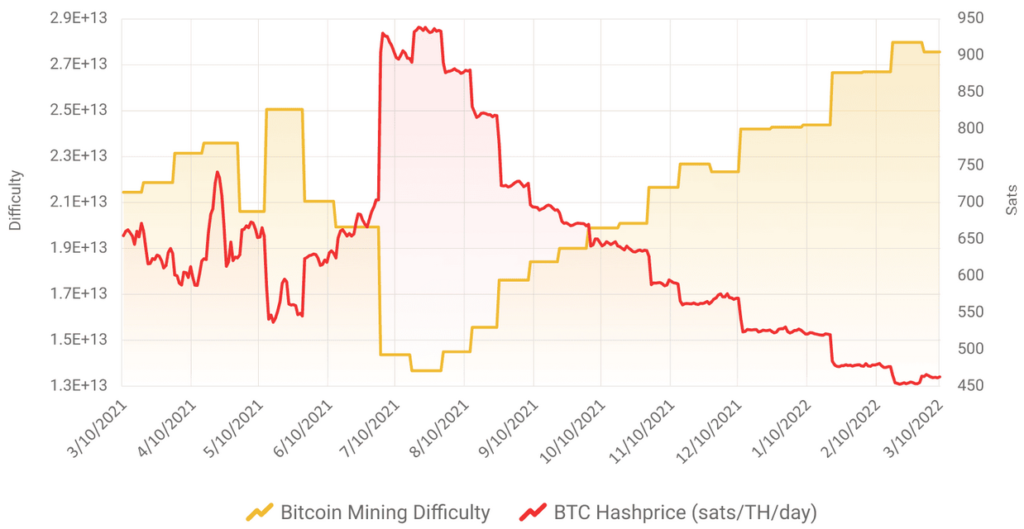
One of Bitcoin’s most powerful features is its built-in difficulty adjustment mechanism. Approximately every two weeks, the network recalibrates how difficult it is to mine a block, ensuring that blocks are produced roughly every 10 minutes regardless of total hashrate.
With the recent decline in hashrate, the next difficulty adjustment is expected to decrease by as much as 10%—one of the largest downward adjustments in the past five years.
This mechanism effectively stabilizes miner incentives:
- When hashrate drops → difficulty decreases → mining becomes easier
- When hashrate rises → difficulty increases → competition intensifies
This feedback loop ensures that the network remains functional and economically balanced.
Difficulty Adjustment Mechanism
4. Miner Capitulation: Risk or Opportunity?
A key concern during periods of declining profitability is miner capitulation—the forced selling of Bitcoin holdings by miners to cover operational costs.
Historically, miner capitulation has often coincided with local market bottoms. When inefficient miners exit the market and sell their reserves, stronger players with lower costs absorb market share.
For investors, this creates a paradox:
- Short-term: Increased selling pressure → potential price weakness
- Long-term: Healthier mining ecosystem → stronger network fundamentals
Recent data suggests that while some miners are indeed under stress, large-scale capitulation has not yet materialized. Moreover, Iran’s share of global hashrate remains below 1%, limiting systemic risk.
5. The Bigger Picture: Bitcoin vs Energy-Dependent Systems
This event highlights a critical insight often overlooked in crypto discussions: Bitcoin is not independent of the physical world—it is deeply intertwined with global energy systems.
However, Bitcoin’s advantage lies in its flexibility:
- Mining can relocate geographically
- Energy sources can diversify (renewables, stranded energy, flare gas)
- Efficiency improvements continuously reduce cost per hash
In contrast, traditional financial systems rely on centralized infrastructure that is often less adaptable.
Interestingly, recent trends show increasing integration between Bitcoin mining and renewable energy projects. Mining operations are being deployed to stabilize energy grids, monetize excess production, and even support green infrastructure investments.
Mining Energy Mix and Cost Pressure
6. Emerging Trends: AI, Energy, and Mining Convergence
A notable trend gaining traction is the convergence between Bitcoin mining and AI infrastructure.
Companies are increasingly repurposing mining facilities for AI workloads or hybrid models. This shift is driven by:
- High-performance computing demand (AI training)
- Similar infrastructure requirements (cooling, power density)
- Revenue diversification strategies
Asset managers such as VanEck have pointed out that mining companies may be undervalued relative to their infrastructure potential.
This suggests that mining is evolving beyond Bitcoin—it is becoming part of a broader digital infrastructure layer.
7. Strategic Implications for Investors and Builders
For those seeking new revenue opportunities or practical blockchain applications, several strategic insights emerge:
1. Energy Arbitrage Opportunities
Mining profitability increasingly depends on access to cheap and stable energy. Regions with excess or stranded energy present significant opportunities.
2. Infrastructure Plays
Mining companies are not just crypto businesses—they are infrastructure operators. This opens pathways into AI, data centers, and energy markets.
3. Risk-Adjusted Bitcoin Exposure
Periods of miner stress can create attractive entry points for long-term investors.
4. Regulatory and Geopolitical Awareness
Mining is sensitive to policy, energy markets, and geopolitical risks. Strategic positioning requires global awareness.
Conclusion: A Stress Test That Reinforces Bitcoin’s Design
The recent 8% drop in Bitcoin’s hashrate is not a sign of failure—it is a real-time stress test of the system.
Despite rising energy costs, geopolitical instability, and macroeconomic pressure, the network continues to function exactly as designed. Difficulty adjusts, inefficient players exit, and equilibrium is restored.
This is Bitcoin’s core strength: not stability in the traditional sense, but adaptive resilience.
For investors and builders, the message is clear—Bitcoin is not just a digital asset. It is an evolving economic system deeply connected to energy, infrastructure, and global macro trends.
Understanding these connections is key to identifying the next generation of opportunities in the crypto space.
